
The average attorney spends 30-40% of their day drafting documents. Briefs, motions to compel, memoranda of law, client advisories, settlement agreements, demand letters — the written output of legal practice is enormous. Typing at 50 WPM, a 10-page brief takes hours of keyboard time alone.
Voice dictation at 160+ WPM changes this equation fundamentally. You draft the substance in a fraction of the time, then spend your remaining effort on what actually matters: refining arguments, checking citations, and strengthening analysis.
The Tools
WisprFlow for Legal Document Drafting
WisprFlow works at the system level on Mac, injecting dictated text wherever your cursor is focused. For legal drafting, this means you dictate directly into Word, Google Docs, or your document management system without switching applications.
Document Types You Can Dictate
Motions and briefs: Dictate your argument structure and supporting analysis section by section. The AI removes filler words and hesitations, producing clean prose ready for refinement. Dictate the Statement of Facts, then the Argument section, then the Conclusion — treating each as a discrete dictation session.
Client memoranda: Speak through your legal analysis the way you would explain it to a colleague. The natural cadence of spoken analysis often produces clearer writing than labored typing.
Demand letters: Particularly effective for personal injury and commercial litigation. Lay out liability, damages, and the demand conversationally — WisprFlow delivers it as polished written text.
Discovery responses: Objections and responses to interrogatories are repetitive and formulaic. Dictate them rapidly instead of copying, pasting, and editing.
Contracts and agreements: Dictate custom provisions and special terms. Boilerplate stays in your templates; the bespoke language gets dictated.
Legal Vocabulary Handling
WisprFlow's personal dictionary learns your practice-specific terminology:
- Case names: Smith v. Jones, In re Acme Corp.
- Latin phrases: res judicata, stare decisis, prima facie, voir dire
- Statutes: 28 U.S.C. Section 1332, Rule 12(b)(6)
- Party names, judge names, and court designations
After two to three days of regular use, recognition accuracy for specialized terms reaches near-perfect levels.
Granola for Research-to-Draft Workflow
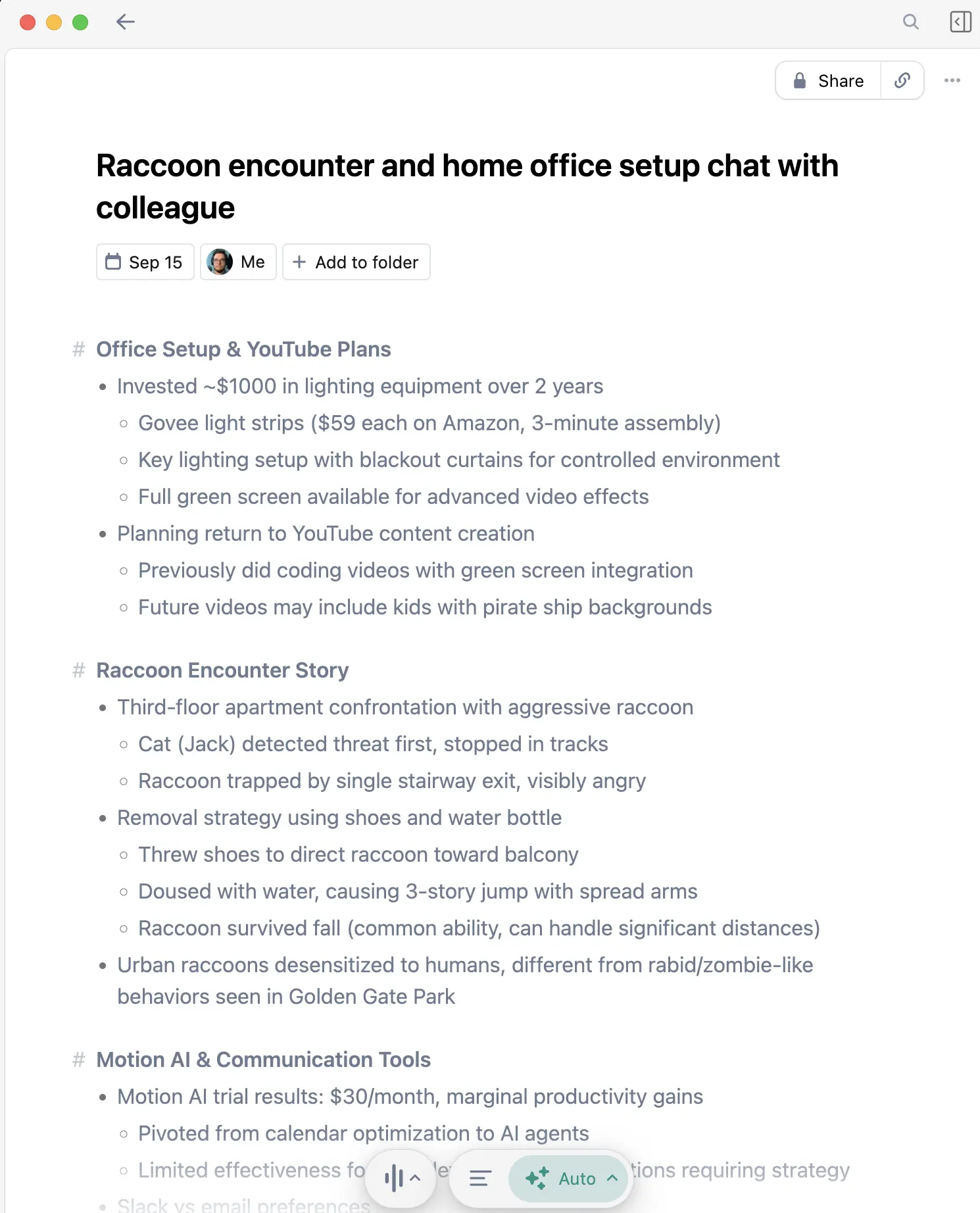
Granola captures meetings without a visible bot — essential when discussing case strategy or client matters. For document drafting, Granola serves a different but complementary role.
How Granola Supports Drafting
Strategy sessions become outlines: When you discuss a brief's approach with colleagues, Granola captures the discussion and generates structured notes. These notes become your drafting outline.
Client calls become fact sections: Your Statement of Facts often draws on what clients tell you. Granola captures those calls verbatim, so you draft from a complete record rather than scribbled notes.
Deposition prep becomes testimony summaries: Record preparation sessions and get organized summaries of expected testimony, impeachment points, and key exhibits.
Research discussions: When associates report research findings verbally, Granola captures it all — no more "can you send me what you found in an email?"
Daily Workflow: Dictation-Centered Legal Practice
Morning (8:00 - 10:00 AM)
Review Granola notes from prior-day meetings. Use WisprFlow to dictate responses to overnight emails and update time entries for yesterday's work. Dictate an outline for today's primary drafting project.
Midday (10:00 AM - 1:00 PM)
Primary drafting block. Dictate first drafts of briefs, motions, or memoranda with WisprFlow. Client calls and team meetings captured by Granola feed into afternoon edits.
Afternoon (1:00 - 4:00 PM)
Refine morning drafts using Granola's meeting notes for additional facts and context. Dictate discovery responses and routine correspondence with WisprFlow.
End of Day (4:00 - 6:00 PM)
Dictate detailed time entries for all day's work. Review Granola summaries for follow-up items. Dictate notes-to-file on pending matters.
Time Savings: Drafting With Voice vs. Keyboard
| Document Type | Typing (50 WPM) | Voice Dictation (160 WPM) | Time Saved |
|---|---|---|---|
| 5-page motion | 2.5 hours | 45 minutes | 70% |
| Client memo (3 pages) | 1.5 hours | 30 minutes | 67% |
| Demand letter | 45 minutes | 15 minutes | 67% |
| 20 interrogatory responses | 2 hours | 40 minutes | 67% |
| Settlement agreement (custom terms) | 1 hour | 20 minutes | 67% |
| Weekly drafting total | ~15 hours | ~5 hours | ~10 hours reclaimed |
Getting Started
WisprFlow has a free trial; Granola gives new users their first three months free:
WisprFlow: Try free — Start with low-stakes dictation like time entries and emails. Graduate to substantive drafting once the tool has learned your vocabulary. Full details in the WisprFlow review.
Granola: Start three months free — Use the full quarter to see how structured meeting output feeds into your drafting workflow. Compare options with the Granola vs Otter breakdown.
Related Guides
- Best Voice Tools for Lawyers 2026 — Comprehensive overview of voice AI for legal
- Voice Notes for Client Meetings — Meeting capture for attorneys
- Best Legal Dictation Software 2026 — WisprFlow vs Dragon vs built-in
- AI Voice Tools for Personal Injury Lawyers — PI-specific drafting workflows
- AI Tools for Lawyers — General AI tools overview
Frequently Asked Questions
Is dictated text accurate enough for filed documents?
Dictation produces a first draft, not a final product. You review and refine exactly as you would with typed text. The difference is that the first draft takes minutes instead of hours.
How does WisprFlow handle citations and formatting?
Dictate the substance; add precise citations and formatting during the review pass. Many attorneys find it faster to speak the argument flow, then layer in pinpoint citations manually.
Can I dictate into my firm's document management system?
Yes. WisprFlow works at the OS level, so it injects text into any application — NetDocuments, iManage, Worldox, or plain Word.
What about confidentiality of dictated content?
WisprFlow processes audio with enterprise-grade encryption and does not store or use your content for model training. Firms should still review data handling policies through their IT and ethics committees.
The best legal writing comes from clear thinking, not fast typing. Voice dictation separates the intellectual work from the mechanical work — and that separation makes both better.
How each tool turns speech into text
The useful difference is where the text appears and how much work remains afterward.
Traditional typing stays precise and familiar for short edits.
WisprFlow dictates into any app with AI formatting, and it is free to try.

Discussion
Giscus