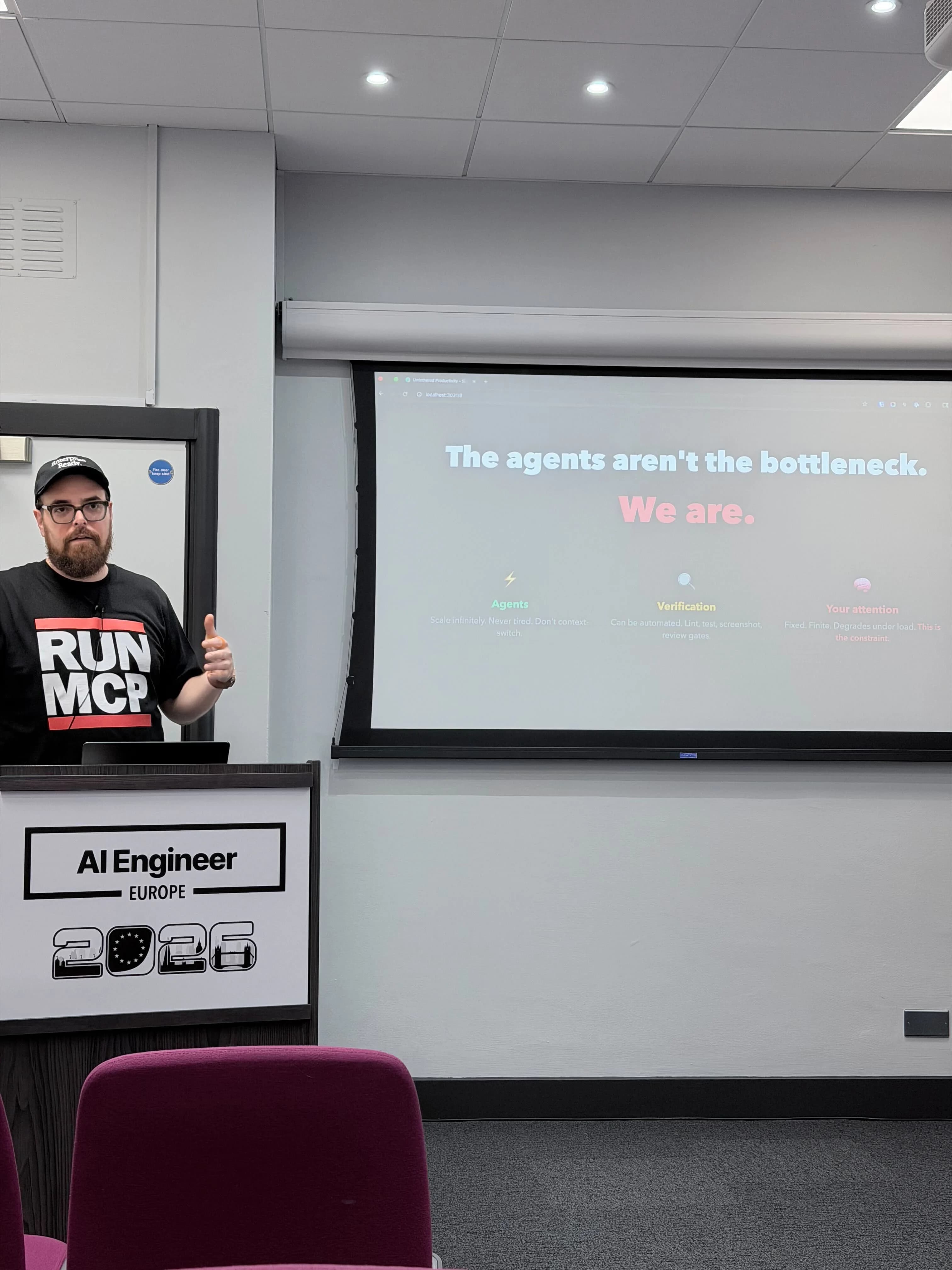
I gave a talk at AI Engineering London this month called "Untethered Productivity: Staying Healthy, Creative, and Shipping in the AI Coding Era." The core thesis: the tools are nuclear, but your nervous system is relatively ancient. If you don't design your workflows around that mismatch, you'll burn out.
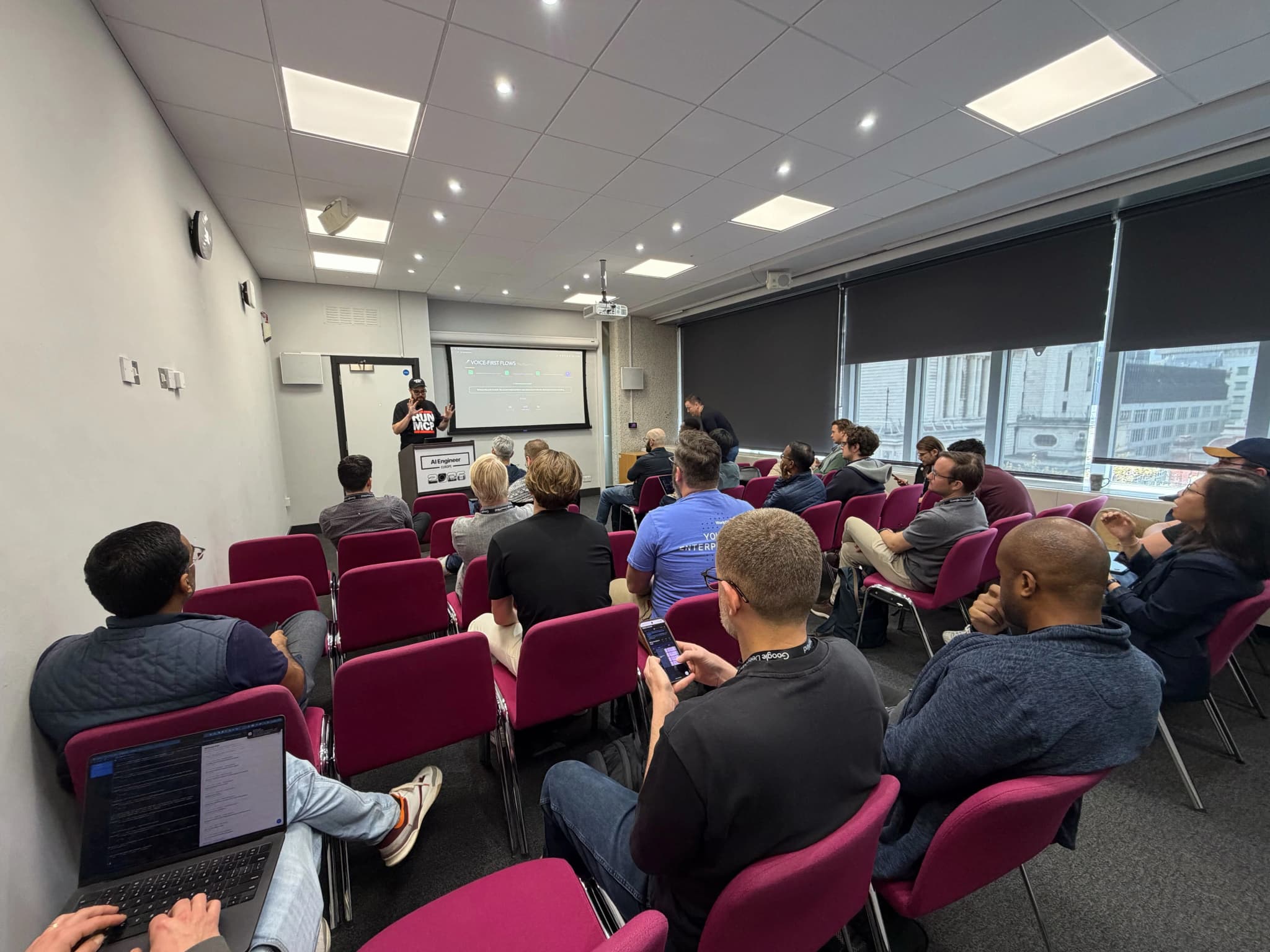
Check out the speaking detail page for more context, or browse the full interactive deck right here:
Click the deck, then use ← and → to navigate. On tablet or mobile, open full screen and use the nav controls that appear at the bottom-left on tap.
Full screenThe recording from AI Engineering London is also available:
The opening demo
I opened with a story about a Slack bot I built at WorkOS that generates blog drafts. It had a bug — acronyms like SCIM and SSO were getting mangled in the output. The old version of me would have context-switched out of what I was doing, cloned the repo, reproduced the issue, fixed it, deployed, tested, verified. Instead, I gave Claude Code direct access to the Slack workspace. It found the bug, fixed the code, deployed to Cloudflare, posted a test message, read its own output, and confirmed the fix — all without me touching anything.
That felt incredible. It also scared me. If the agent can do all of that autonomously, what exactly is my job? That question framed the rest of the talk.
The agents scale. You don't.
The central argument: agents scale infinitely. They don't get tired. They don't context-switch. Verification can be automated — lint, test, screenshot, review gates. But your attention is fixed and finite, and it degrades under load. You are the constraint, not the tooling.
Simon Willison put it well on Lenny's Podcast (April 2, 2026): "I fire up 4 parallel agents and I'm wiped out by 11 AM. Finding our new limits is a personal skill we need to learn."
I've felt this firsthand. The temptation is to stack more loops, run more agents, stay at 120% all day. The default path leads to burnout inside of 18 months. The intentional path — designing workflows that protect you — lets you ship more, move more, sleep more, and sustain it for years.
The enabling stack
I walked through four capabilities that make this work in practice.
Signal layers
I plugged Slack MCP and Linear MCP into Claude Code. Messages flow in, Claude classifies them — action needed, noise, duplicate of an existing ticket — and auto-creates Linear tickets for the real work. I never open Slack. I only see the delta.
In one demo, 16 incoming Slack messages got distilled to 2 new tickets and 1 dedup. Two minor connectors reduced my perceived context-switching cost by about 90%.
Voice-first flows
I've been using WisprFlow for voice-first development for over a year now, hitting 179 WPM compared to 90 WPM typing. For this talk I showed the dispatch advantage: speak 3 instructions to 3 agents simultaneously. Total dispatch time is about 9 seconds. A keyboard-only developer is still typing the first task.
Remote control
This ties into what I wrote about in walking and talking with AI. I use focused mode at the desk and diffuse mode on walks. With the --remote-control flag, agents work on local files while I'm on the trail. I check progress on my phone and redirect them with new insights as they come. The desk is optional.
I also showed Handwave, the watchOS app I had Claude Code build me. It lets me control sessions from my wrist via the Bonjour protocol. Between voice dispatch, phone check-ins, and wrist control, I can run a full development day from a hiking trail.
The system improves itself
Every Monday, a scheduled task scans all my Claude Code JSONL session logs from the previous week. It extracts patterns — tasks done more than once, repeated instructions, workflows that could be automated. The output is a list of new skills to build and inefficiencies I missed.
One week it flagged that I'd reformatted blog images for CDN upload four separate times without noticing. It recommended building a skill to automate it. That kind of self-reflection loop means the system gets tighter every week without me actively optimizing it.
Verification gates
Speed without safety is recklessness. I laid out three tiers of verification gates that I run before trusting agent output:
- Lint and build — TypeScript compilation, ESLint. The basics.
- Browser use — The agent launches the app, takes screenshots, visually confirms the output matches expectations.
- Rules and review gates — CLAUDE.md files, custom linting rules, project-specific constraints that catch subtle errors automated tests can't.
These gates are what let me scale the number of parallel agents without scaling my anxiety.
Choreography of a day
I showed my actual daily schedule to make this concrete:
- 7-9:30 AM: Desk time. Focused mode — architect, plan, define intent, set verification gates.
- 9:30 AM: Dispatch and leave. Spin up worktree agents, voice-dispatch tasks.
- 9:45-11 AM: Trail time. Agents are running. I check in on my phone occasionally.
- 11 AM-Noon: Mobile review. Check diffs, voice-dictate follow-up tasks.
- Noon: Lunch. Agents keep running. I approve merges if anything's ready.
- 1 PM: Back at desk, refreshed. Review what shipped while I was gone.
The Oura Ring integration
I demoed the Oura Ring MCP integration I built, which exposes my sleep and HRV data to Claude Code. When I'm planning my day, Claude has access to my physical state. If I slept poorly, it adjusts — "You're running on fumes, let's do 2 tickets max today." Developer balance requires feedback from your body as much as your backlog.
Two paths, three takeaways
I closed with a choice. The default path: stack more loops, run at 120% constantly, burn out in 18 months. The intentional path: design workflows that protect your attention, ship more while moving more and sleeping more, sustain it for years.
Three things to try this week:
- Build one signal layer. Automate your noisiest input channel — Slack, email, whatever generates the most context-switching for you.
- Add verification gates before scaling agent count. Speed without safety is how you end up debugging agent-generated chaos at 2 AM.
- Reclaim one hour of margin. Use the speed gains for a walk, not more work.
The tools are nuclear. Your nervous system is ancient. Find your developer balance.

Discussion
Giscus