I ship production code from mountain trails. Not as a stunt — as my actual workflow. I walk, I talk, AI agents build, and I review and steer from my phone or watch. It started as an RSI workaround and became the most productive development setup I've ever used.
Here's my full hands-free programming stack, piece by piece.
The Core: Voice-First Development with WisprFlow
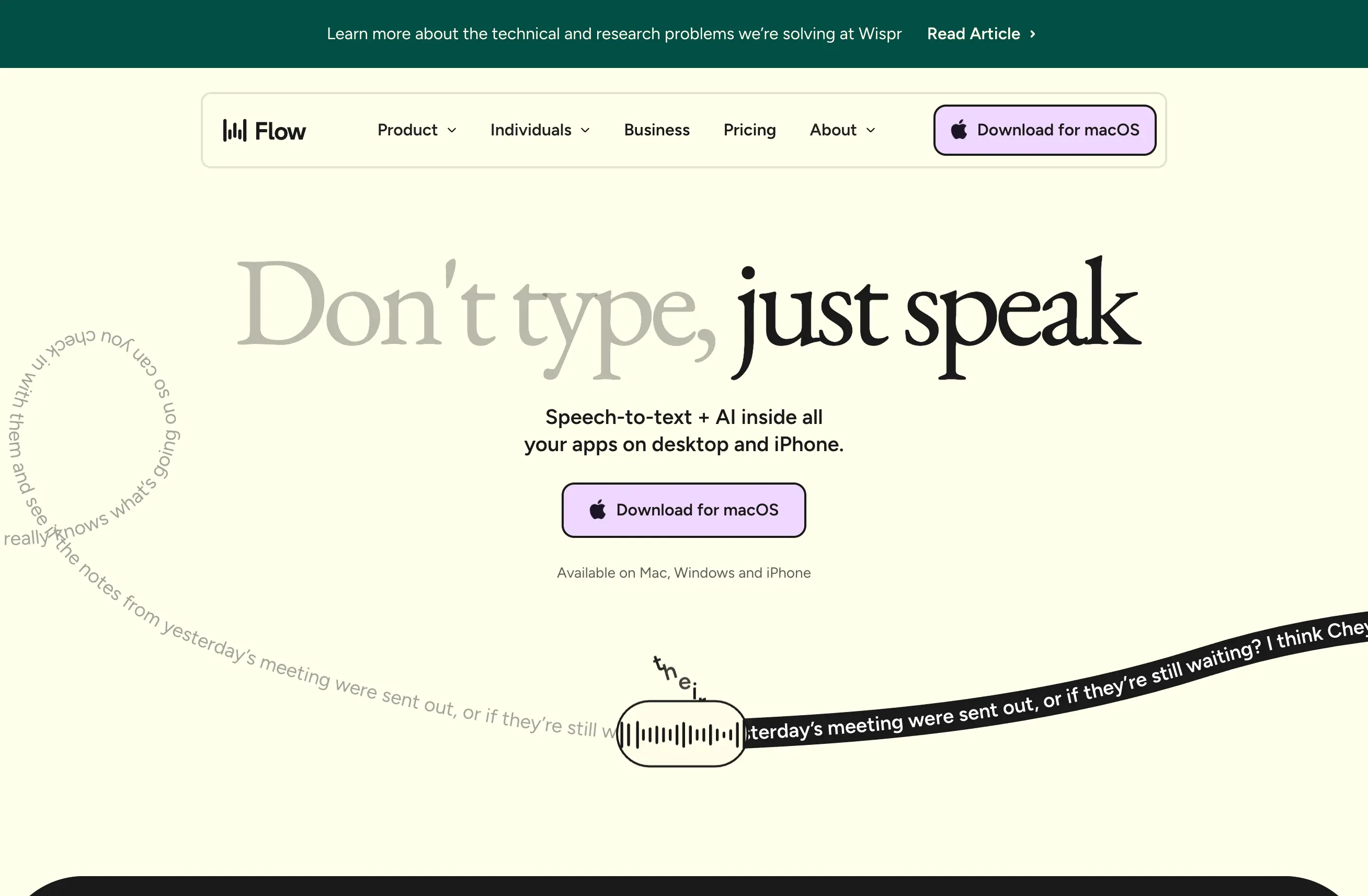
Everything starts with WisprFlow. It's a voice dictation app that runs on your Mac and drops text wherever your cursor is — terminal, IDE, browser, Slack, anywhere.
I was typing at 90 WPM. With WisprFlow, I speak at 179 WPM. That's not a minor improvement — it's a fundamentally different speed of communicating with computers. And because WisprFlow uses advanced AI to clean up your speech, the output is polished. No ums, no false starts, proper punctuation. It sounds like I carefully typed it.
Two modes I use constantly:
- Hold-to-talk: Hold a key, speak into whatever's focused, release. Text appears. I use this for quick commands, Slack messages, email replies.
- Hands-free mode: Double-tap to activate, then walk around and talk for up to six minutes. I use this for architecture brain dumps, detailed prompts to Claude Code, and long-form writing like this article.
The Agent Layer: Claude Code
WisprFlow handles input. Claude Code handles execution. I speak what I want built, and Claude Code builds it.
My typical flow:
- Brain dump via voice — I rant about what I want. Architecture, requirements, edge cases, stuff I hate about the current implementation. Six minutes of stream-of-consciousness.
- Claude Code receives the prompt — it parses my dump into a plan
- I review the plan — sometimes from my desk, sometimes from my phone on a walk
- Claude Code executes — writes code, runs tests, iterates on errors
- I review and steer — "that's close but change the error handling" (spoken, not typed)
I often have 3-8 Claude Code sessions running simultaneously. One per task or project. I rotate between them, speaking directions into each one. This is where the voice speed really compounds — I can context-switch between agents faster than I could switch IDE tabs by typing.
The Watch: Handwave
I built Handwave — a watchOS app that connects to my Claude Code sessions via Bonjour protocol. From my Apple Watch, I can:
- See all active sessions and their status
- Listen to the latest response from any session
- Speak a new direction and send it to a session
- Resume sessions from the trail
This is the piece that makes truly untethered development work. I don't need my laptop in front of me. I don't even need my phone. I can check on my agents from my wrist while walking the dog.
The Walking Setup
Here's my actual gear for walking-and-coding:
- AirPods Pro — for hearing agent responses and noise cancellation
- Apple Watch with Handwave — for checking and steering agents
- iPhone in pocket — backup for reviewing code diffs when needed
- WisprFlow running on my Mac at home — connected sessions waiting for input
I walk 3-5 miles while "coding." The physical movement triggers diffuse-mode thinking — the neural state where your brain makes connections between disparate ideas. It's the same reason you get your best ideas in the shower. Except now I can act on those ideas immediately by speaking them to an agent.
The Brain Dump Workflow
This is my favorite pattern and the one I'd recommend starting with if you're new to voice-first development:
When I'm overwhelmed, stuck, or just starting a new project, I double-tap WisprFlow and talk for 3-6 minutes. Everything in my head comes out:
"I need to refactor the auth module because right now it's handling both session management and token validation in the same file. The token validation should be its own thing because we're going to need to reuse it for the API routes too. Also I keep forgetting we need rate limiting on the public endpoints, that's been a TODO for two weeks. And the error messages are garbage right now — when auth fails the user just gets a 401 with no context..."
Claude takes this chaos and produces a structured plan. Usually within two turns of conversation, I have a prioritized task list and Claude is already working on the first item.
Why This Setup Actually Works
The ergonomic benefits are obvious — no RSI, no carpal tunnel, no hunching over a keyboard. But that's not why I kept doing it. I kept doing it because I'm faster and produce better work this way.
Speed: 179 WPM voice vs 90 WPM typing, multiplied across 3-8 parallel agent sessions. The throughput is genuinely 5-10x what I could do typing alone.
Quality: When I speak my requirements, I include more context, more nuance, more edge cases than when I type. Typing is terse by nature — it costs effort per character, so you minimize. Speaking is abundant — you naturally elaborate, explain, and think out loud. Agents get better instructions and produce better code.
Health: I walk 15,000+ steps on days I'm "at the computer." My back doesn't hurt. My wrists don't hurt. My eyes aren't strained from staring at a monitor for 10 hours. I get sunlight. I get fresh air. This matters.
Focus: Walking prevents the ADHD trap of tab-switching, Slack-checking, email-refreshing. When I'm on a trail, there's nothing to distract me. Just me, my thoughts, and my agents.
Getting Started
You don't need the full stack on day one. Start with just WisprFlow:
- Install it and try hold-to-talk in Slack or email. Get comfortable with voice input.
- Try it in your IDE or terminal. Speak a prompt to your AI coding tool instead of typing it.
- Do a brain dump. Next time you're overwhelmed, double-tap and rant for 3 minutes. Let the AI organize it.
Once voice input is natural (give it 3 days), everything else builds on top. Claude Code sessions, the watch app, the walking workflow — they're all just extensions of the core insight: your voice is a faster, more natural interface to computers than your keyboard.
The keyboard is a 150-year-old interface designed for a pre-AI world. Your voice plus AI agents is the stack that replaces it. I'm not going back.
How each tool turns speech into text
The useful difference is where the text appears and how much work remains afterward.
Traditional typing stays precise and familiar for short edits.
WisprFlow dictates into any app with AI formatting, and it is free to try.

Discussion
Giscus