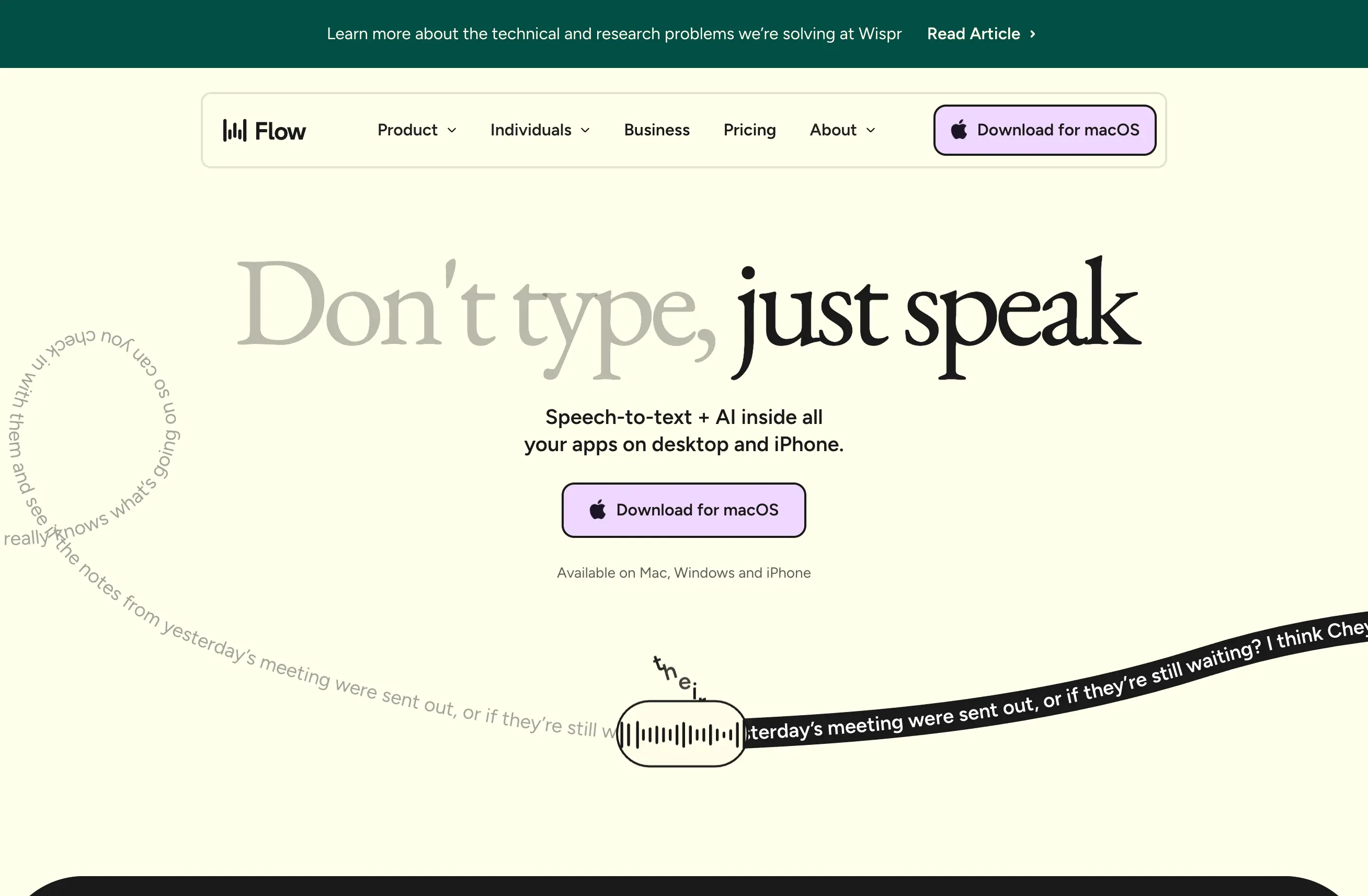
Email is the tax on doing anything meaningful. Every collaboration, every project, every client relationship — they all route through your inbox eventually. And most of us are typing every single reply at 60-90 words per minute, carefully editing as we go, agonizing over phrasing, rewriting the same sentence three times.
I write emails at 179 words per minute now. Not because I'm a faster typist — because I stopped typing entirely.
The Math That Changed Everything
Here's the calculation that broke my brain: the average professional sends 40 emails per day. If each one takes 3-4 minutes to compose by typing, that's two hours per day just writing emails. Two hours of your best cognitive energy, spent on the least creative part of your job.
When I switched to voice dictation with WisprFlow, those same emails take 30-60 seconds each. I speak naturally, the AI cleans up my ums and hesitations, and I get polished text that sounds like me — just faster.
How It Actually Works
I'm not talking about Siri dictation that types "duck" when you definitely didn't say "duck." Modern voice AI is different:
- Hold a key (or double-tap to go hands-free) — WisprFlow activates wherever your cursor is
- Speak naturally — don't slow down, don't enunciate like a robot, just talk
- Release — polished text appears, cleaned of filler words, properly punctuated
It works in Gmail, Outlook, Slack, any text field. I dictate directly into the compose window. The email is written before I'd have finished typing the greeting.
The Voice Advantage for Email Specifically
Email has a weird problem: we write them like documents but they should sound like conversations. When you type, you tend to over-formalize. You write "I wanted to reach out regarding..." when you'd just say "Hey, quick question about..."
Voice dictation naturally produces more conversational, human-sounding emails because you're literally having a conversation — just with yourself. The result reads better than what most people type.
My Email Workflow Now
Quick replies (under 3 sentences): Hold the key, speak the reply, release, send. Total time: 15 seconds.
Longer emails: Double-tap to go hands-free, speak for 30-60 seconds covering everything I need to say, release. WisprFlow cleans it up into proper paragraphs. I scan it once, maybe adjust one thing, send. Total time: 90 seconds.
Complex/sensitive emails: I speak a brain dump of everything I want to convey — every point, every nuance, every caveat. Then I ask Claude to restructure it into a professional email. The voice dump gives Claude perfect source material because I captured my actual thinking, not a typed approximation of it. Total time: 3 minutes for an email that would have taken 15.
The ADHD Email Angle
I'm formally diagnosed ADHD. Email is one of the worst tasks for the ADHD brain: it requires sustained attention to a boring task, with constant context-switching between threads, and the reward for finishing one email is... another email.
Voice dictation transforms email from a writing task (hard, boring, requires focus) into a talking task (natural, easy, almost automatic). My brain doesn't resist it the same way. I can blast through my inbox while pacing around my office, and that movement actually helps me think more clearly.
"But I Need to Think While I Write"
This is the objection I hear most. And it's backwards. You think more clearly when you speak than when you type, because typing adds a translation layer between your thoughts and the output. Your fingers become a bottleneck that forces you to lose threads of thought while you're mechanically pressing keys.
When you speak, your thoughts flow directly into words. You can hold more complex ideas in working memory because you're not splitting attention between thinking and typing. The quality of your communication actually goes up.
What About Tone and Formatting?
WisprFlow uses advanced models to clean up your speech. It handles:
- Punctuation — periods, commas, question marks placed correctly
- Paragraph breaks — it understands when you're shifting topics
- Filler removal — "um," "like," "you know" all get cleaned out
- Context awareness — it knows whether you're writing an email, a code comment, or a Slack message and adjusts accordingly
The result doesn't sound dictated. It sounds like you sat down and carefully composed it — except it took you 30 seconds.
The Compound Effect
Here's what happens when you cut email time from 2 hours to 30 minutes per day:
- 1.5 hours back per day — that's 7.5 hours per week, or nearly a full extra workday
- You actually reply faster — which makes you more responsive, which builds trust
- You stop dreading your inbox — because it's no longer a 2-hour ordeal
- Your emails sound better — more natural, more human, less corporate
I'm not a productivity guru. I'm a developer who got tired of spending 20% of my workday typing the same kinds of messages. Voice dictation wasn't on my radar until I tried it. Now I can't go back.
The keyboard is a 150-year-old interface. Your voice is faster, more natural, and produces better output. Use it.
How each tool turns speech into text
The useful difference is where the text appears and how much work remains afterward.
Traditional typing stays precise and familiar for short edits.
WisprFlow dictates into any app with AI formatting, and it is free to try.

Discussion
Giscus