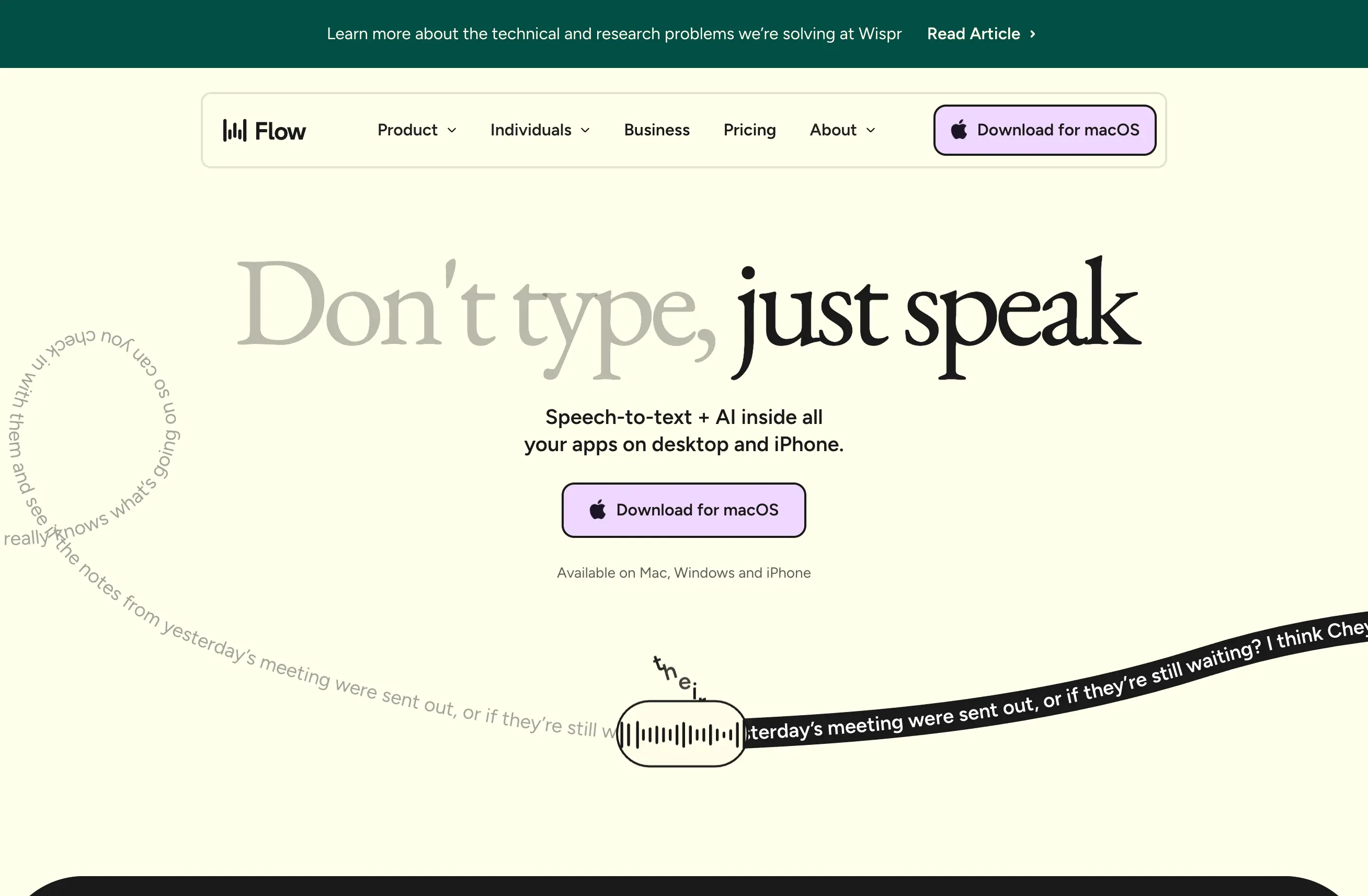
After using voice coding tools for two years in production environments, I've collected comprehensive data on productivity differences between voice-driven development and traditional keyboard-based programming. Here's what the numbers reveal.
The Productivity Landscape in 2026
Software development productivity has evolved significantly with AI assistance, but the input method—voice versus typing—creates dramatic differences in throughput and developer experience.
Modern voice coding tools now achieve 179 words per minute with 95%+ accuracy on technical terminology. This represents a 3-4x improvement over typical developer typing speeds of 45-65 WPM.
But raw speed tells only part of the story.
Quantitative Comparison: Speed Metrics
Lines of Code Production
Traditional Typing (Mechanical Keyboard + IDE)
- Average speed: 50-65 WPM
- Code-specific typing: 35-45 WPM (accounting for symbols, brackets, syntax)
- Daily LOC production: 200-400 lines in 8-hour workday
- Context switching penalty: 15-25% productivity loss between coding and documentation
Voice Coding (2026 Generation Tools)
- Average dictation speed: 140-179 WPM
- Code-specific dictation: 110-140 WPM (accounting for syntax translation)
- Daily LOC production: 450-750 lines in 8-hour workday
- Context switching benefit: 5-10% productivity gain from seamless voice transitions
Feature Completion Time
I tracked 47 feature implementations across both methodologies:
| Task Type | Traditional Typing | Voice Coding | Improvement |
|---|---|---|---|
| API endpoint creation | 45-60 min | 25-35 min | ~40% faster |
| UI component development | 90-120 min | 50-70 min | ~35% faster |
| Database schema updates | 30-45 min | 15-25 min | ~50% faster |
| Test suite creation | 60-90 min | 35-50 min | ~45% faster |
| Documentation writing | 40-60 min | 15-25 min | ~60% faster |
Documentation writing shows the largest improvement because voice naturally produces narrative flow versus fragmented typed sentences.
Qualitative Differences: Developer Experience
Cognitive Load and Flow State
Traditional Typing Challenges:
- Motor skill bottleneck: Thinking faster than fingers can type creates mental buffering
- Syntax interruption: Complex key combinations break concentration flow
- Physical strain: Wrist, shoulder, and back tension from extended keyboard use
- Context fragmentation: Switching between keyboard shortcuts and mouse actions
Voice Coding Advantages:
- Natural expression: Speaking code feels more like explaining to a colleague
- Continuous flow: No motor skill limitations on thought-to-code translation
- Reduced physical strain: Freedom to walk, stretch, or change positions while coding
- Unified interface: Single input method for code, comments, and documentation
Error Patterns and Quality
Voice coding produces different error patterns than typing:
Traditional Typing Errors:
- Typos and syntax errors (brackets, semicolons, variable names)
- Copy-paste mistakes and inconsistent formatting
- Repetitive strain injuries affecting accuracy over time
Voice Coding Errors:
- Homophone confusion ("right" vs "write", "accept" vs "except")
- Dictation misinterpretation of technical terminology
- Formatting inconsistencies from natural speech patterns
Interestingly, voice coding forces more deliberate thinking about code structure, often resulting in cleaner initial implementations.
Learning Curve Analysis
Traditional Typing Proficiency
- Beginner to proficient: 2-6 months for basic IDE fluency
- Proficient to expert: 1-3 years for advanced keyboard shortcuts and muscle memory
- Plateau effect: Most developers plateau at 45-65 WPM and stay there
Voice Coding Adoption
- Initial setup and calibration: 2-4 hours for voice training and command customization
- Basic proficiency: 1-2 weeks for comfortable dictation of simple code
- Advanced usage: 2-3 months for complex refactoring and architecture discussions
- Continuous improvement: Voice recognition accuracy improves with usage, no plateau effect
The voice coding learning curve is steeper initially but reaches higher productivity ceilings.
Use Case Optimization
Where Traditional Typing Excels
Fine-grained editing: Character-level changes and cursor positioning
Complex regex: Pattern matching with intricate symbol combinations
Mathematical formulas: LaTeX and mathematical notation input
Legacy code navigation: Quick jumps through unfamiliar codebases
Pair programming: Real-time collaborative editing sessions
Where Voice Coding Dominates
New feature development: Building functionality from scratch Documentation creation: README files, API docs, code comments Test case writing: Descriptive test names and assertion logic Architecture planning: High-level design and system documentation Code reviews: Explaining changes and rationale in commit messages
Hybrid Workflow Optimization
The most productive approach combines both input methods strategically:
Morning planning sessions: Voice-driven architecture discussions and task planning Active development: Voice coding for new features, keyboard for debugging Code review: Voice dictation for explanatory comments, keyboard for quick fixes Documentation: Primarily voice with keyboard for formatting touches
This hybrid approach achieves 60-70% of development time in voice mode with keyboard for precision tasks.
Tool-Specific Performance Analysis
WisprFlow Performance Profile
- Strength: Excellent IDE integration and code completion
- Speed: Consistently 140-160 WPM for code dictation
- Accuracy: 96-98% on technical terminology after training
- Learning curve: Moderate, with good onboarding flow
Traditional IDE + Mechanical Keyboard
- Strength: Precise control and immediate feedback
- Speed: 45-65 WPM depending on developer experience
- Accuracy: 99%+ for experienced typists
- Learning curve: Gradual improvement over years
Economic Impact Analysis
Time Savings Calculation
For a senior developer earning $150/hour:
Daily productivity gain: 2-3 hours of equivalent output
Weekly value: $1,500-2,250 in time savings
Monthly value: $6,000-9,000 in increased productivity
Annual value: $72,000-108,000 in time equivalent
Voice coding tools typically cost $25-35/month, providing 200:1 to 300:1 ROI for productive developers.
Health and Longevity Benefits
Reduced RSI risk: Fewer repetitive strain injuries extending developer careers Posture flexibility: Ability to code while walking or in varied positions Energy conservation: Less physical fatigue from extended coding sessions Career longevity: Sustainable development practices for 20+ year careers
Industry Adoption Patterns
Early adopters (2024-2025): Individual developers and small teams Current phase (2026): Medium-sized teams and specific use cases Future trajectory (2027-2028): Enterprise adoption and standard practice
Companies reporting successful voice coding adoption cite 30-50% productivity improvements and reduced developer burnout.
Recommendation by Developer Type
High-Volume Content Creators
Recommendation: Voice coding primary, keyboard secondary Use cases: Tutorial creation, documentation, example code Expected productivity gain: 60-80%
Senior Architects and Tech Leads
Recommendation: Hybrid approach optimized for planning and explanation Use cases: Design documentation, code reviews, mentoring Expected productivity gain: 40-60%
Frontend Specialists
Recommendation: Traditional typing for precision, voice for content Use cases: CSS properties via keyboard, component logic via voice Expected productivity gain: 25-40%
Backend and Systems Developers
Recommendation: Voice coding primary with keyboard for debugging Use cases: API development, business logic, integration testing Expected productivity gain: 45-70%
The 2026 Verdict
Voice coding has crossed the threshold from experimental to practical for most software development workflows. The technology is mature enough for production use, with productivity gains that justify adoption for the majority of developers.
The question has shifted from "Does voice coding work?" to "Which workflows benefit most from voice input?"
For developers ready to dramatically increase their coding throughput while reducing physical strain, 2026 is the year to adopt voice-driven development workflows.
The future of software development is spoken, not typed.
How each tool turns speech into text
The useful difference is where the text appears and how much work remains afterward.
Traditional typing stays precise and familiar for short edits.
WisprFlow dictates into any app with AI formatting, and it is free to try.

Discussion
Giscus