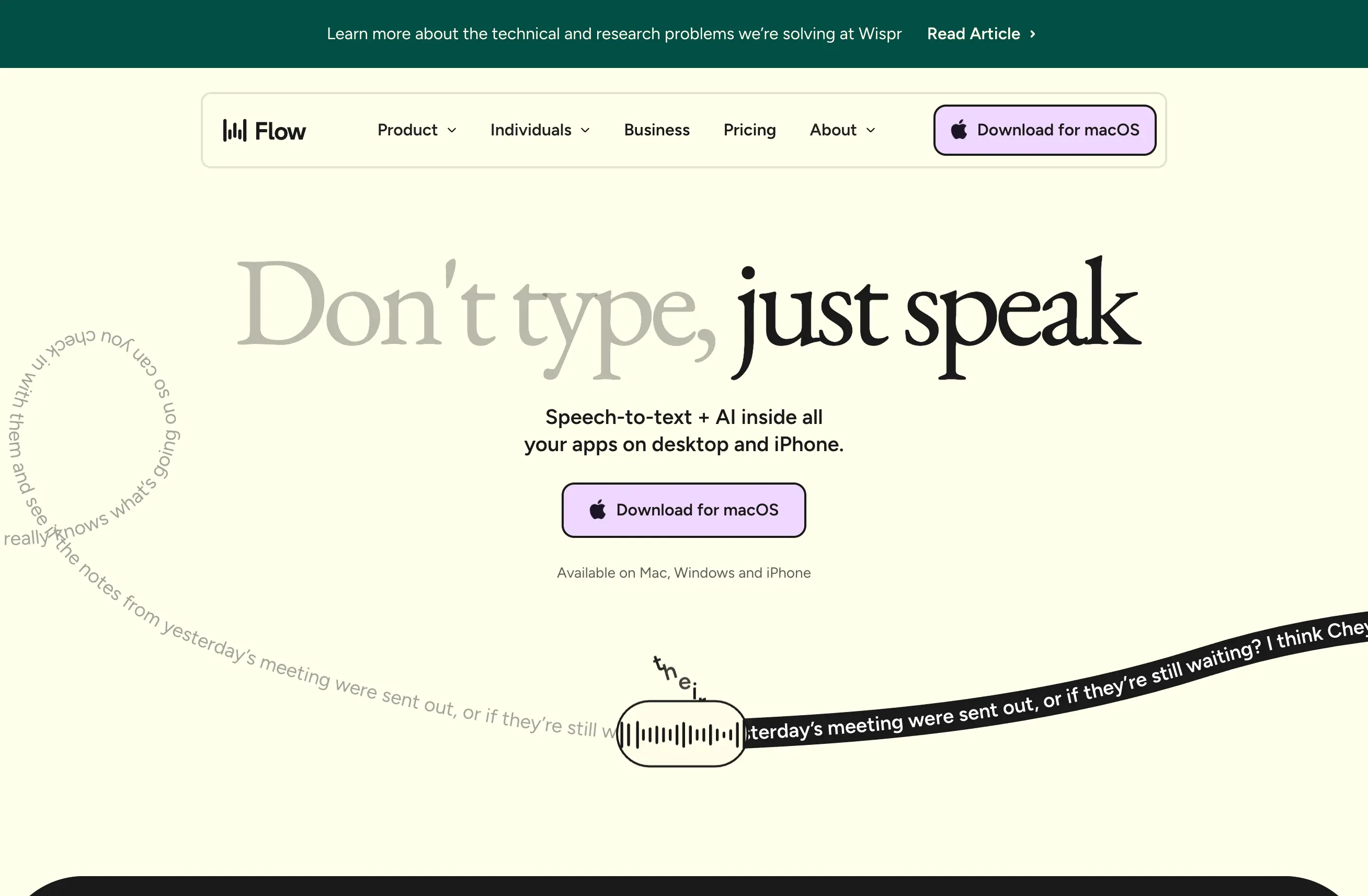
Most knowledge workers spend 6-8 hours daily creating text: emails, documents, code, presentations, and analysis. The bottleneck is the mechanical process of translating thoughts into written form through typing.
Voice-first workflows eliminate this bottleneck completely. Instead of hunting and pecking through ideas at 40-80 words per minute, you can speak your thoughts at 150-200 words per minute while maintaining higher quality output.
After 8 months of voice-first work across coding, writing, and business communication, I've fundamentally changed how I approach knowledge work productivity.
The Typing Bottleneck
Traditional knowledge work limitations:
- Typing speed caps at 60-90 WPM for most professionals
- Cognitive load split between idea generation and mechanical input
- Physical fatigue from extended keyboard sessions
- Error correction overhead from typos and formatting mistakes
- Context switching between thinking and typing mechanics
Real example: Writing a complex business proposal traditionally requires:
- Outline the structure (10 minutes thinking, 5 minutes typing)
- Draft each section (30 minutes thinking, 45 minutes typing)
- Edit and refine (15 minutes thinking, 30 minutes retyping)
- Format and finalize (5 minutes thinking, 20 minutes formatting)
The mechanical input process takes longer than the creative thinking process. This is backwards.
Voice-First Workflow Transformation
Voice-enabled knowledge work:
- Speaking speed of 150-200 WPM maintains pace with thinking
- Cognitive resources focused entirely on content quality and structure
- Physical comfort during extended creation sessions
- Error patterns shift from mechanical to conceptual (higher value corrections)
- Natural flow between ideation and expression
Same business proposal with voice workflow:
- Speak the complete outline while walking (8 minutes total)
- Voice-draft each section naturally (35 minutes total)
- Voice-edit for clarity and flow (10 minutes speaking, 5 minutes review)
- Quick formatting review (5 minutes total)
Total time: 58 minutes versus 105 minutes. More importantly, the output quality is higher because cognitive energy focused on content instead of mechanics.
Writing and Content Creation
Email Productivity
Professional email consumes 2-3 hours daily for most knowledge workers. Voice-first email transforms this completely:
Traditional email workflow:
- Read message → Think response → Type slowly → Review for typos → Send
- Average time per substantive email: 8-12 minutes
- Mental fatigue from typing overhead
Voice email workflow:
- Read message → Speak response naturally → Quick review → Send
- Average time per substantive email: 3-5 minutes
- Higher quality responses due to natural speech patterns
Voice email feels more conversational and authentic. Recipients often comment that voice-composed emails have better tone and clarity.
Document Creation
Long-form documents benefit enormously from voice-first composition:
Reports and analysis: Speak your findings and conclusions naturally rather than struggling to "write" complex ideas Presentations: Voice-create slide content that mirrors your speaking patterns for better delivery alignment Technical documentation: Explain complex processes in natural language that voice recognition converts to clear written instructions
Creative and Strategic Thinking
Brainstorming and Ideation
Voice workflows enhance creative thinking by removing the mechanical barrier between ideas and capture:
Traditional brainstorming: Ideas → Mental filter → Typing mechanics → Written capture Voice brainstorming: Ideas → Immediate spoken capture → Review and organize
The elimination of typing mechanics allows faster idea generation and capture. You can explore conceptual threads without losing momentum to typing speed.
Strategic Planning
Complex strategic thinking benefits from voice workflows that maintain the flow of analysis:
Business planning: Speak through market analysis, competitive positioning, and growth strategies without typing interruption Problem solving: Voice-work through complex problems while walking or moving (physical movement enhances creative thinking) Decision analysis: Speak through decision frameworks and criteria while maintaining analytical momentum
Code and Technical Development
Programming with Voice
Software development transforms dramatically with voice input:
Traditional coding: Think logic → Type syntax → Debug typos → Refactor for clarity Voice coding: Think logic → Speak implementation → Focus on architecture and algorithms
Voice coding forces clearer thinking because you must articulate your intentions well enough for voice recognition. This results in better-designed code.
Example transformation:
Instead of typing: const userData = users.filter(u => u.active && u.lastLogin > Date.now() - 86400000)
You speak: "Create a constant called userData that filters the users array to only include active users who logged in within the last 24 hours"
The voice version is clearer and produces more readable code.
Technical Documentation
Explaining complex technical concepts is natural with voice input:
API documentation: Speak endpoint descriptions, parameter explanations, and usage examples Architecture decisions: Voice-document technical decisions with natural explanations of trade-offs and reasoning Code comments: Speak inline documentation that explains business logic and design decisions
Business Communication
Meeting Preparation
Voice workflows excel at meeting preparation and follow-up:
Agenda creation: Speak agenda items and talking points while reviewing relevant materials Presentation prep: Voice-create presentation notes that match your natural speaking style Follow-up actions: Immediately voice-capture action items and next steps after meetings
Client Communication
Professional client communication benefits from voice composition:
Proposals: Speak proposals conversationally for more engaging and persuasive content Status updates: Quick voice updates that maintain regular client communication without typing overhead Problem explanations: Complex issue explanations are clearer when spoken naturally then transcribed
Learning and Knowledge Management
Note-Taking and Research
Voice input transforms how you capture and process information:
Research notes: Speak insights and analysis while reading without losing research momentum Learning capture: Voice-record key concepts and connections during studying or training Meeting notes: Focus on conversation while speaking notes without disengaging from discussion
Knowledge Organization
Voice workflows help organize and connect complex information:
Content summarization: Speak summaries of articles, books, or research while the material is fresh
Insight synthesis: Voice-connect ideas across different sources and disciplines
Knowledge review: Speak through stored information to reinforce learning and identify patterns
Physical and Mental Health Benefits
Ergonomic Advantages
Voice-first workflows reduce physical strain from extended computer work:
Reduced typing stress: Elimination of repetitive strain and carpal tunnel risk Improved posture: Freedom to stand, walk, or change positions while working Eye strain reduction: Less screen focus required during creation phases Movement integration: Ability to walk while working enhances both physical health and creative thinking
Cognitive Benefits
Voice workflows align better with natural thinking patterns:
Reduced cognitive load: No mental resources spent on typing mechanics Natural expression: Speech patterns that match thinking patterns produce higher quality output Flow state maintenance: Fewer interruptions to creative and analytical thinking Mental energy conservation: Reserve cognitive resources for high-value thinking rather than mechanical input
Implementation Strategy
Getting Started
- Choose one workflow: Begin with email or document creation rather than trying to change everything simultaneously
- Practice basic commands: Master fundamental voice input before attempting complex workflows
- Measure improvements: Track time savings and quality improvements to maintain motivation
- Gradually expand: Add voice input to additional workflows as proficiency develops
Tools and Setup
Voice recognition: High-quality microphone and reliable voice recognition software Environment: Quiet space for clear voice input (or noise-canceling microphone for busier environments) Integration: Tools that support voice input natively or through integration platforms Backup methods: Maintain typing capabilities for situations where voice input isn't practical
Overcoming Common Obstacles
Privacy Concerns
Office environments: Use noise-canceling microphones or designated voice-work spaces Sensitive content: Understand data handling and privacy policies of voice recognition services Hybrid approaches: Combine voice input for creation with keyboard input for final editing and sensitive information
Quality Control
Review processes: Develop efficient review and editing workflows for voice-generated content Accuracy improvement: Train voice recognition systems with your vocabulary and speaking patterns Error patterns: Understand common voice recognition errors and develop correction strategies
Social Acceptance
Professional settings: Gradually introduce voice workflows and demonstrate productivity improvements Team adoption: Share benefits and best practices to encourage broader team adoption Client interactions: Use voice preparation for better in-person communication and presentation quality
Measuring Success
Quantitative metrics:
- Words per minute improvement (typing vs. voice)
- Time per task reduction
- Daily output volume increases
- Error reduction and quality improvements
Qualitative improvements:
- Reduced physical fatigue and discomfort
- Enhanced creative flow and thinking quality
- Improved work-life balance through faster task completion
- Greater job satisfaction due to reduced mechanical friction
Voice-first productivity eliminates the typing bottleneck from creative and analytical work while keeping keyboard input for tasks where it excels.
When your ideas can flow directly from thought to written form at the speed of speech, everything changes. You think faster, create more, and produce higher quality output while reducing physical strain and mental fatigue.
The technology exists today. The only question is whether you'll adopt voice-first workflows before or after your competition discovers the advantage.
Try speaking your next email instead of typing it. You'll immediately understand why voice-first productivity is the future of knowledge work.
How each tool turns speech into text
The useful difference is where the text appears and how much work remains afterward.
Traditional typing stays precise and familiar for short edits.
WisprFlow dictates into any app with AI formatting, and it is free to try.

Discussion
Giscus