You just finished a 45-minute discovery call in a client's parking lot. You have another meeting in 20 minutes across town. The CRM isn't going to update itself.
For years, this moment — the between-meetings scramble — has been the graveyard of good sales data. You either type fast enough to capture the gist (and lose detail), or you wait until the evening and lose half of it to memory decay. Neither option is good enough.
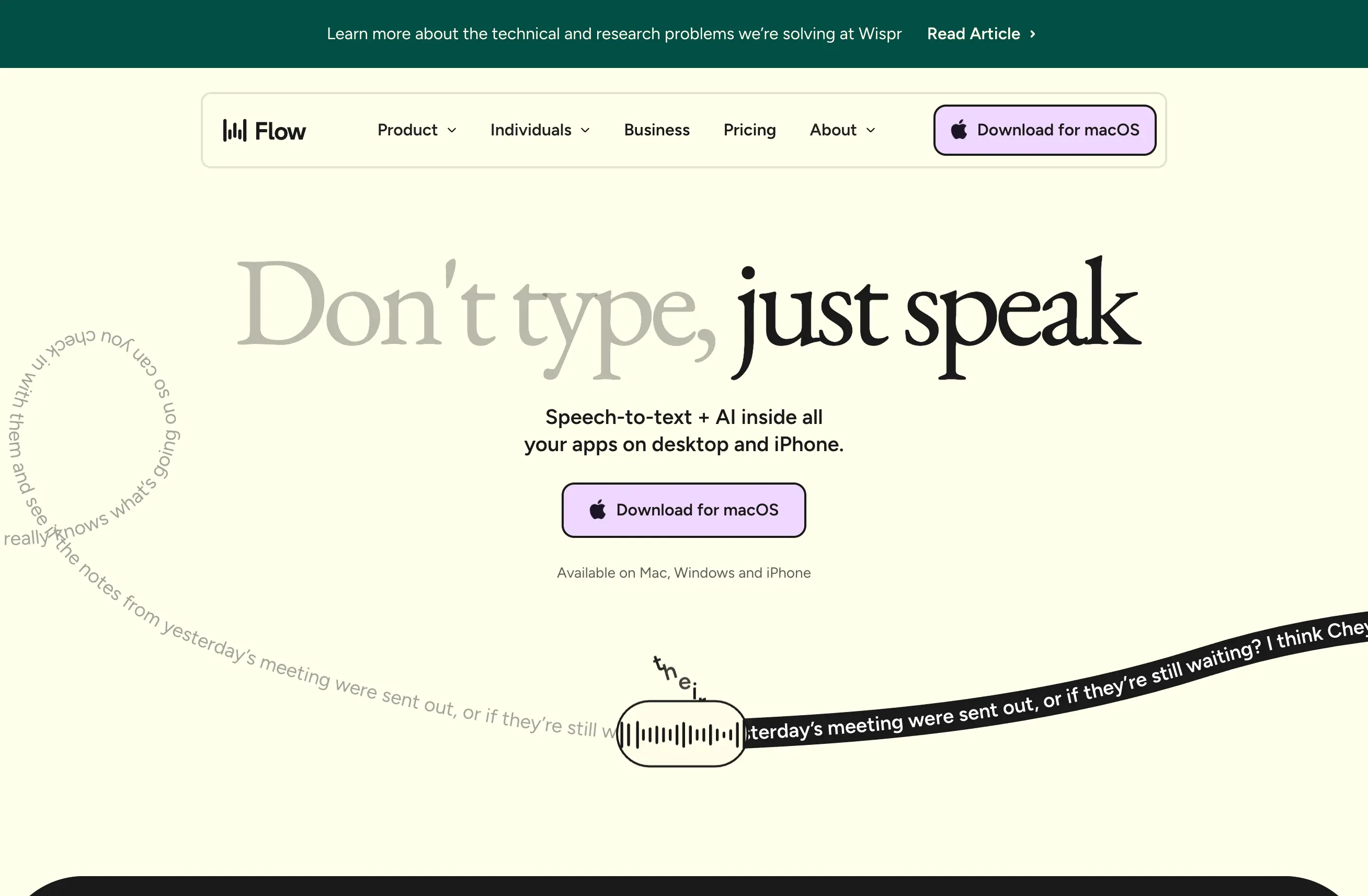
WisprFlow launched on Android on February 23, 2026, and it changes this entirely.
The Core Problem with Field Sales Documentation
Enterprise sales teams running Salesforce, HubSpot, or any other CRM have the same structural problem: the people who need to update the CRM are also the people who are never at a desk when they need to update it. Mobile CRM apps exist, but typing on a phone while standing in a parking lot, walking to your car, or sitting in a lobby is friction that compounds.
Most reps end up doing one of three things: dictating terrible voice memos they never transcribe, typing fragments that require cleanup later, or just skipping documentation entirely. None of these work at scale.
Voice dictation at 179 WPM is the answer, but only if the accuracy is high enough that you're not spending more time editing than you saved dictating. WisprFlow's local AI processing is what makes this viable — it's not sending audio to a cloud service and hoping the transcription comes back clean. The model runs on-device, which means it works offline and handles domain-specific vocabulary — including industry jargon, company names, and product terminology — far better than generic voice-to-text.
The Workflow: Parking Lot to CRM in Under Two Minutes
Here's what the actual workflow looks like with WisprFlow on Android:
Immediately after a call or meeting: You're still in the parking lot. You activate WisprFlow and start talking. You cover the key topics discussed, objections raised, next steps agreed, and anything the prospect mentioned that you want to remember. At 179 WPM, a detailed two-minute summary comes out as ~350 words — more than enough context for any CRM entry.
Routing the text: WisprFlow works system-wide. That means the transcribed text goes directly wherever your cursor is — your CRM's mobile app, an email compose window, a Slack message to your manager, or a Notes doc. You don't paste from a separate app. It just shows up.
Follow-up email drafting: Same approach. You dictate the follow-up email right there — reference what you discussed, confirm next steps, attach whatever materials you promised. By the time you've driven to your next meeting, the email is sent.
Android Opens Up the Rest of the Sales World
This matters beyond individual productivity. WisprFlow was Apple-only for a long time, which meant it was available to Mac and iOS users but entirely unavailable to Android users. Many sales organizations — particularly in manufacturing, healthcare, logistics, and field services — run almost entirely on Android. Their reps carry Samsung Galaxy or Pixel phones, full stop.
The February 23 Android launch means WisprFlow is now viable for these teams. A field sales team at a medical device company, a wholesale distributor, a construction supply outfit — these are all Android shops. Before February 23, WisprFlow wasn't in the conversation. Now it is.
For sales managers, this is also a data quality story. If your reps can accurately document calls in real-time with minimal friction, your CRM actually reflects what's happening in the field. Forecasting gets better. Coaching gets more specific. Deal review meetings are based on data, not vibes.
Expense Reporting by Voice
One more workflow worth calling out explicitly: expense reporting. This is the administrative task that sales reps hate most, and for good reason — it's tedious, detail-oriented, and completely orthogonal to selling.
WisprFlow doesn't automate expense submission, but it removes the typing friction entirely. Right after a client lunch, you activate WisprFlow and dictate: "Lunch at Osteria Morini with Michael Torres and Sarah Kim from Accenture, $187 including tip, discussing enterprise expansion of Q3 contract." That sentence — captured accurately, in seconds — is everything you need to complete the expense entry later. You're not trying to remember the restaurant name or the attendees two weeks later.
For post-meeting notes you want to keep long-term and share with your team, Granola is worth pairing here. It handles structured meeting capture with action item extraction, building a searchable record of every call.
Getting Started
Setup on Android is straightforward. Install WisprFlow from the Play Store, set it as your default keyboard or enable the overlay shortcut, and it works in every app immediately. The custom vocabulary feature is worth spending five minutes on — add your company name, key product names, prospect names, and industry terms you use regularly. Accuracy on domain-specific language improves noticeably.
The onboarding flow will prompt you to set up your preferred activation method. Most sales reps prefer the floating button overlay — it's always available regardless of which app you're in, which is exactly the behavior you want when you're moving between CRM, email, and messaging throughout the day.
If you're already on WisprFlow for iOS and your organization is issuing Android devices, the account carries over. Same custom vocabulary, same settings. The learning curve is essentially zero.
The Bottom Line
Sales is a high-volume documentation job wrapped around a relationship-building job. The documentation has to happen — deals depend on it — but it shouldn't be the thing eating your time between calls.
WisprFlow on Android makes the documentation fast enough that you can do it properly, in the moment, without it costing you anything more than two minutes in a parking lot. For teams where Android is the standard-issue device, the February 23 launch is the thing that makes this viable at scale.
Your pipeline is only as good as what's in the CRM. Voice-first documentation is how you fix that without sacrificing selling time.
How each tool turns speech into text
The useful difference is where the text appears and how much work remains afterward.
Traditional typing stays precise and familiar for short edits.
WisprFlow dictates into any app with AI formatting, and it is free to try.

Discussion
Giscus