Let's get the obvious out of the way: Gboard's voice typing is free, it comes pre-installed on most Android devices, and for casual use it works fine. If you occasionally want to dictate a quick text message or search query, Gboard does the job and you don't need anything else.
This article is for people who type a lot. People for whom voice-to-text is a core workflow tool, not an occasional convenience. If you're a writer, a developer, a field professional, or anyone who generates significant amounts of text on their phone every day — the comparison looks very different, and WisprFlow (which launched on Android February 23, 2026) is worth taking seriously.
Where Gboard Voice Typing Falls Short
Gboard's voice transcription runs on Google's cloud. Audio goes from your microphone to Google's servers, transcription happens, text comes back. This architecture creates several structural limitations:
It requires internet connectivity. Gboard voice typing fails silently (or loudly, with a spinning indicator) when you're offline, on spotty cellular, or in environments with poor signal. You already know this from experience if you've tried to use it in a basement, a rural area, on a subway, or in a building where your carrier has weak penetration.
It doesn't handle domain-specific vocabulary well. Gboard is trained on general language. It doesn't know your industry's terminology, your company's product names, the acronyms your team uses, or proper nouns outside the mainstream. If you're dictating anything technical or specialized, you're getting autocorrect-style guesses on the words that matter most.
Latency is variable and depends on your connection. When the connection is good, Gboard voice is fast. When it's mediocre, there's a perceptible lag between speech and transcription that breaks the flow of dictation. For long-form content, this is genuinely annoying.
It only works inside Gboard. You have to switch to the Gboard keyboard to use voice typing. If you're in an app that uses a different keyboard by default, you're switching keyboards to dictate, then switching back. The friction accumulates.
What WisprFlow Does Differently
WisprFlow's voice transcription runs on-device. The AI model lives on your phone. Audio never leaves the device for transcription processing.
That single architectural difference cascades into several practical advantages:
Full offline capability. WisprFlow transcribes at full accuracy with zero bars of signal. The model is local. This is not a degraded offline mode — it's the same model, the same accuracy, regardless of connectivity.
179 WPM throughput. WisprFlow is built for continuous, fast dictation — not command-by-command recognition. The model is optimized for long-form speech at speed. If you dictate in natural prose, the accuracy stays high even when you're talking quickly.
Custom vocabulary. You can add specific terms, names, product identifiers, acronyms, and technical vocabulary to WisprFlow's model. It learns what you call things. The difference in accuracy on domain-specific language is significant — this is the feature that matters most for professionals.
System-wide overlay. WisprFlow works in every app on Android via a floating overlay button. You don't switch keyboards. The button is always there, always accessible, and the text lands wherever your cursor is. This is genuinely more convenient than Gboard's voice mode for heavy dictation use.
The Accuracy Question: How Much Does It Actually Matter?
For casual use — short messages, simple queries — Gboard's accuracy is good enough. You're not writing anything complex enough for the error rate to matter.
For professional use, accuracy compounds in the other direction. Consider what happens when Gboard mishears a technical term in a report, a client name in a CRM entry, or a part number in a work order. You either catch it during review (adding friction) or you don't (creating downstream problems). At Gboard's error rate on specialized vocabulary, you're editing more than you're saving.
WisprFlow's accuracy on general language is meaningfully higher than Gboard's at speed. On specialized vocabulary with custom terms added, the gap widens further. The practical benchmark: dictate a 500-word professional document with some technical terminology on both. The edit time on Gboard output is materially longer.
Data Privacy
This is worth mentioning directly. Gboard voice typing sends audio to Google's servers. Google's privacy policy governs what happens to that data. For most casual use, this is a non-issue.
For anyone dictating sensitive content — medical professionals, legal professionals, people in regulated industries, anyone discussing confidential business information — on-device processing is the only acceptable architecture. Audio that never leaves your phone cannot be captured, logged, or processed by a third party. WisprFlow's local model is the answer to this requirement. Gboard's cloud model is not.
The Honest Cost-Benefit Analysis
WisprFlow costs money. Gboard is free. Whether the upgrade is worth it depends on how much you use voice input.
If you dictate text for 15+ minutes per day — notes, emails, messages, reports, documentation — the accuracy and speed improvements translate into real time savings. Fewer corrections, faster output, reliable offline performance. The productivity value exceeds the subscription cost quickly.
If you use voice input five times a week for short messages, Gboard is probably fine. The upgrade cost doesn't pay off at that volume.
For heavy voice users — the people WisprFlow is designed for — it's not a close call.
For capturing meeting content and building a searchable record of discussions, Granola handles that specific workflow well and pairs naturally with WisprFlow's dictation focus.
Getting Started
WisprFlow is available on Android via the Play Store as of February 23, 2026. Enable the floating overlay, set up custom vocabulary with your most common specialized terms, and configure offline mode. The setup takes about ten minutes. The accuracy difference is apparent immediately.
Gboard is the right answer for casual voice use. WisprFlow is the right answer for professionals who live in voice input. Know which one you are, and pick accordingly.
How each tool turns speech into text
The useful difference is where the text appears and how much work remains afterward.
Traditional typing stays precise and familiar for short edits.
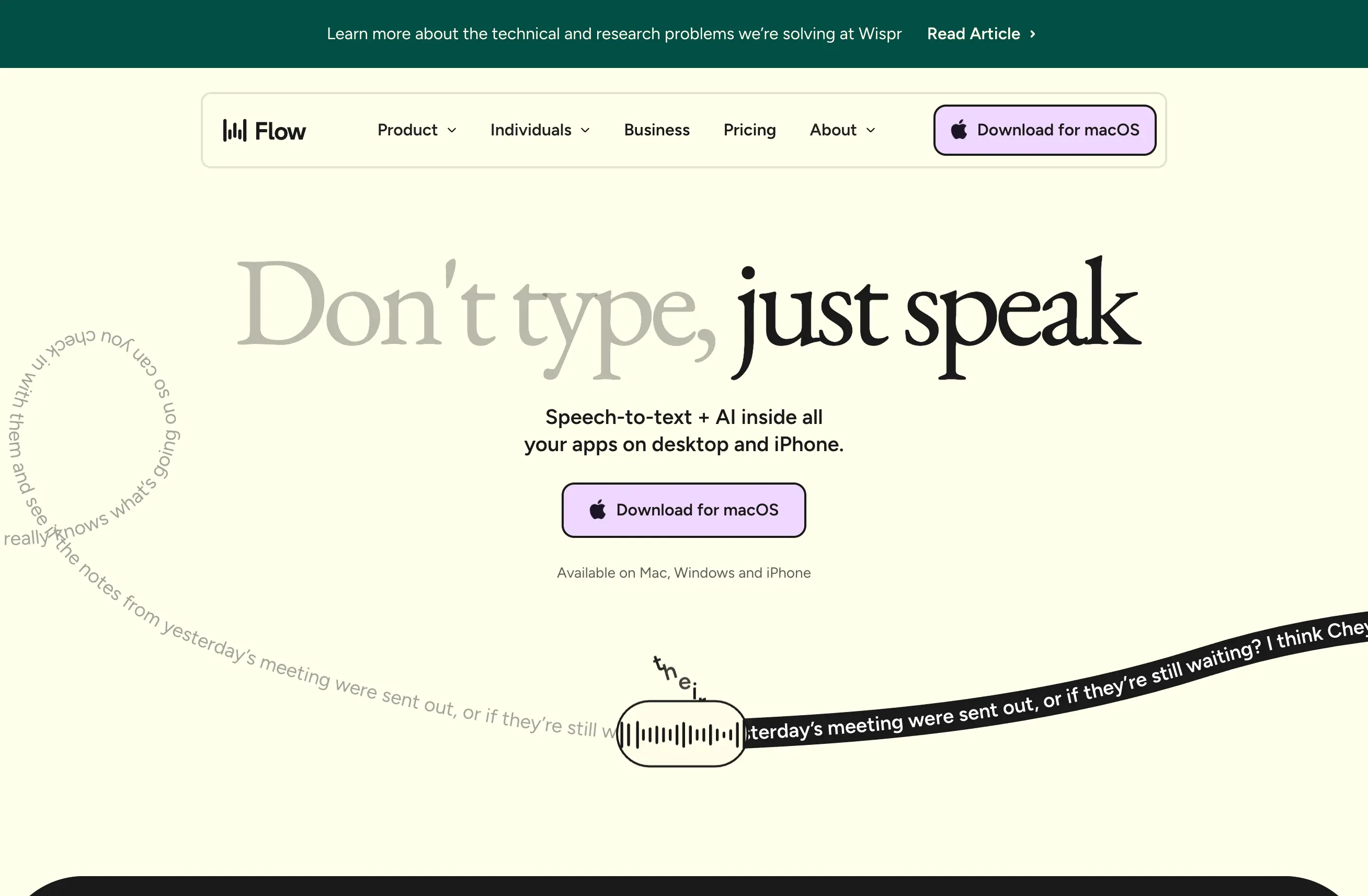
WisprFlow dictates into any app with AI formatting, and it is free to try.

Discussion
Giscus