Mobile development is inherently tactile. You're constantly switching between simulator, device, and code editor. Your hands are busy tapping, swiping, and debugging on physical devices. Traditional typing becomes a bottleneck when you need to code while testing gestures, orientations, and real-world mobile scenarios.
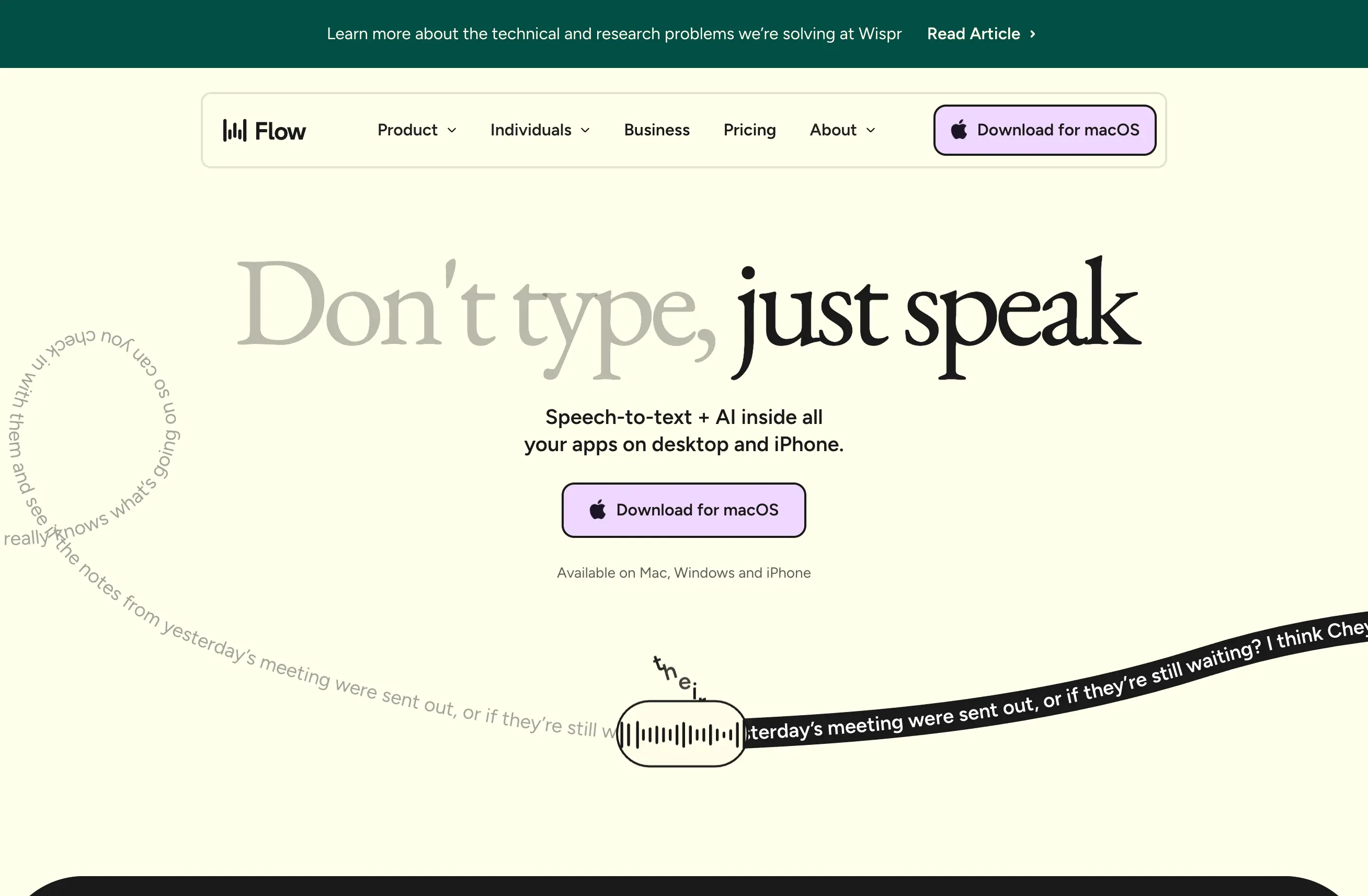
WisprFlow transforms mobile development by letting you write React Native, Swift, and Kotlin code entirely by voice while your hands stay free for device interaction.
The Mobile Developer's Context-Switching Problem
Mobile development involves unique challenges:
- Device testing - constantly switching between simulator and physical devices
- Gesture debugging - testing touch interactions while coding responses
- Orientation changes - coding layout adjustments while physically rotating devices
- Platform differences - managing iOS and Android codebases simultaneously
- API integration - testing location, camera, and sensor APIs in real environments
You need your hands for the device. Voice coding eliminates the keyboard bottleneck.
Voice Coding Mobile-Specific Workflows
React Native Development
Speak your way through cross-platform development:
// Voice: "Create async function handle location permission"
const handleLocationPermission = async () => {
  // Voice: "Try catch block for location permission request"
  try {
    const granted = await PermissionsAndroid.request(
      PermissionsAndroid.PERMISSIONS.ACCESS_FINE_LOCATION
    );
    // Voice: "If granted equals permission granted return true"
    if (granted === PermissionsAndroid.RESULTS.GRANTED) {
      return true;
    }
  } catch (error) {
    // Voice: "Console error permission denied error"
    console.error('Permission denied:', error);
  }
  return false;
};
Test permissions on device while dictating error handling.
iOS Swift Development
Voice coding while interacting with iOS simulator:
// Voice: "Class location manager implements location manager delegate"
class LocationManager: NSObject, CLLocationManagerDelegate {
  // Voice: "Private var manager equals CL location manager"
  private var manager = CLLocationManager()

  // Voice: "Override init super init then setup manager"
  override init() {
    super.init()
    setupManager()
  }

  // Voice: "Function setup manager manager delegate equals self"
  func setupManager() {
    manager.delegate = self
    // Voice: "Manager desired accuracy equals kCL location accuracy best"
    manager.desiredAccuracy = kCLLocationAccuracyBest
  }
}
Android Kotlin Development
Navigate Android-specific patterns by voice:
// Voice: "Class main activity extends app compat activity"
class MainActivity : AppCompatActivity() {

  // Voice: "Private lateinit var binding activity main binding"
  private lateinit var binding: ActivityMainBinding

  // Voice: "Override on create bundle super on create"
  override fun onCreate(savedInstanceState: Bundle?) {
    super.onCreate(savedInstanceState)

    // Voice: "Binding equals activity main binding inflate layout inflater"
    binding = ActivityMainBinding.inflate(layoutInflater)
    // Voice: "Set content view binding root"
    setContentView(binding.root)

    // Voice: "Setup click listeners"
    setupClickListeners()
  }
}
Mobile-Specific Voice Patterns
UI Layout and Constraints
Voice code responsive layouts while testing on different screen sizes:
<!-- Voice: "Constraint layout width match parent height wrap content" -->
<androidx.constraintlayout.widget.ConstraintLayout
    android:layout_width="match_parent"
    android:layout_height="wrap_content">

    <!-- Voice: "Text view ID title text width zero height wrap constraint start to parent start margin 16" -->
    <TextView
        android:id="@+id/titleText"
        android:layout_width="0dp"
        android:layout_height="wrap_content"
        app:layout_constraintStart_toStartOf="parent"
        app:layout_constraintTop_toTopOf="parent"
        android:layout_marginStart="16dp" />

</androidx.constraintlayout.widget.ConstraintLayout>
API Integration Patterns
Code networking while testing on device networks:
// Voice: "Class API service"
class ApiService {
  // Voice: "Static const base URL equals HTTPS API example com"
  static const baseUrl = 'https://api.example.com';

  // Voice: "Future map string dynamic get user data int user ID"
  Future<Map<String, dynamic>> getUserData(int userId) async {
    // Voice: "Final response equals await HTTP get URI parse base URL slash users slash user ID"
    final response = await http.get(Uri.parse('$baseUrl/users/$userId'));

    // Voice: "If response status code equals 200"
    if (response.statusCode == 200) {
      // Voice: "Return JSON decode response body as map string dynamic"
      return json.decode(response.body) as Map<String, dynamic>;
    }
    // Voice: "Throw exception failed to load user data"
    throw Exception('Failed to load user data');
  }
}
State Management
Voice code complex state while interacting with UI:
// Voice: "Class counter bloc extends bloc counter event int"
class CounterBloc extends Bloc<CounterEvent, int> {
  // Voice: "Counter bloc colon super zero"
  CounterBloc() : super(0) {
    // Voice: "On increment event yield state plus 1"
    on<IncrementEvent>((event, emit) {
      emit(state + 1);
    });

    // Voice: "On decrement event yield state minus 1"
    on<DecrementEvent>((event, emit) {
      emit(state - 1);
    });
  }
}
Testing and Debugging Workflows
Voice-Driven Device Testing
Code test scenarios while physically using the app:
// Voice: "Describe test user authentication flow"
describe('User Authentication Flow', () => {
  // Voice: "Test should login successfully with valid credentials"
  test('should login successfully with valid credentials', async () => {
    // Voice: "Const screen equals render login screen"
    const screen = render(<LoginScreen />);

    // Voice: "Fire event change text get by placeholder email john at example dot com"
    fireEvent.changeText(screen.getByPlaceholderText('Email'), 'john@example.com');
    // Voice: "Fire event change text get by placeholder password password 123"
    fireEvent.changeText(screen.getByPlaceholderText('Password'), 'password123');

    // Voice: "Fire event press get by text login"
    fireEvent.press(screen.getByText('Login'));

    // Voice: "Await wait for expect get by text welcome"
    await waitFor(() => {
      expect(screen.getByText('Welcome')).toBeTruthy();
    });
  });
});
Platform-Specific Optimizations
WisprFlow understands mobile development terminology:
- Framework recognition - React Native, Flutter, Xamarin commands
- Platform APIs - location, camera, push notifications, biometrics
- UI components - navigation, tab bars, modal presentations
- Build tools - Xcode, Android Studio, Metro bundler integration
Hands-Free Development Benefits
Simultaneous Testing and Coding
- Code gesture handlers while testing swipe interactions
- Implement orientation changes while physically rotating device
- Debug camera features while holding and positioning device
- Test location features while walking with device
Ergonomic Advantages
- Reduce repetitive strain from constant keyboard-device switching
- Maintain better posture during long debugging sessions
- Code while standing or moving around
- Protect wrists from excessive typing
Getting Started with Mobile Voice Coding
- Install WisprFlow and configure for your development environment
- Practice common patterns - API calls, UI layouts, navigation
- Set up device workflows - voice coding while device testing
- Customize commands - create shortcuts for your mobile frameworks
- Integrate with tools - connect to simulators and build systems
Mobile development is inherently interactive. WisprFlow lets you code as fluidly as you interact with the devices you're building for.
Start your free trial and discover how voice coding transforms mobile development workflows.
How each tool turns speech into text
The useful difference is where the text appears and how much work remains afterward.
Traditional typing stays precise and familiar for short edits.
WisprFlow dictates into any app with AI formatting, and it is free to try.

Discussion
Giscus