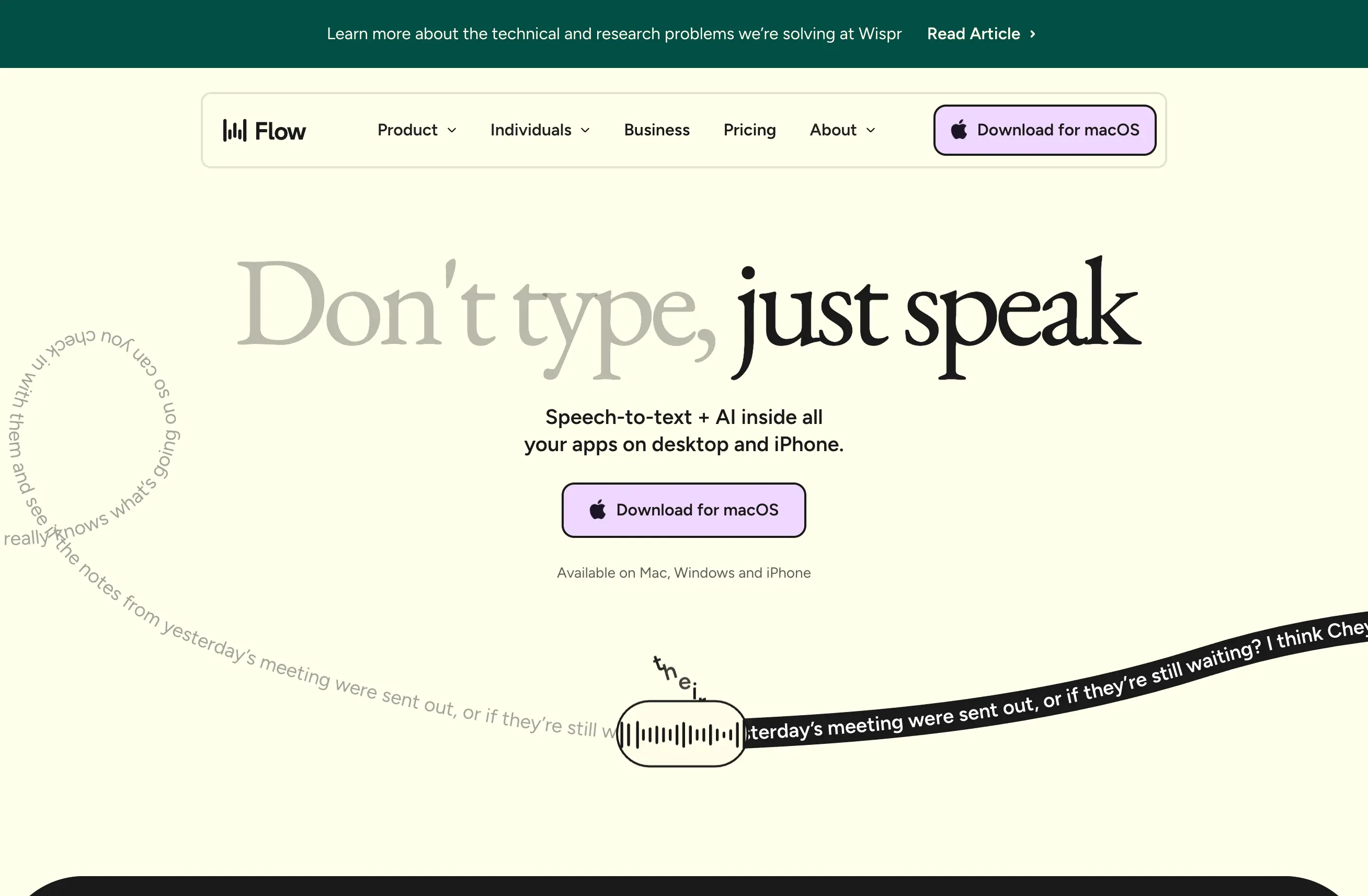
WisprFlow and GitHub Copilot represent different approaches to AI-assisted coding. WisprFlow uses voice recognition to convert speech into code, while Copilot provides AI-powered code completion and suggestions. After using both tools for four months on the same projects, the comparison reveals complementary strengths rather than direct competition.
Here's how these tools perform in real development workflows.
Fundamental Approach Differences
WisprFlow philosophy: You describe what you want to build, and voice recognition converts your speech into syntactically correct code. The AI handles transcription accuracy and code formatting.
GitHub Copilot philosophy: You start typing code, and AI predicts what you want to write next based on context clues and patterns from your codebase.
These approaches solve different problems in the development workflow.
Code Creation Speed Comparison
Test scenario: Building a React user authentication component from scratch
WisprFlow approach:
- Speak the complete component structure, state management, and event handlers
- Time to complete: 8.5 minutes
- Manual corrections needed: 2 minor syntax adjustments
GitHub Copilot approach:
- Type component declaration, Copilot suggests function body
- Accept/reject suggestions iteratively while building component
- Time to complete: 12.3 minutes
- Manual typing required: 40% of total code
WisprFlow shows advantages for initial code creation because you can describe complete functions without stopping to evaluate AI suggestions.
Complex Logic Implementation
Test scenario: Implementing recursive tree traversal algorithm
GitHub Copilot strengths:
- Excellent at suggesting standard algorithm patterns
- Handles edge cases and error conditions automatically
- Provides multiple implementation alternatives via suggestion cycling
WisprFlow challenges:
- Voice description of complex recursive logic requires precise articulation
- Algorithm correctness depends on accuracy of verbal description
- Less effective for mathematical or algorithmic code
Result: Copilot completed the recursive function 35% faster with better edge case handling.
Complex algorithmic work favors Copilot's pattern-matching approach over voice description.
Documentation and Comments
GitHub Copilot documentation:
- Suggests comments based on function names and parameters
- Auto-generates JSDoc blocks and type annotations
- Quality varies depending on code context clarity
WisprFlow documentation:
- Natural speech translates directly into comprehensive documentation
- Explains reasoning and implementation decisions fluidly
- Handles complex explanations that would be awkward to type
/**
 * Processes user authentication by validating credentials against
 * multiple identity providers (OAuth, SAML, local database).
 * Falls back to guest access if all authentication methods fail.
 * Logs authentication attempts for security monitoring.
 * Returns user object with roles and permissions for session management.
 *
 * @param {Object} credentials - User login credentials
 * @param {string} provider - Preferred authentication provider
 * @returns {Promise<User>} Authenticated user object or guest access
 */
That entire documentation block came from voice input describing the function's purpose and behavior. Copilot generates structurally correct JSDoc but with less comprehensive explanations.
Code Review and Refactoring
GitHub Copilot for reviews:
- Suggests improvements when you start modifying existing code
- Good at identifying optimization opportunities
- Limited to code-level suggestions, not architectural changes
WisprFlow for reviews:
- Natural for speaking code review comments and suggestions
- Excellent for explaining refactoring rationale
- Handles complex architectural discussions that would be slow to type
Review comment generation:
"This authentication function violates single responsibility principle by handling both credential validation and session management. Consider extracting session logic into a separate service class. The nested try-catch blocks make error handling unclear—recommend using async/await with explicit error boundaries. Performance concern: database query runs on every authentication attempt without caching."
That review comment came from voice input while reading the code. Much faster than typing detailed feedback.
Learning and Skill Development
GitHub Copilot learning impact:
- Exposes developers to new patterns and libraries
- Risk of over-reliance reducing coding skills
- Excellent for discovering API usage patterns
WisprFlow learning impact:
- Forces developers to articulate code structure clearly
- Improves understanding of what you're actually building
- Maintains active coding skills while increasing speed
Voice coding requires you to understand what you're building well enough to describe it accurately, potentially leading to better code comprehension.
Integration Ecosystem
GitHub Copilot integrations:
- Native support in VS Code, JetBrains IDEs, Neovim
- Works with any language GitHub has training data for
- Integrated with GitHub's entire development ecosystem
WisprFlow integrations:
- IDE plugins for major editors
- Language-agnostic voice recognition
- Focuses on transcription accuracy rather than code intelligence
Copilot wins on breadth of ecosystem integration, especially for GitHub-centric workflows.
Workflow Combination Strategy
The most productive approach combines both tools for different use cases:
Use WisprFlow for:
- Initial component and function creation
- Documentation and comment writing
- Code review discussions and feedback
- Boilerplate generation and configuration files
Use GitHub Copilot for:
- Complex algorithm implementation
- API integration and method discovery
- Error handling and edge case coverage
- Refactoring and optimization suggestions
Example combined workflow:
- Architecture planning: Voice-describe component structure with WisprFlow
- Implementation details: Use Copilot for specific method implementations
- Documentation: Voice-generate comprehensive comments with WisprFlow
- Testing: Copilot suggestions for test cases and assertions
- Code review: Voice-speak review feedback with WisprFlow
This combination uses each tool's strengths while minimizing weaknesses.
Cost and Accessibility
GitHub Copilot pricing:
- Individual: $10/month or $100/year
- Business: $19/user/month
- Enterprise: $39/user/month
WisprFlow pricing:
- Pro: $29/month for unlimited transcription
- Team: $19/user/month for organizations
- Enterprise: Custom pricing with advanced features
WisprFlow costs more but provides different value through voice interface and transcription accuracy.
Physical and Mental Health Impact
GitHub Copilot:
- Reduces total typing volume by 30-40%
- Still requires keyboard interaction for suggestion acceptance
- Minimal impact on repetitive strain injury risk
WisprFlow:
- Eliminates 60-80% of typing for supported tasks
- Reduces wrist and finger strain significantly
- Vocal fatigue becomes limiting factor after 4-6 hours
For developers with repetitive strain injuries or ergonomic concerns, WisprFlow provides greater physical relief.
Bottom Line Recommendations
Choose GitHub Copilot if you:
- Work primarily with algorithmic or mathematical code
- Want IDE integration with minimal workflow changes
- Prefer typing-based development with intelligent assistance
- Work extensively within the GitHub ecosystem
Choose WisprFlow if you:
- Create lots of documentation, comments, and explanatory content
- Have ergonomic concerns or repetitive strain issues
- Prefer describing code structure over iterative typing
- Focus on web development, configuration, and boilerplate generation
Use both tools if you:
- Want maximum productivity across different coding tasks
- Can afford the combined subscription costs
- Value having options for different development scenarios
The tools complement rather than compete with each other.
Try WisprFlow alongside your existing coding tools and see how voice coding enhances your development workflow without replacing other AI assistance.
How each tool turns speech into text
The useful difference is where the text appears and how much work remains afterward.
GitHub Copilot is useful when you want code suggestions built from typed context.
WisprFlow dictates into any app with AI formatting, and it is free to try.

Discussion
Giscus