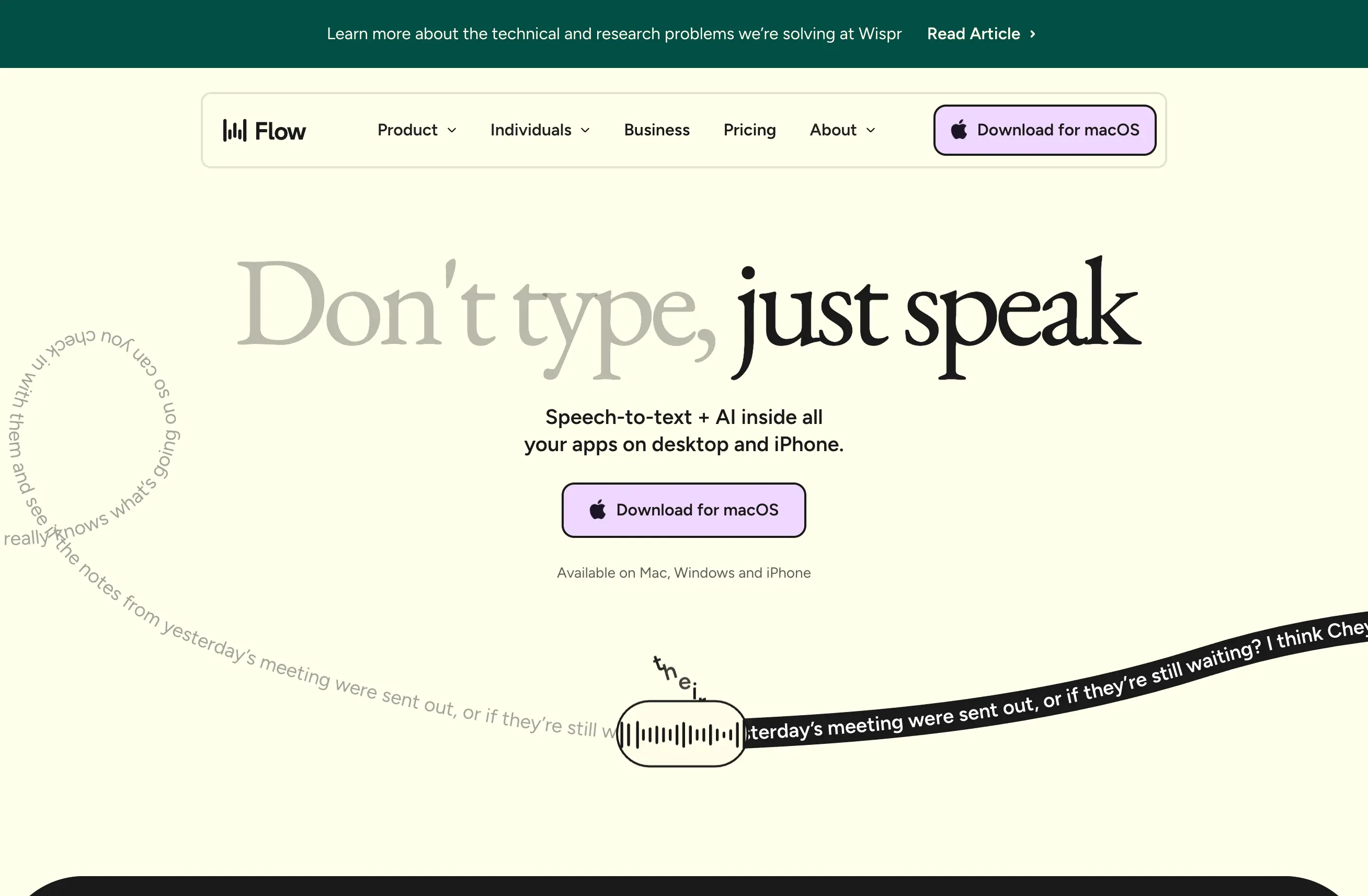
Windows 11 ships with a voice dictation shortcut built in (Win + H). It's free, it works, and for casual use it's not bad. But once you start relying on voice dictation as a primary input method, the gap between Microsoft's built-in tool and WisprFlow becomes obvious quickly.
Here's where that gap actually shows.
What You Get with Microsoft Dictate
Press Win + H anywhere in Windows and a microphone panel appears. Speak and text appears in whatever field is focused. It supports auto-punctuation, voice commands ("delete that," "go to sleep"), and 30+ languages.
It's a capable baseline. For someone who occasionally dictates emails or quick notes, it does the job. Microsoft also integrates dictation directly into Word and Outlook with slightly better accuracy in those apps.
Where WisprFlow Pulls Ahead
Accuracy on Technical Content
Microsoft's dictation stumbles with domain-specific vocabulary. Try dictating code variable names, medical terminology, or legal citations and you'll spend time correcting errors.
WisprFlow's AI model is trained with much broader context awareness. It handles technical jargon, mixed-language input (saying code snippets while explaining in English), and adapts to your vocabulary over time.
Accuracy comparison for technical content:
- WisprFlow: 93–96%
- Microsoft Dictate: 82–87%
That 10-point gap translates to significant correction time across a full workday of dictation.
Cross-Platform Consistency
Microsoft Dictate is Windows-only. If you also work on a Mac or Android device, you're starting over with a different tool, different commands, and different accuracy levels.
WisprFlow runs on Windows, Mac, and Android with consistent behavior, keyboard shortcuts, and vocabulary across all platforms. One subscription, one muscle memory, everywhere.
Custom Vocabulary and Commands
Microsoft Dictate doesn't let you add custom vocabulary. Industry-specific words, client names, product names — if the model doesn't know them, it guesses.
WisprFlow supports custom word lists and lets you create voice shortcuts that expand into longer phrases. Useful for repetitive documentation, email templates, and specialized terminology.
Speed and Latency
Both tools process speech in near-real-time, but WisprFlow's response is faster and more consistent. Microsoft Dictate occasionally hiccups under system load, introducing gaps in transcription that break flow.
WisprFlow's latency stays under 200ms across normal system conditions.
When Microsoft Dictate Is Fine
If you're an occasional dictation user — a few hundred words a day, mostly in Word or Outlook, all on Windows — Microsoft's built-in tool is adequate and free.
It's also worth noting that Microsoft 365 users get enhanced dictation accuracy in Word and Outlook specifically, which narrows the gap in those apps.
Pricing Reality
Microsoft Dictate is free with Windows and Microsoft 365.
WisprFlow Pro runs $10/month. That's $120/year.
The question is whether the accuracy improvement, cross-platform support, and custom vocabulary features are worth $10/month for your workflow. If you're dictating more than an hour a day, the time savings from higher accuracy alone justify it.
The Verdict
Microsoft Dictate is a solid starting point. For light use, it's fine. For heavy dictation workflows — especially technical content, cross-platform work, or mobile dictation — it runs out of capability quickly.
WisprFlow is what happens when a company builds dictation as a primary product rather than a bundled feature. The difference shows in accuracy, consistency, and the willingness to keep improving the model.
Start with Microsoft Dictate if you want to test whether voice input works for you. Upgrade to WisprFlow when you're ready to actually rely on it.
How each tool turns speech into text
The useful difference is where the text appears and how much work remains afterward.
Microsoft Dictate works well for short, literal dictation in a focused text field.
WisprFlow dictates into any app with AI formatting, and it is free to try.

Discussion
Giscus