Mixed-skill on purpose
Engineer + exec + ops + curious. Nobody is the most senior or the most junior at the table. Awkwardness has nowhere to land.
Three practitioners. Half-day to two-day. Up to one hundred leaders shipping with Claude by the end of the session — including the ones who haven't opened a terminal in a decade.
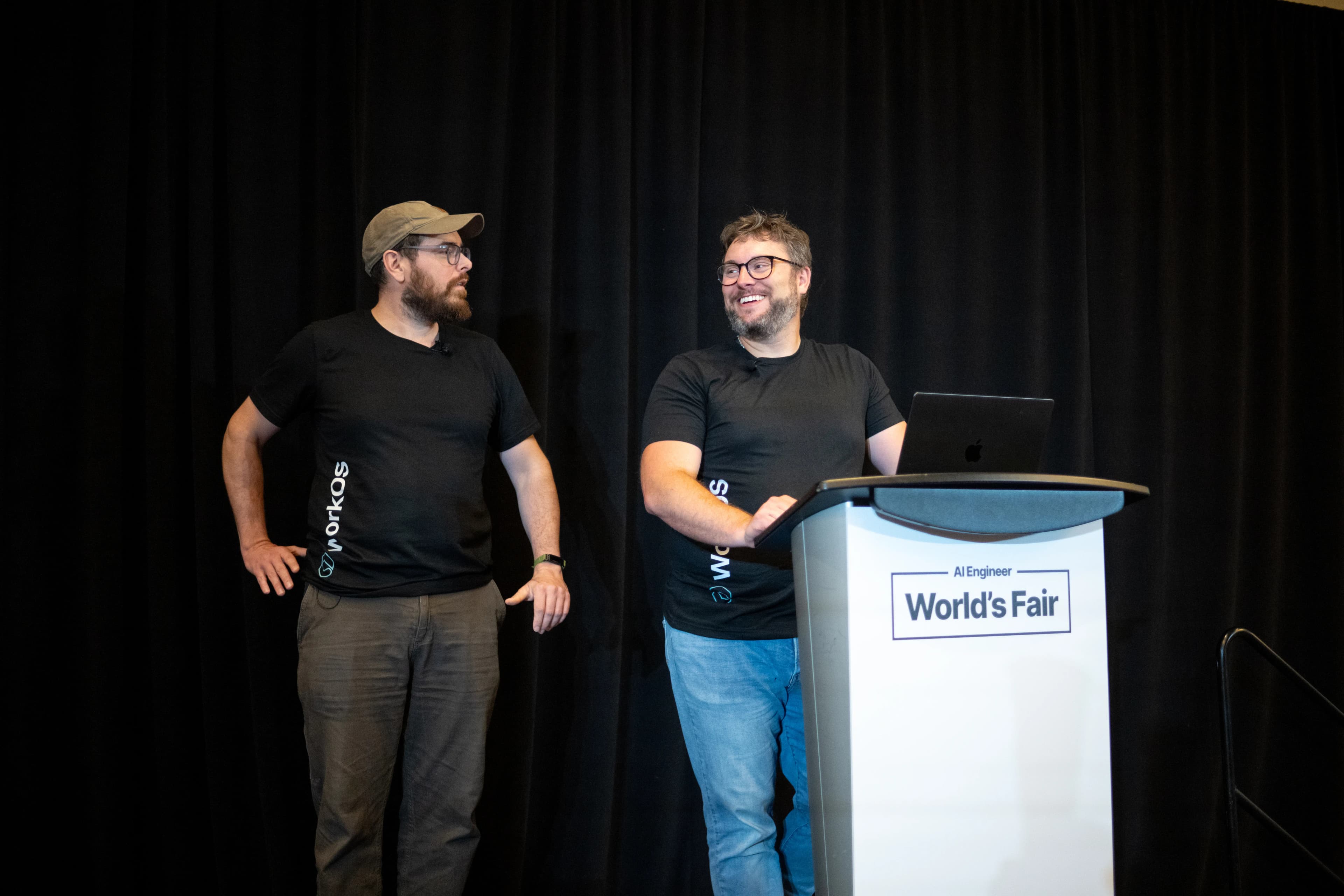
AIE World's Fair · SF · Mastra workshop
The license is bought. The pilots are running. Engineering has been on Claude Code for months. But the rest of the org is either making cool emojis with the chat or quietly waiting for someone else to figure it out — and your CEO is asking what's taking so long.
We've watched the same pattern at every org we've talked to this year. The bottleneck is never the model. It's the change management — the cultural shift from “AI is a thing engineers do” to “AI is how everyone here works.” Speakers don't move that. Office hours don't move that. A room of your peers shipping something together, with practitioners embedded inside the pods, does.
Workshop-shaped, not classroom-shaped. We split your room into pods of four to five, mixed-skill on purpose — exec next to engineer next to ops next to CS. Each pod has a designated keyboard owner; it rotates every fifteen minutes. The practitioners float, embedded — somebody is sitting next to you when you get stuck, not raising your hand on Zoom.
Engineer + exec + ops + curious. Nobody is the most senior or the most junior at the table. Awkwardness has nowhere to land.
You build, watch, build again. No “stand up and demo to the whole room.” The hot seat moves long enough to feel something, short enough that nobody owns the failure.
We float through the pods, embedded. Roughly seven pods per practitioner at full scale, but in practice we go where the action is.
The most expensive thing a workshop can do is burn the first ninety minutes on env setup. We've watched it kill rooms. So we don't.
Laptop image, install script, account checklist. Your IT team runs it; we're on Slack if they get stuck.
We log into three random machines remotely and verify. Never goes clean on the first pass — that's the point.
We arrive 90 min early. Tables labeled. Pods pre-assigned, mixed-skill on purpose.
Recordings posted. Skills merged. Playbook delivered. Sync with your AI lead — we don't disappear.
The single biggest shift for non-engineering leaders is realizing that the wall between “chat with Claude” and “Claude is building software for me” is about thirty minutes of practice. We walk every pod across it. Two-day intensives double up on Phase 03 and Phase 04 — that's where the real organizational compounding happens.
Laptops verified. Whisper Flow, Claude Code, and a pod-shared scratchpad warmed up. We do introductions during the install, not before.
Whisper Flow plus Claude Code in a terminal. We dictate the same task three different ways and watch the pod realize they just typed at 180 WPM without typing. This is the moment the room shifts.
Each pod picks a workflow from their own job. CS picks a triage automation. Marketing picks a competitive teardown. Finance picks a Salesforce report. We unblock, suggest, get out of the way. Working code at the end of the hour — not a demo.
The thing your pod just built becomes a Claude skill — branded, on-policy, in your org's shared repo. Fifteen to forty of these by the time we leave, depending on engagement shape.
Each pod shows their skill. We tag the people who lit up — your internal champions. They go home with a 30-day playbook for keeping the flywheel turning after we're gone.
We've each spent fifteen years learning to type fast. Now we dictate. Nick and I still text each other when something feels strange about that — when we realize we've lost a skill we used to be proud of. We get the whiplash personally. So when your hundredth leader puts their hands on Claude Code for the first time and freezes, we know exactly what they're feeling.
Compassion isn't a posture we put on for the workshop. It's the only reason any of this works. People learn when they feel safe. They feel safe when nobody at the table is going to be ridiculed for what they don't know. The room is calibrated around that, deliberately, top to bottom.
Each pod has an exec, an engineer who's been on Claude Code for months, and a couple of curious neutrals. Nobody is the most senior or the most junior at the table.
You build, you watch, you build again. There is no “stand up and demo to the whole room.” The hot seat moves every fifteen minutes by design.
Every practitioner has personally been bad at Claude in front of someone who was better at it. We remember exactly what it felt like. We lead with that memory.
A workshop that ends when the room empties is worth roughly nothing thirty days later. Every engagement ships a kit your champions can carry forward — built during the session, signed off by you, ready to share on Monday morning. The biggest of these is the tailored playbook, written for your org by name.
A bound and digital playbook written for your org by name. Covers the workflows your pods discovered, the skills they shipped, the rules of your brand and policy, and the specific way your champions should run their first thirty days of office hours. Your team's voice, your team's tools.
Fifteen to forty reusable skills built by the pods during the session, branded with your brand template, scoped to your stack and your policy. Each one solves an actual problem someone in the room has.
By end of day we hand you a labeled list of who lit up, where they sit, and what they shipped. Plus a heatmap of which departments are warm, lukewarm, or about-to-revolt — so your next moves are aimed, not sprayed.
Every plenary recorded, transcribed, and uploaded to a private destination of your choosing. People who couldn't attend get a chaptered, searchable archive — not a four-hour video they'll never watch.
You're not hiring a speaker. You're hiring three full-time builders at companies that use Claude in anger every day. We run workshops as the side of our job that translates what we do daily into something your team can pick up by 5pm.
Every engagement is fixed-scope, fixed-price, held the moment you sign. No hourly. No discovery phase before you can plan a budget. You pick a shape, we hold the date, we ship.
A focused half-day for one team that already has Claude in their hands and wants to compound. Engineering teams who want the Claude Code playbook compressed. AI working groups who want voice coding and skills under their belt by lunch.
The collaboration-week shape. Built for orgs running a top-down Claude rollout — leadership offsite, all-hands programming, “everyone in one room and let’s actually move.” This is where the change management lives.
Two days, full crew, deep. For organizations who want substantively more shipped, more champions identified, more workflows transformed — not just sparked. Day one mirrors the half-day arc; day two doubles down on skills, autonomous task runners, and the org-specific patterns your champions will run with for a quarter.
Once we've run a workshop together and the foundation is in place, some orgs ask us to keep showing up — running monthly champion office hours, reviewing skill PRs, sitting in on quarterly AI strategy. We're selective about retainers: we only take them after a workshop, because that's how we know we can actually move the needle for your team. Monthly, scoped to your scale, starting in the low five figures.
Mention it on the scoping call →Travel for the crew is billed at cost, separately. Venue, catering, and per-diems are on you. We can deliver remote — it's effective at smaller sizes; we'll be straight with you about what changes.
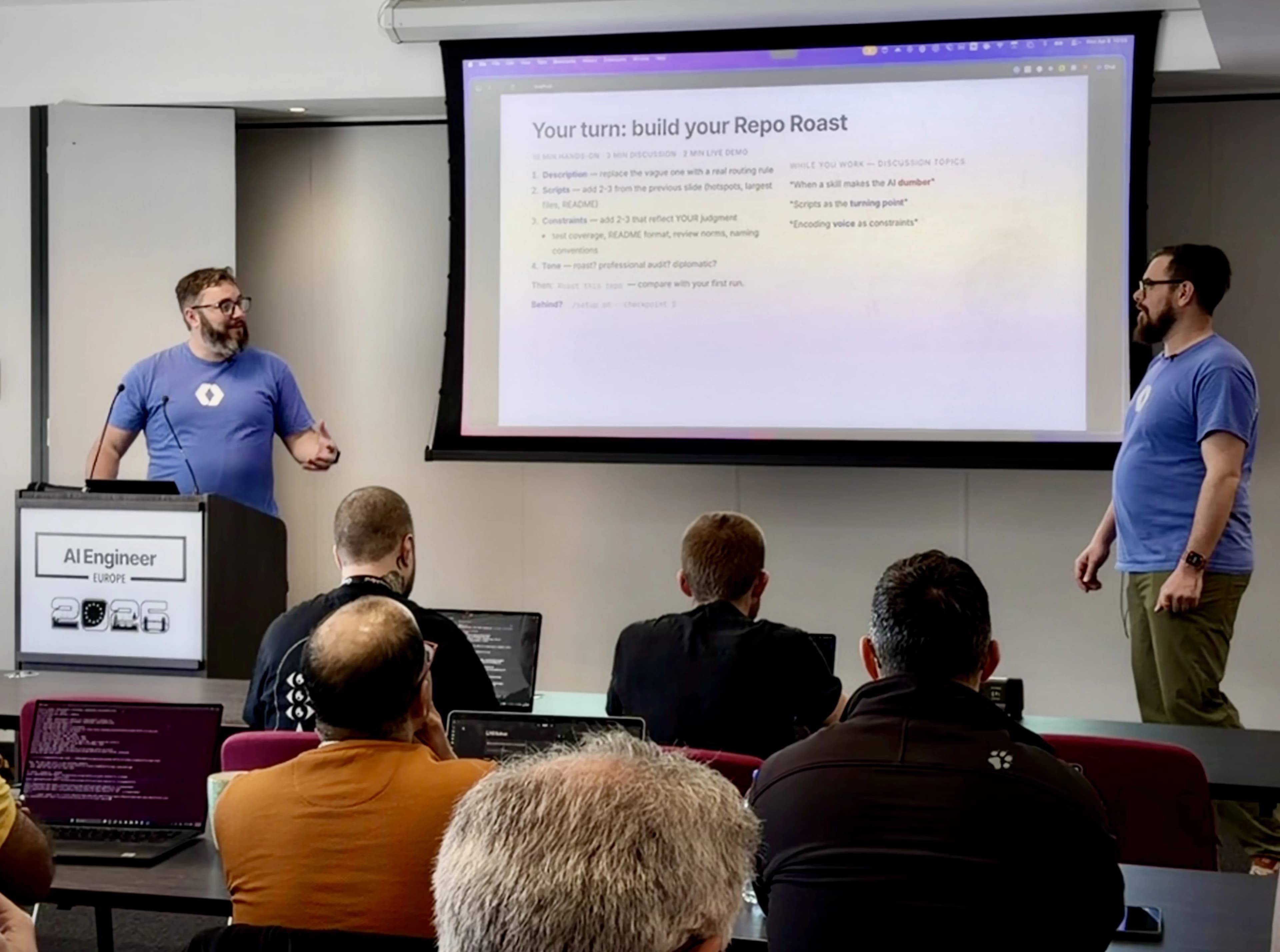
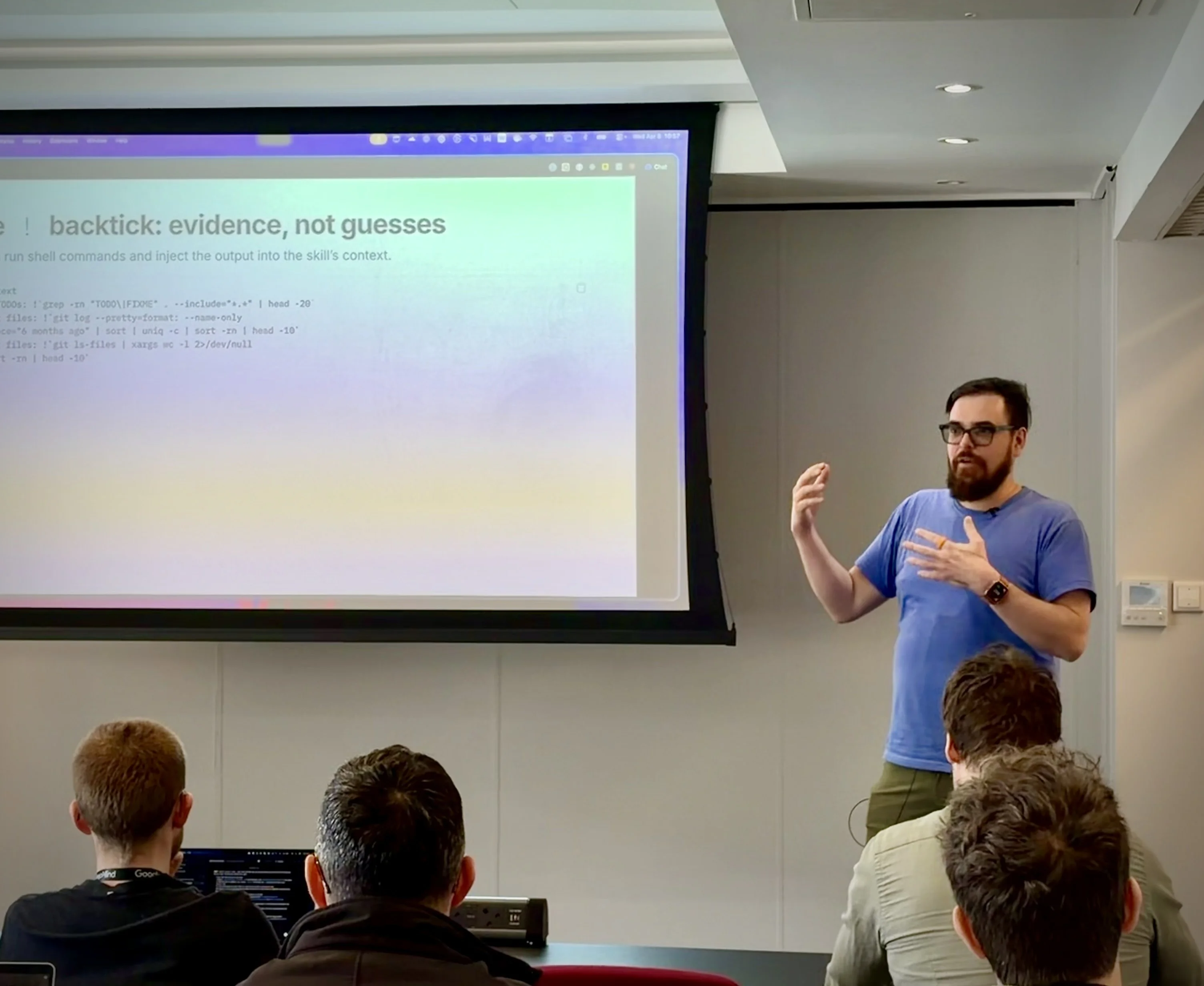
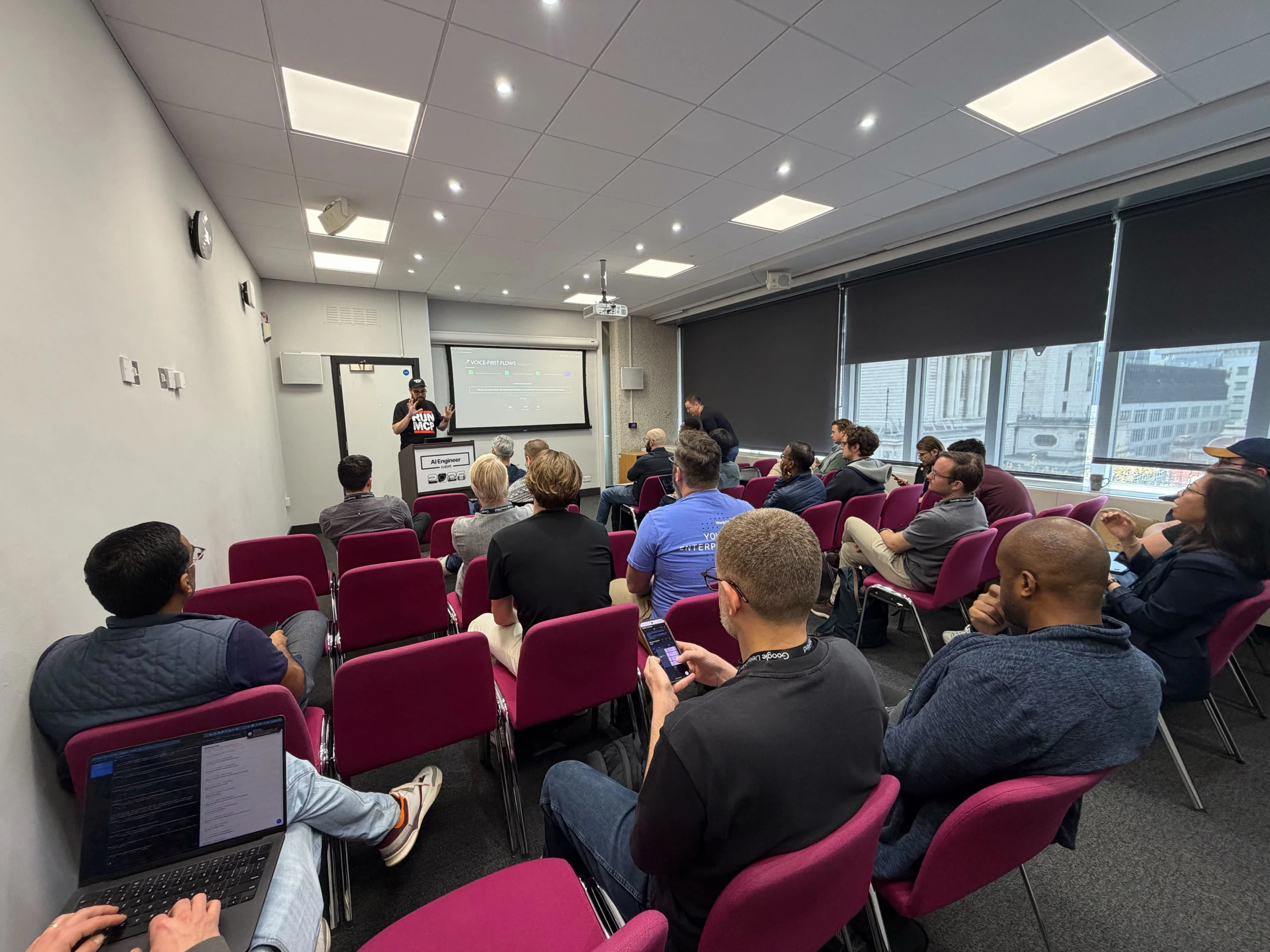
AI Engineer World's Fair · New York & London · WorkOS internal Claude Day · SF
No — and that's not an accident. See § 05 above. Mixed-skill pods, a rotating keyboard, no public coding, no "stand up and demo." The shape of the room makes embarrassment impossible by design, not by hope.
Yes — it's the engagement we run most often. We split the room into roughly twenty pods of 4–5 with one keyboard owner each. The three of us rotate through, embedded — roughly seven pods per practitioner, but in practice we float to where the action is.
We send you a laptop image, install script, and account checklist two weeks before the workshop. Your IT team runs it; we're on Slack if anything breaks. We dry-run three random machines remotely three days before. The sterile pre-flight is non-negotiable for a reason.
They're the engine. We pair them inside mixed pods, where they become the local expert and walk a non-engineer across the chat → code bridge. Most engineers tell us afterward it was the most fun part of their week. If you specifically want engineering-only depth, the half-day single-team shape is the right pick.
If your goal is to spark adoption across the org and identify champions, the half-day is plenty. If your goal is substantive transformation — workflows actually replaced, autonomous task runners shipped, your team operating in a new mode — book the two-day intensive. The collaboration-week shape sits in between.
Yes, but only after we've run a workshop together first. We need to have set a foundation with your team before ongoing work makes sense — otherwise we'd be guessing at where the leverage actually is. Mention it on the scoping call.
Yes, with caveats. The pod mechanic translates to breakout rooms reasonably well; the embedded-practitioner mechanic doesn't translate as cleanly. We discount remote engagements meaningfully, and we'll be straight with you about what changes.
Anthropic teaches the product. We teach what doing the rollout inside an org actually looks like — change management, the bridge from chat to code, the skills layer that turns one person's win into an org-wide habit. We co-hosted with Anthropic in SF in Feb 2026. We're orthogonal, not competitive.
30-minute scoping call. We send you a proposal within 48 hours. We hold the date the moment you sign — typically booked out 6–10 weeks.