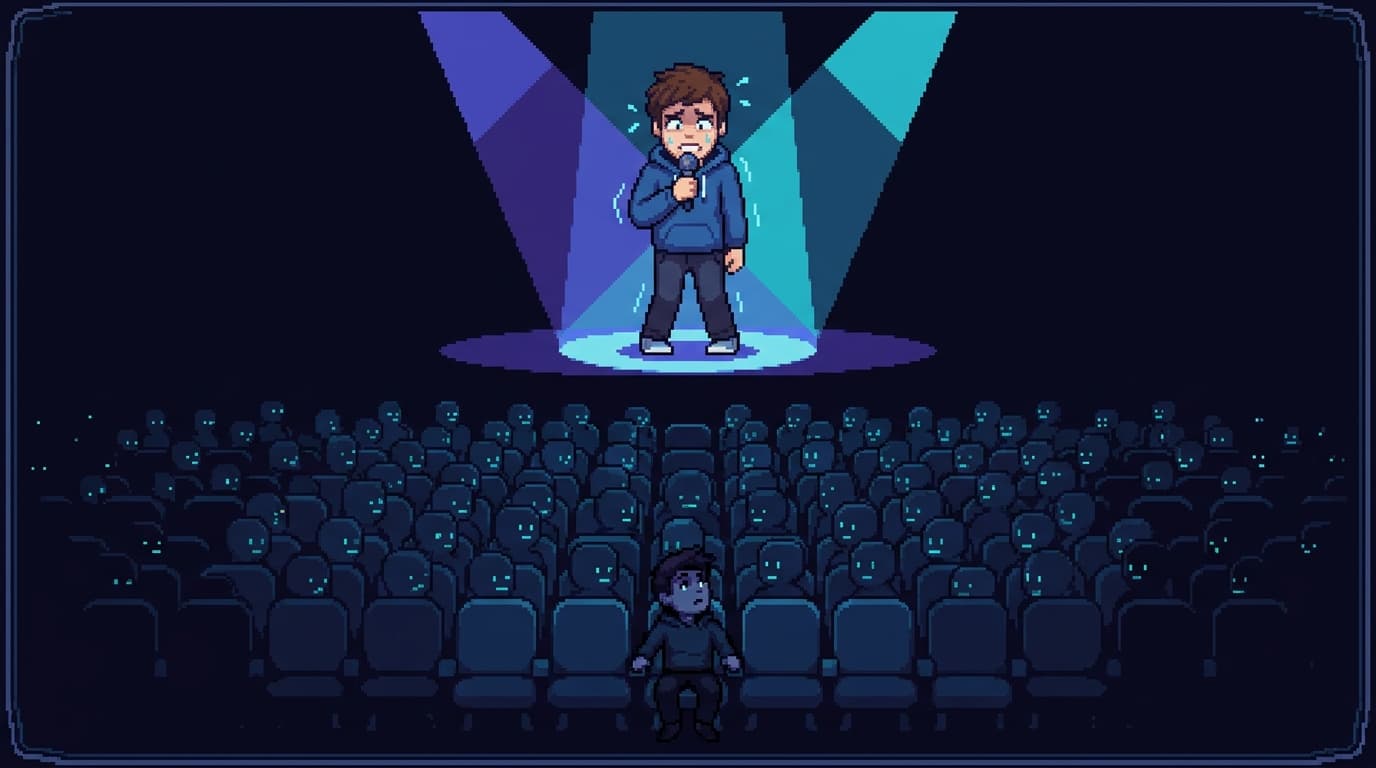
Today, I can honestly say I'm at the point where I can sleep well even before hour-plus live workshops, on-stage talks that I haven't fully finished, and even multi-round days of workshops and talks and interviews in a foreign country on broken sleep and jet lagged.
I did not start here. I started about as badly as it's possible to start.
This post is about everything I have learned about public speaking. It's published here in honor of everyone who still suffers paralyzing anxiety around this topic — which is most people I meet and work with who are not regularly giving talks and speaking publicly. One of the ways my brain works is to constantly sponge up random crumbs of knowledge from diverse sources until it's able to cobble together a working mental model. My hope is that this article helps you skip ahead by collecting the crumbs I've found most helpful, upfront, in one place.
The worst talk I ever gave
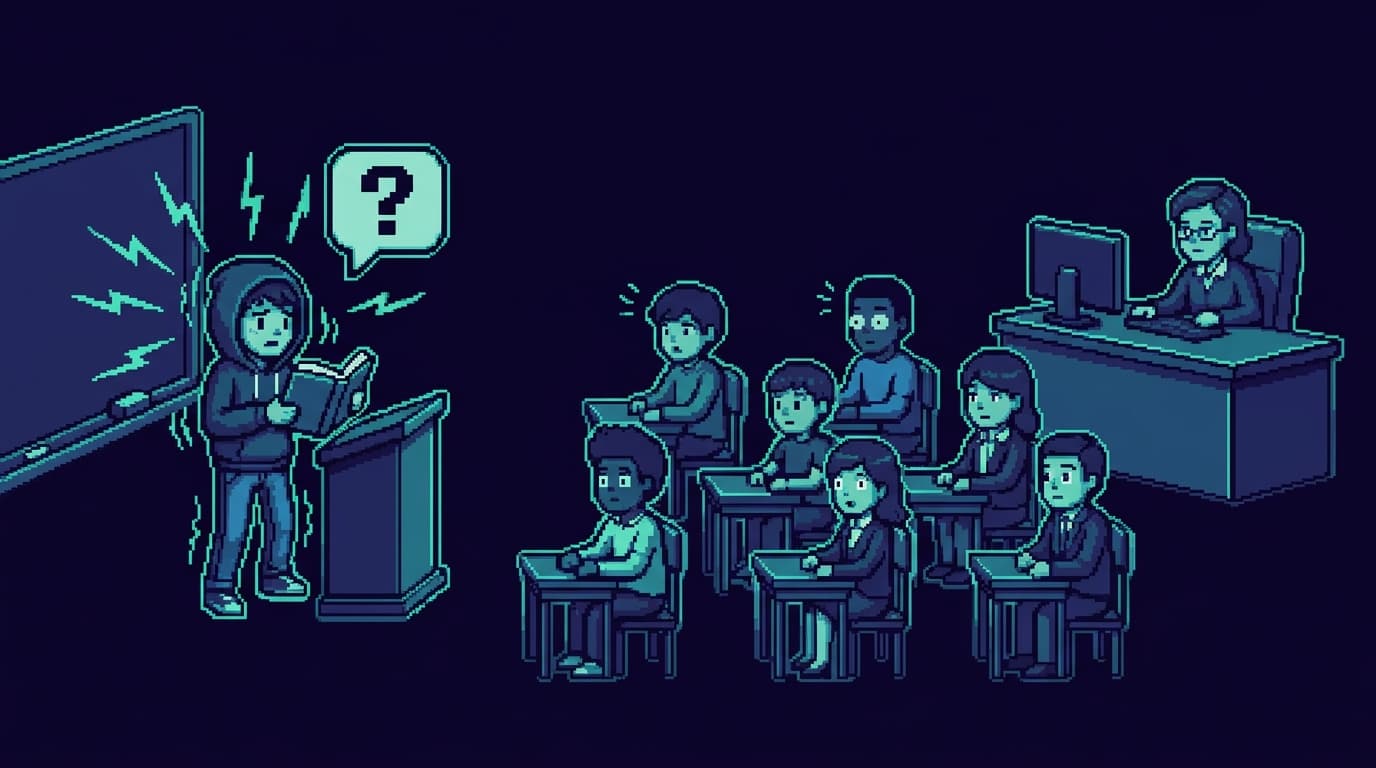
Once at my first startup, in my early 20's, I was asked last minute to prepare a live speech at a gathering of several engineers and tech folks doing a hackathon where our API, BrightContext, was one of the sponsors.
My only public speaking experience by then was the miserable experience we all had in 11th grade doing mandatory presentations about book topics to practice. I remember, like most of my classmates, visibly quaking from the stress while trying to speak coherently about a literary topic while the whole room watched — even though we mostly liked each other and had a good teacher. That was the entire foundation I was building on.
I was juggling a lot of other things, so I whipped together my best first draft of the talk and gave it to my boss, our founder, in our tiny office space in Arlington, VA. He watched with not hidden horror and said, that was super long, and really boring.
Anxiety stage set.
I worked over the draft several times that night and got bad sleep. Even more torturously, my mother — who I was estranged from — decided to show up to this event unannounced, and I clocked her sitting near the front row.
When it was my time to speak, I took the lavalier mic, held it up to my face, made a weird joke about dropping it later that got some chuckles, and then essentially blacked out. I lost all executive function and the ability to speak, heard my own voice catching in my throat which made me more nervous, as 4,000 Microsoft engineers and assorted community members watched on. I barely got the name of our company out, and definitely didn't hit all the key notes about why you should try to use our API, or even what the fuck we did.
It was terrifically awful. And it was capped off by my estranged mother later saying, you did a good job.
I'm telling you this first because I want you to understand the distance. If you're reading this from inside your own version of that hall, throat closing, room spinning — I was there. The gap between that day and now is not talent. It's a pile of crumbs I collected, one at a time, that I'm going to hand you all at once.
Medication: the part most people won't write down

I am the furthest thing from a doctor, in that I am not sworn to first do no harm, and I am not advocating that you blindly accept my experiences as a personal prescription. Talk to an actual physician. This is my experience, not your prescription.
I take propranolol before I need to speak publicly — sometimes even before a large video call, especially at a new company before I am comfortable with everyone, or even on a voice-only remote call with more than one interlocutor when the stakes are higher.
Propranolol is a beta blocker. I first learned about it about two decades ago while reading an article in the newspaper about high-performing concert musicians taking it to steady their nerves. Not ever considering concert musicians the type to regularly get down, I remember finding it interesting that apparently so many took these to steady their body — which allowed their minds to follow.
That is what is most interesting about propranolol. There is no perceptible high, or euphoria, and it is totally possible to continue to feel mental dread, worry, and anxiety before an event when on it — and I regularly still do. What it does do is prevent your body from dumping pure adrenaline into your bloodstream on the regular. It steadies your shaking voice. It essentially blunts the method of action that would normally turn you into a shaky and quaky mess, and then in turn your mind goes, oh, I guess this is okay — and is able to speak like a normal human being.
That is my experience, at least. I can take as little as 20–30 mg for this effect. And lately I'm able to forget right up until before an event, take 20–30 mg late so it's not even fully active yet, and get the same effect from placebo plus the knowledge that my chemical support will arrive.
The thing the BrightContext story taught me, and the thing propranolol made physical, is that the panic starts in the body and recruits the mind. Steady the body and the mind follows. That insight ended up being the spine of everything else I figured out.
You are excited to share this information
I am excited to share this information and this knowledge.
Many people say it, and it's true in my experience: speaking publicly, especially about your work or learnings, is one of the fastest ways to move your title, your compensation, and your overall influence. I have experienced this myself as a reluctant public speaker.
One of the mental tricks I got from Daniel Miessler was essentially this: consider that you are in fact excited to share this information with other people. It is a nice grounding way to remember that you're not being asked to sacrifice your organs in public without anesthesia — which is what your brain often tells your body in terms of perceived threat level. You are instead helping and educating your peers and colleagues and people you don't even know with information that you have come to learn from experience and that they are likely to find valuable and informative, or at least interesting.
I am constantly shocked to see people say that my talk was inspiring, helpful, one of the best talks they saw on X event or topic. But it now happens regularly. I say this to share that if you continuously deal with the anxiety, find your own patterns to work through it and manage it, and give the talk, do the workshop, join the panel, join the conference call, do the webinar — the effects will compound faster than you expect. Even if your first couple of forays are shitty. And they likely will be. No, that's not a sufficiently good reason to stop.
Learn all the rules and then forget them

Learn all the rules and then forget them. For public speaking, that translates to: practice the slides and refine them while dry-running your talk alone, or to one trusted friend or colleague — about a maximum of seven times before the event.
Do not rehearse word for word, or try to memorize your speech word for word.
I used to use speaker notes in Keynote and other programs to give me the confidence that if I blanked I could reach for the notes. But these days — even though I am older and more likely to forget one or two things here or there, especially when under stress — I do not write or use speaker notes at all.
You want to go in knowing the milestones of your talk or workshop, and roughly the key points you want to make in each section, or the anecdote you want to share. But paradoxically, being fluid and loose and under-prepped consistently leads to my best performances. The most engaging talks, where most of the room is holding up their camera and recording or taking photos even though the materials are available elsewhere or online, and where I end up feeling the most comfortable and able to riff in the moment — about material that I know well but have not memorized word for word.
Your mileage may vary, but I see this same advice again and again from practiced speakers. The memorized talk fails the instant one word slips, because there's nothing underneath it. The known talk can take a hit — a dead clicker, a heckle, a fire alarm — and keep walking, because you're navigating by milestones, not by a script.
This is not the last time I'm going to give this talk

This is not the last time I'm going to give this talk.
Another nugget stolen from Daniel Miessler. It is one iteration of many in the lifetime of this talk or talk track, and I'm excited to just do this one rep — which does not need to be perfect — because it's as much about me putting it out there to learn what resonated and what to tweak or tune next time. It is not my final judgment day as a human being who must speak perfectly and encapsulate all the things without error, or be thrown into the volcano.
This is just one iteration, one loop, in the lifetime of this talk.
Hold both of these at once — it doesn't need to be perfect and this is just one rep — and the stakes deflate to their actual size. The volcano was never real. There was always just the next rep.
Strong slides and animations help me

Strong slides and animations help me.
I like to have Claude build them according to my brain dump and a few contextual sources, as animated HTML on a Cloudflare Worker. This means the URL is public — so it survives machine deaths and can be run on any compatriot's machine when yours inevitably fails in a London conference room. And it means the slides are already live and shareable when people ask you for the slides from your awesome talk.
More importantly, it means that you have bandwidth to scale up or down as you're talking. If you need to fill some time and vamp, you step over and point out the animations and what they're showing — diagrams, charts and graphs, things that move in a loop are all ideal. If you need to tighten up because you're low on time, you just hit your key points as the audience takes in your animated visual presentation, and you target the folks in the room who learn verbally and those who are more visual in one swoop.
This is the same instinct I wrote about in The Interface Matters Most — the surface a person actually touches does most of the persuading. On stage, the slide is the interface, and a live, animated one buys you slack in both directions.
If you want the longer version of how I think about running a room full of engineers, I put most of it in the conference workshop playbook and the recap of my Untethered Productivity talk at AI Engineering London.
Put your talks online immediately
Put your talks online immediately.
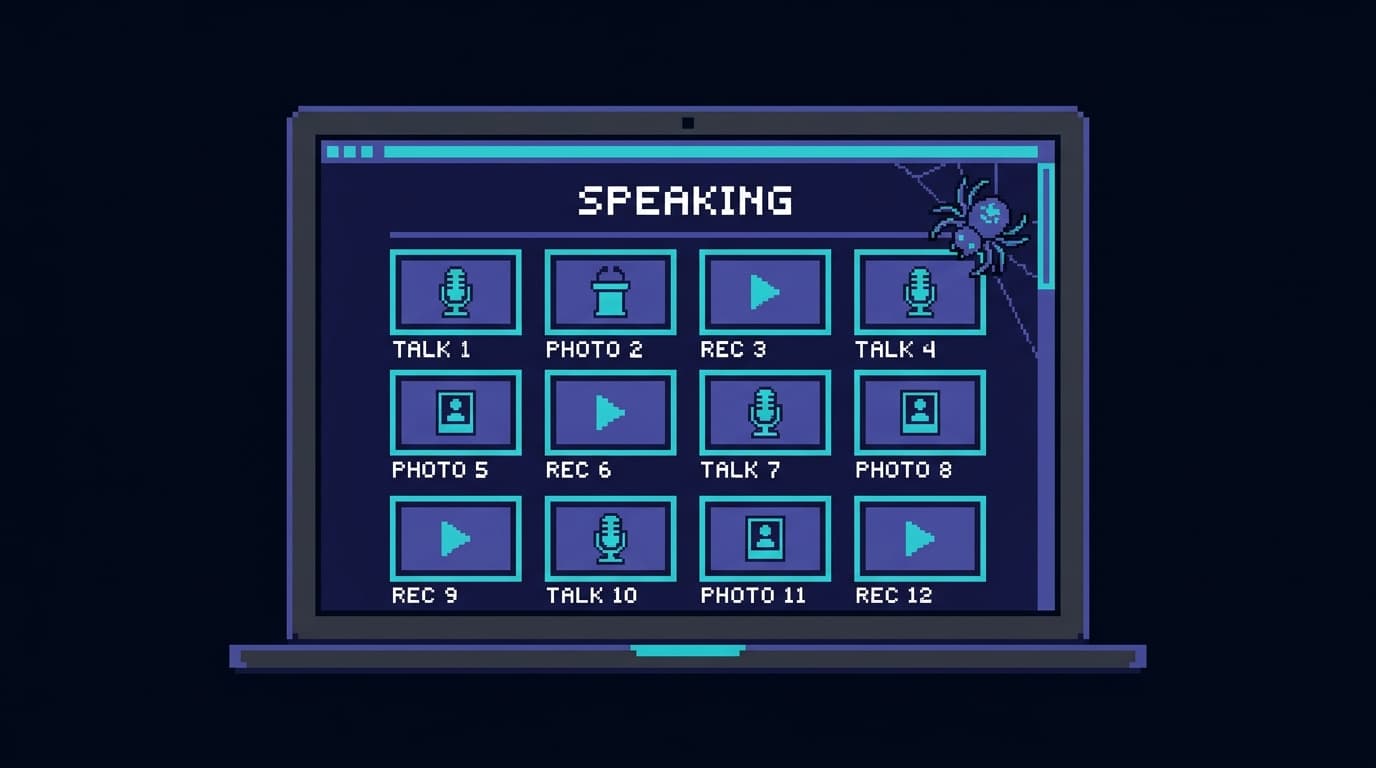
Build a page on your site just for speaking. Run Granola or similar on talk day, and feed it into your favorite agent to get your talk — and the eventual photos and recordings — onto a separate page that can be found and crawled by search engines, so that you can be found as an expert on that thing.
This is incredibly important and not enough people do it. But all my colleagues at WorkOS who are serious operators do it religiously, usually before the flight home. And I do too. Now I get offers to speak at conferences that I can't always say yes to, and some other very interesting opportunities — like doing keynotes that eventually produce assets I'm proud of and able to point to for years.
The mechanics are boring and that's the point: Granola sits quietly in the meeting or the green room and gives you a clean transcript without you babysitting a recorder, the agent turns that transcript into a draft page, you drop in the photos and the eventual video, and you ship it. The compounding only starts once the artifact is public and crawlable. A talk that lives only in the room it was given in may as well not have happened.
There is a number of reps at which the suffering lessens

There is a number of reps at which the suffering lessens.
If you cannot stand the sight of yourself at the podium, or your own voice, then record yourself at home giving the talk again and again and again, and force yourself to watch it. It only hurts the first 1,000 times. Then eventually you'll have other people doing it for you, and find your video or talk blowing up on YouTube enough to attract 75% grateful like-minded folks who got it and said it was great — and 25% of people who live in their moms' basements, are secretly grumpy that you're being asked to speak and they're not, but are not emotionally mature enough to admit that to themselves, or the fact that it's a big part of the reason they can't get laid.
That ratio, by the way, is a sign you've arrived. Nobody heckles the talk nobody watched.
Where this leaves you
I'm not a naturally gifted speaker. I'm a guy who blacked out holding a lavalier mic in front of 4,000 people with his estranged mother in the front row, and then collected crumbs for fifteen years until the panic shrank to something I sleep through.
Here's the whole pile, in order:
- Steady the body and the mind follows. For me that's propranolol — your version might be something else, and you should talk to a doctor about it.
- You are excited to share this. You're educating people, not having your organs removed in public.
- Learn the rules, then forget them. Know your milestones, not your script. Seven dry runs, no memorization, no notes.
- This is not the last time you'll give this talk. One rep. It doesn't need to be perfect.
- Build live, shareable, animated slides so you can vamp or tighten on the fly.
- Put every talk online immediately so the work compounds and you get found.
- Do the reps. The suffering has a number, and you can reach it.
If you continuously deal with the anxiety, find your own patterns, and actually give the talk — the effects compound faster than you expect. Your first couple will probably be shitty. That's not a reason to stop. That's the price of admission.

Discussion
Giscus