
In Security Operations Centers (SOCs), every second counts during incident response. Security analysts juggle multiple monitors, real-time alerts, and complex investigation workflows while maintaining detailed documentation for compliance and knowledge sharing.
Voice AI tools now enable analysts to capture comprehensive incident documentation without taking focus away from threat detection and response activities. This guide covers practical voice solutions for cybersecurity workflows.
Granola clinical boundary
Do not use Granola to capture patient or therapy sessions; this guide does not recommend Granola for clinical capture. Granola documents HIPAA support for Enterprise customers with HIPAA enabled and a signed Business Associate Agreement (BAA). Its security FAQs limit current BAA coverage to desktop and laptop apps. Free, Personal, and Business accounts must not store or process protected health information (PHI). Consent alone does not change these account restrictions. An Enterprise deployment needs separate organizational review; the ordinary referral evaluation here remains limited to approved non-clinical meetings with no PHI. Its security FAQs, transcription documentation, and security overview describe cloud transcription and AI processing, not local-only operation. Consider only an explicitly approved non-clinical meeting with no PHI.
The Tools
WisprFlow for Incident Documentation

WisprFlow revolutionizes security documentation by enabling hands-free incident logging directly into SIEM consoles, ticketing systems, and threat intelligence platforms while maintaining focus on security monitoring dashboards.
Why Security Analysts Choose WisprFlow
SIEM integration: Works with Splunk, QRadar, ArcSight, and any web-based security platform. If you can type incident notes in it, you can dictate into it.
Cybersecurity vocabulary: Recognizes complex technical terminology including IOCs, TTPs, CVE numbers, and attack vectors. From "lateral movement" to "command and control infrastructure," accuracy is consistently high.
Real-time documentation: Capture incident details as they unfold rather than reconstructing timelines hours later when memory fades and urgency passes.
SOC-Specific Applications
- Incident response: Document attack vectors, affected systems, and containment actions while actively investigating threats
- Alert triage: Voice-enable initial assessment notes, false positive classifications, and escalation decisions
- Threat hunting: Capture hypothesis, investigation steps, and findings during proactive threat hunting sessions
- Vulnerability assessments: Document findings, risk ratings, and remediation recommendations efficiently
- Forensic analysis: Record timeline reconstruction, evidence collection, and technical analysis findings
- Shift handoffs: Create detailed handoff notes for 24/7 SOC operations without typing delays
Real-World SOC Workflow
During an active breach investigation, an analyst can dictate: "Lateral movement detected from compromised host 192.168.1.45 to domain controller. PowerShell execution with suspicious base64 payload. Isolated affected systems at 14:23 UTC. Initiated memory dump collection. Contacting IR team for advanced malware analysis."
This level of technical detail, captured without looking away from the investigation, ensures comprehensive incident documentation for forensics and legal requirements.
Granola for Security Team Communications
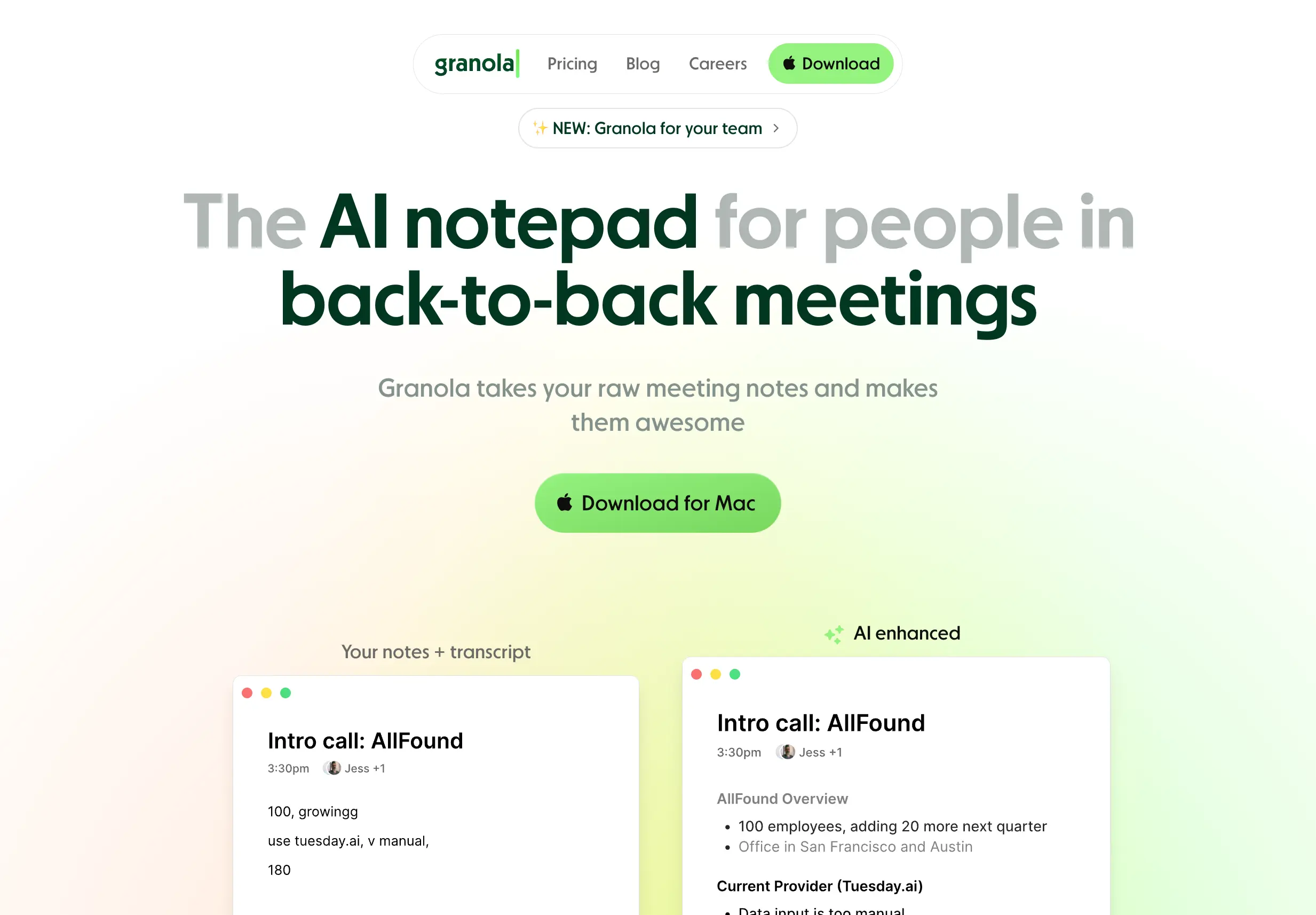
Granola captures security briefings, incident response calls, and team discussions without visible recording equipment, ensuring sensitive security communications are properly documented.
Applications in Security Operations
Incident response calls: Document emergency response coordination, stakeholder communications, and decision-making processes during active incidents
Threat briefings: Capture intelligence updates, new IOC distributions, and threat landscape discussions automatically
Post-incident reviews: Record lessons learned sessions, process improvements, and technical deep dives
Vendor security calls: Document security tool evaluations, threat intelligence briefings, and compliance discussions
Executive security updates: Capture high-level security posture discussions and resource allocation decisions
Compliance and Audit Benefits
Many security frameworks require detailed documentation of security processes and incident response activities. Granola ensures no critical details are missed during high-stress security events.
Integration with Security Platforms
SIEM Platforms
Splunk: WisprFlow works seamlessly with Splunk's investigation workflows, allowing voice dictation into notable events, case notes, and search comments
IBM QRadar: Full compatibility with QRadar's offense management, allowing voice documentation of investigation findings and response actions
ArcSight ESM: Voice dictation integrates with case management, active channels, and investigation workspaces
Chronicle Security: Compatible with Chronicle's investigation tools and case documentation features
Security Orchestration Platforms
- Phantom/SOAR: Voice notes work with playbook documentation and case management
- Demisto/Cortex XSOAR: Integrate voice documentation with incident workflows and response playbooks
- Swimlane: Voice-enable case documentation and process improvement notes
Ticketing and Case Management
- ServiceNow Security Incident Response: Voice dictation works with security incident records and knowledge articles
- Jira Service Management: Document security requests, vulnerability management, and compliance tracking
- TheHive: Open-source incident response platform compatibility with case documentation
Operational Efficiency Metrics
Documentation Speed Analysis
| Activity Type | Manual Documentation | With Voice AI | Time Saved |
|---|---|---|---|
| Initial incident triage | 8 min | 3 min | 5 min |
| Detailed investigation report | 25 min | 10 min | 15 min |
| Threat hunting summary | 15 min | 6 min | 9 min |
| Post-incident report | 45 min | 20 min | 25 min |
| Shift handoff notes | 10 min | 4 min | 6 min |
For analysts handling 20-30 incidents daily, voice AI can save 2-3 hours of documentation time, allowing more focus on actual threat detection and response.
Quality Improvements
- Enhanced detail: Voice allows for more comprehensive incident documentation while maintaining investigation speed
- Improved accuracy: Eyes stay on security dashboards rather than switching between screens and keyboards
- Better timeline accuracy: Real-time voice notes capture exact timing of security events and response actions
- Reduced burnout: Less repetitive typing during high-stress incident response situations
Advanced Security Use Cases
Threat Intelligence Documentation
Capture analysis of new threats, malware families, and attack techniques:
- Document IOC analysis and attribution research
- Record threat landscape trends and emerging techniques
- Capture intelligence source evaluation and reliability assessments
Red Team Exercises
Document offensive security testing:
- Record attack path documentation and technique effectiveness
- Capture defensive response observations and recommendations
- Document exercise lessons learned and security control effectiveness
Compliance Documentation
Maintain audit trails for security frameworks:
- SOC 2 compliance documentation and control testing
- PCI DSS security assessment findings and remediation
- NIST Cybersecurity Framework implementation documentation
Vulnerability Management
Efficient vulnerability documentation workflow:
- Risk assessment rationale and business impact analysis
- Remediation timeline documentation and stakeholder communication
- Vulnerability disclosure coordination and vendor interaction
Security and Privacy Considerations
Sensitive Data Protection
Classification awareness: Voice tools should be configured to recognize and protect classified security information
Encryption requirements: Both WisprFlow and Granola use enterprise-grade encryption suitable for sensitive security operations
Access controls: Implement proper access controls and logging for voice documentation tools in security environments
Data retention: Configure retention policies that align with security incident documentation requirements
Compliance Integration
- SOX compliance: Voice documentation supports financial fraud investigation documentation requirements
- GDPR compliance: Proper configuration for privacy incident response and breach notification documentation Do not capture health histories, patient information, or PHI with Granola. Use an approved system for sensitive records.
- Industry-specific requirements: Banking, energy, and critical infrastructure security documentation needs
Related Resources
Explore other security and technical voice AI applications:
- Voice Tools for IT Professionals - Technical documentation workflows
- AI Tools for Consultants - Professional services efficiency
- Voice AI for Business - Enterprise productivity applications
- Technical Writing Voice Tools - Documentation and reporting
Getting Started in Your SOC
- For incident documentation: Try WisprFlow - Start with low-priority incidents to build security vocabulary
- For team communications: Try Granola - Perfect for briefings and post-incident reviews
WisprFlow offers a free trial, while new Granola users get three months free to assess its security features in their operations environment.
Frequently Asked Questions
Is this secure enough for classified security operations?
Both tools offer enterprise security features, but organizations handling classified information should conduct security assessments and may require on-premises deployment options.
Will this work in a 24/7 SOC environment?
Voice recognition adapts to different analysts' speech patterns and works effectively during night shifts. Background noise filtering handles typical SOC environment sounds.
What about integration with security automation tools?
WisprFlow integrates with any platform that accepts text input, including SOAR platforms, custom security dashboards, and automation frameworks.
Can junior analysts use these tools effectively?
Voice documentation often helps junior analysts create more comprehensive incident reports by allowing them to narrate their investigation process in real-time.
How does this help with security certifications?
Detailed voice documentation of security processes and incident handling provides excellent evidence for CISSP, GCIH, and other certification requirements that emphasize practical experience.
Effective cybersecurity requires both rapid response and meticulous documentation. Voice AI tools ensure analysts can maintain comprehensive records without compromising their ability to detect and respond to evolving threats.
How each tool turns speech into text
The useful difference is where the text appears and how much work remains afterward.
Traditional typing stays precise and familiar for short edits.
WisprFlow dictates into any app with AI formatting, and it is free to try.

Discussion
Giscus