
Granola is not currently a HIPAA-compliant medical transcription service. Granola says it cannot sign a Business Associate Agreement, so healthcare teams should not use it to capture patient consultations, telehealth visits, clinical handoffs, or any other meeting that contains protected health information.
That answer is less exciting than a list of AI features, but it is the useful answer for someone choosing a healthcare documentation tool.
If your approved use is explicitly non-clinical and excludes PHI, review Granola only for that narrow meeting set. It is not a path around the HIPAA boundary above.
Granola is a general meeting note-taker
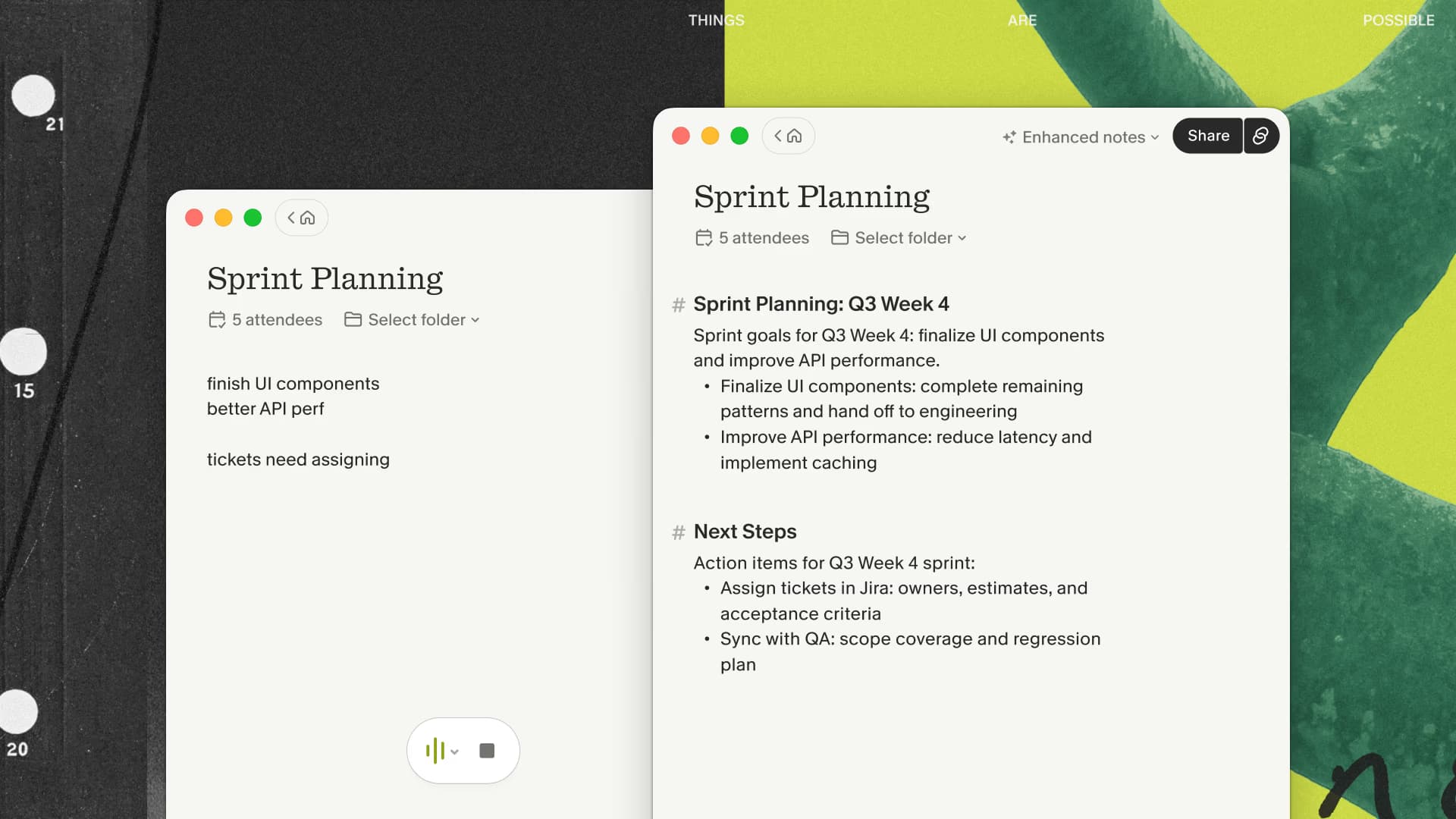
Granola's desktop app captures microphone and system audio, sends it to cloud transcription providers, and uses cloud AI providers to create enhanced notes. It stores transcripts and notes in US-hosted AWS infrastructure. The product is designed for ordinary meetings, not clinical dictation, EHR documentation, coding, or medical-quality assurance.
A medical transcription system usually needs controls and contracts for protected health information, defined retention, access auditing, role-specific permissions, clinical vocabulary, review workflows, and integration with the health record. A general AI meeting assistant should not be treated as a substitute.
Where Granola should not be used today
Do not use Granola for:
- patient visits or telehealth sessions;
- case conferences that identify patients;
- clinical handoffs;
- psychotherapy or counseling sessions;
- dictating charts, assessments, or treatment plans;
- conversations containing insurance, diagnosis, medication, or laboratory information;
- meetings where incidental PHI is likely to appear.
Removing a patient's name may not be enough to de-identify health information. Ask your privacy or compliance team to decide what qualifies as PHI in your workflow.
Possible non-clinical uses
A healthcare organization may still consider Granola for low-risk administrative meetings that contain no PHI, such as a public marketing discussion or a software-project standup. That use should be explicitly approved and separated from clinical workflows.
Before any pilot, define:
- The exact meeting categories allowed.
- The data that participants may discuss.
- A process for stopping transcription if PHI enters the conversation.
- The approved retention and sharing settings.
- The person responsible for reviewing incidents.
If the rule is hard to follow during a natural conversation, choose a different tool or do not transcribe the meeting.
If compliance approves a stable non-clinical category, test Granola on one low-risk administrative meeting and stop immediately if the conversation crosses the approved boundary.
What to require from a medical transcription vendor
For clinical or patient-facing use, ask prospective vendors for evidence rather than relying on a feature page:
- a signed BAA that covers the intended service;
- a current security and subprocessor package;
- documented PHI handling and deletion behavior;
- access controls and audit logs appropriate to your organization;
- supported EHR or documentation workflow;
- clinical review and correction procedures;
- clear boundaries for model training and secondary data use;
- incident-response and breach-notification commitments;
- accuracy evaluation using your specialties, accents, and terminology.
HIPAA eligibility is the beginning of a review. The organization still needs a lawful, safe workflow and human review of generated documentation.
Consent still matters outside HIPAA
Meeting transcription can be subject to communications, privacy, employment, and professional rules even when PHI is absent. Tell participants what service will process the conversation, why notes are being created, who will receive them, and how long they will be kept. Obtain the consent your legal team requires.
Bot-free capture does not make the transcription invisible from a compliance perspective. Granola places responsibility for consent on the user.
Recheck the contract, not an old article
Vendor status can change. If Granola later announces HIPAA support, confirm it through the current contract and Trust Center before changing your policy. Verify that a BAA is available for your exact plan, that every relevant subprocessor is covered, and that retention, deletion, access, and incident terms match the intended clinical workflow.
An announcement or security certification alone is insufficient. The signed agreement and approved configuration govern the deployment.
My recommendation
Do not use Granola as a medical transcription product or for meetings containing PHI under its current documented terms. Consider it only for a narrowly approved non-clinical workflow where sensitive health information is excluded.
For that approved use only, use the three-month Granola offer for a controlled pilot rather than expanding it into patient-facing work.

Discussion
Giscus