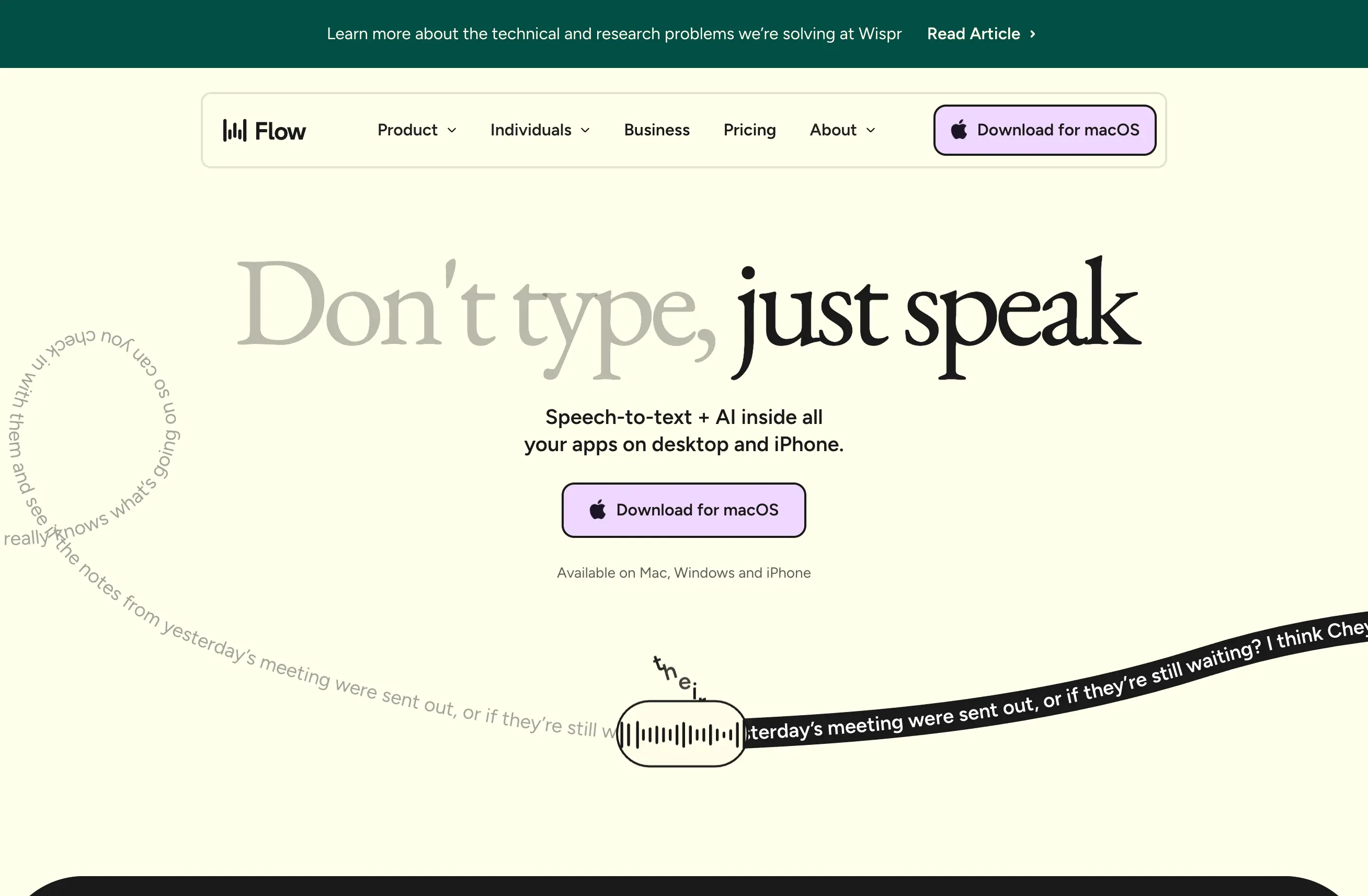
WisprFlow's Android release in February 2026 fundamentally changed where and how I write code. Last week, I fixed a critical production bug while walking my dog. Three months ago, I shipped a major feature update from 30,000 feet on a cross-country flight.
Mobile voice coding opens entirely new ways to think about software development. When your most productive coding environment fits in your pocket, everything changes.
Beyond Desktop Development Constraints
Traditional development chains you to specific environments: your desk, your mechanical keyboard, your multiple monitors. Android voice coding breaks those constraints completely.
Real scenarios where mobile voice coding wins:
- Airport delays: Instead of losing 3 hours to flight delays, I use the time to implement feature requests
- Commute coding: Voice coding during train rides or passenger seat time
- Walking meetings: Debug issues while discussing solutions with teammates on walking calls
- Hotel coding: No need to pack keyboards or worry about terrible hotel WiFi - your phone's hotspot is enough
- Coffee shop productivity: Skip the laptop battery anxiety and cramped tables
Android-Specific Advantages
Native Speech Recognition
Android's built-in speech recognition is optimized for mobile hardware and network conditions. WisprFlow uses these native capabilities for reliable voice-to-code translation even on cellular connections.
The system understands coding terminology naturally. Technical terms like "async await," "try catch," and "forEach" are recognized accurately without training custom dictionaries.
Offline Capability
Unlike desktop voice coding that relies on cloud processing, WisprFlow on Android includes local processing for core voice commands. You can write basic functions and fix bugs even without internet connectivity.
This is crucial for mobile developers who work in areas with spotty coverage or need to preserve battery by minimizing cloud API calls.
Touch + Voice Hybrid
Mobile development benefits from combining touch navigation with voice input. Quickly scroll to the right function with touch, then speak your changes directly into the code.
The hybrid approach is faster than pure voice or pure touch. Use touch for navigation and selection, voice for creation and editing.
Mobile Development Workflows
Emergency Bug Fixes
Production issues don't wait for you to get back to your desk. With Android voice coding, you can:
- Investigate: Use your phone to access logs and monitoring dashboards
- Code the fix: Speak the solution directly into your repository
- Test: Use mobile browser testing or staging environment checks
- Deploy: Trigger CI/CD pipelines from mobile interfaces
I've resolved customer-facing issues in under 10 minutes using only my phone and voice commands.
Feature Development On-The-Go
Inspiration strikes at weird times. When you're walking and suddenly understand how to solve a complex architecture problem, you can speak the solution immediately instead of trying to remember it later.
The best code often comes during diffuse thinking - walking, exercising, or traveling. Android voice coding captures those insights in real-time instead of losing them to distraction.
Client Demos and Prototyping
Client meetings become interactive development sessions. When stakeholders describe a feature request, you can prototype it live during the conversation.
"So you want the user dashboard to show real-time status updates?" → Speak the WebSocket implementation directly into the codebase while discussing requirements. By the end of the meeting, you have working code instead of just notes.
Performance on Mobile Hardware
Battery efficiency: Voice processing is surprisingly battery-efficient compared to intensive typing on touchscreens. Most of the heavy lifting happens server-side, so your phone acts more like a microphone than a processing unit.
Network optimization: WisprFlow compresses voice data for mobile networks. Even on slower connections, voice commands sync faster than traditional file uploads from desktop editors.
Storage requirements: The Android app is lightweight compared to full desktop IDEs. No need for gigabytes of extensions and language servers - just the core voice-to-code engine.
Integration with Mobile Development Tools
GitHub Mobile
Perfect companion to WisprFlow Android. Write code with voice, then use GitHub Mobile for:
- Pull request reviews and approvals
- Issue triage and assignment
- Code review comments and feedback
- Merge and deployment approvals
Cloud Development Environments
WisprFlow Android works smoothly with cloud IDEs like GitHub Codespaces, Replit, and CodeSandbox. Your voice becomes the input method for fully-featured development environments running in the cloud.
No more dealing with limited mobile keyboards or cramped code editing interfaces. Speak your code naturally into professional development tools.
Mobile Testing and Debugging
Since you're already on Android, testing mobile-specific features is immediate:
- Test responsive web designs on your actual device
- Debug mobile browser compatibility issues
- Verify touch interfaces and mobile UX flows
- Test location services and device API integrations
Real-World Mobile Coding Examples
API Integration
Speaking REST API logic on mobile: "Create a new async function called fetchUserProfile that takes a user ID parameter, makes a GET request to our API endpoint with proper authentication headers, handles both success and error responses, and returns the parsed user data or throws a descriptive error."
The entire function scaffolds instantly, complete with error handling and proper async/await patterns.
React Component Development
Mobile voice coding excels at component creation: "Build a UserCard component that accepts user props, displays the user's avatar image, name, and email in a card layout, includes a follow button that calls an onFollow callback, and uses our standard card styling with hover effects."
Components that take 10 minutes to type take 2 minutes to speak.
The Future of Mobile Development
Android voice coding represents a shift toward untethered development - writing production code without being tied to specific hardware or locations.
This changes how we think about developer productivity:
- Flexibility over setup: Productive anywhere instead of optimized for one workspace
- Speed over precision: Rapid iteration instead of perfect typing
- Clarity over complexity: Code you can explain clearly instead of clever shortcuts
The best developers I know are those who can think clearly about complex problems. Android voice coding amplifies that core skill by removing the mechanical barriers between thinking and implementation.
Try building your next feature using only voice input on your Android device. You'll be surprised how natural it feels - and how much faster you ship.
Mobile voice coding is already here, and it's available today.
How each tool turns speech into text
The useful difference is where the text appears and how much work remains afterward.
Traditional typing stays precise and familiar for short edits.
WisprFlow dictates into any app with AI formatting, and it is free to try.

Discussion
Giscus