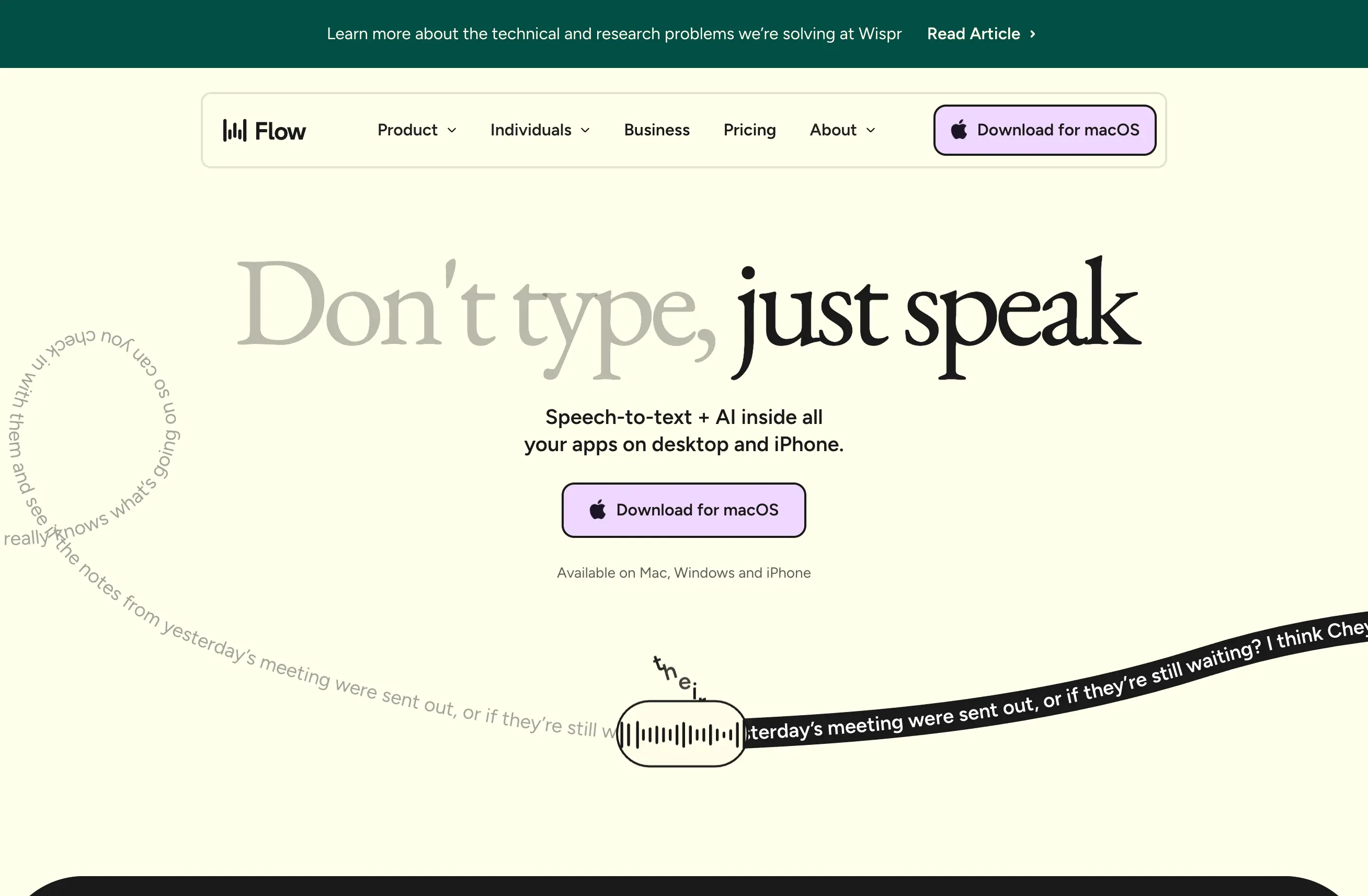
The voice input revolution isn't happening gradually—it arrived all at once in 2026. Traditional dictation software that dominated for decades suddenly faces obsolescence from AI-powered voice tools that understand context, meaning, and intent.
Dragon NaturallySpeaking ruled the dictation world for 25 years. But 2026 marked the inflection point where AI-native voice tools like WisprFlow and Granola made traditional dictation irrelevant for most users.
We're witnessing a fundamental shift in what voice input can accomplish.
The Traditional Dictation Era (1990-2025)
Traditional dictation software followed a simple model: convert speech to text with high accuracy. The user speaks, the software transcribes, corrections happen manually.
The Dragon Model
Dragon NaturallySpeaking established the dictation software template:
Training Required: 30-60 minutes of initial voice training Accuracy Goal: 99% with proper training and optimal conditions Processing: Local speech recognition with user-specific voice models Features: Basic text formatting, custom vocabularies, voice commands Integration: Windows applications through API hooks and accessibility features
Limitations That Defined an Era
Traditional dictation software had fundamental constraints:
Single Platform Lock-in: Tied to specific operating systems and devices Training Overhead: Extensive setup time before productive use Context Blindness: No understanding of content meaning or business context Collaboration Barriers: No sharing or real-time collaboration features Static Intelligence: Accuracy and features only improved through major software updates
These limitations were acceptable when alternatives didn't exist. Voice input with 99% accuracy beat no voice input at all.
The AI Voice Revolution (2026+)
AI-powered voice tools represent a fundamental architectural shift. Instead of converting speech to text, they understand language, context, and intent.
The New AI Model
Modern voice AI tools like WisprFlow operate differently:
No Training Required: AI models trained on millions of hours of human speech Intelligence Goal: Understanding meaning, context, and desired outcomes Processing: Cloud-native AI with continuous learning and improvement Features: Content creation, collaboration, cross-platform synchronization Integration: Universal compatibility through modern APIs and web standards
Capabilities That Define the New Era
AI voice tools transcend traditional dictation limitations:
Cross-Platform Native: Consistent experience across all devices and platforms Zero Training Setup: Immediate productivity without configuration overhead Context Intelligence: Understanding of business situations, meeting dynamics, and content requirements Collaborative Intelligence: Real-time sharing, editing, and team coordination Continuous Evolution: Cloud-based AI that improves automatically without software updates
Head-to-Head Comparison: Dragon vs WisprFlow
Accuracy and Performance
Dragon NaturallySpeaking:
- 99% accuracy after 30-60 minutes of training
- Requires periodic retraining and correction sessions
- Performance degrades with voice changes, illness, or fatigue
- Works offline but limited to single device
- Static accuracy until major version updates
WisprFlow:
- 97% accuracy immediately without training
- Learns from corrections automatically
- Maintains performance across voice conditions and environments
- Requires internet but works across all devices
- Continuous accuracy improvements through AI updates
Winner: Context-dependent - Dragon edges out raw accuracy, but WisprFlow provides better practical usability.
Setup and Onboarding Experience
Dragon Setup Process:
- Install 2GB software package
- Complete 30-60 minute voice training
- Configure application-specific integrations
- Import custom vocabularies and commands
- Test and adjust accuracy settings
Total setup time: 2-4 hours for optimal performance
WisprFlow Setup Process:
- Create account and verify email
- Grant microphone permissions
- Start dictating immediately
Total setup time: Under 3 minutes
Winner: WisprFlow - dramatically lower barrier to entry.
Platform and Device Support
Dragon Limitations:
- Windows only (macOS version discontinued)
- Single device installation
- No mobile apps or web interface
- Limited cloud synchronization
- Requires powerful local hardware
WisprFlow Advantages:
- Works on Windows, macOS, iOS, Android, and web browsers
- Universal synchronization across all devices
- Consistent experience regardless of hardware
- Cloud processing eliminates local hardware requirements
Winner: WisprFlow - platform agnostic vs. platform locked.
The Business Context Revolution
Traditional dictation treated every voice input session as isolated transcription. AI voice tools understand business context and workflow integration.
Meeting Intelligence (Granola)
Traditional Approach:
- Record meeting audio
- Generate verbatim transcript
- Manual extraction of action items
- Separate tools for follow-up and task management
AI Approach:
- Automatic understanding of meeting dynamics
- Intelligent summary with key decisions and action items
- Direct integration with project management and CRM systems
- Real-time collaboration and accountability tracking
New Granola users get their first three months free through my link, giving you a full quarter of real meetings to compare the AI workflow with traditional dictation.
Professional Writing (WisprFlow)
Traditional Approach:
- Dictate text word-by-word
- Manual formatting and structure creation
- Single-device editing and revision
- Export to separate collaboration tools
AI Approach:
- Intelligent formatting and structure recognition
- Cross-device draft synchronization
- Real-time collaborative editing
- Integration with modern productivity workflows
The Economics of Voice AI vs Traditional Dictation
Cost Structure Analysis
Dragon NaturallySpeaking:
- $200-1200 one-time purchase depending on edition
- Additional costs for updates and specialized vocabularies
- Hardware requirements for optimal performance
- IT support and training costs for teams
AI Voice Tools:
- $15-25 per month subscription pricing
- Automatic updates and feature additions included
- No hardware requirements beyond basic microphone
- Minimal training and support costs
Return on Investment
Traditional Dictation ROI:
- High upfront cost with long payback period
- ROI limited to individual users and single devices
- Productivity gains capped by software limitations
- Replacement cost every 3-5 years with new versions
AI Voice Tools ROI:
- Lower upfront cost with immediate productivity gains
- ROI multiplied by cross-platform and collaboration benefits
- Continuous productivity improvements through AI advances
- Subscription model ensures always-current features
The Technology Architecture Shift
Traditional Dictation: Client-Server Model
Architecture: Desktop software with local processing Intelligence: Rules-based speech recognition Updates: Manual software installations Customization: User-specific training and vocabulary files Scalability: Limited to individual users and devices
AI Voice Tools: Cloud-Native Intelligence
Architecture: Web-based applications with cloud AI processing Intelligence: Machine learning models trained on massive datasets Updates: Continuous deployment of AI improvements Customization: Automatic learning from user behavior patterns Scalability: Unlimited users with shared intelligence improvements
The architectural difference enables completely different user experiences and business models.
Industry-Specific Impacts
Healthcare and Medical Documentation
Do not use Granola to capture patient or therapy sessions; this guide does not recommend Granola for clinical capture. Granola documents HIPAA support for Enterprise customers with HIPAA enabled and a signed Business Associate Agreement (BAA). Its security FAQs limit current BAA coverage to desktop and laptop apps. Free, Personal, and Business accounts must not store or process protected health information (PHI). Consent alone does not change these account restrictions. An Enterprise deployment needs separate organizational review; the ordinary referral evaluation here remains limited to approved non-clinical meetings with no PHI. Its security FAQs, transcription documentation, and security overview describe cloud transcription and AI processing, not local-only operation. Consider only an explicitly approved non-clinical meeting with no PHI.
Clinical documentation requires a separately approved vendor with appropriate contracts and verified capabilities. General AI features do not establish clinical decision support.
Legal Services and Documentation
Traditional Dictation Era:
- Legal vocabulary and citation formatting
- Integration with specific legal software
- Local processing for confidential information
- High accuracy for legal terminology
AI Voice Era:
- Understanding of legal document structure and requirements
- Cloud-based security with attorney-client privilege protection
- Universal compatibility with modern legal technology
- Intelligent legal research and document creation assistance
Business and Corporate Communication
Traditional Dictation Era:
- Basic email and document creation
- Limited formatting and collaboration features
- Single-user productivity gains
- Manual integration with business systems
AI Voice Era:
- Intelligent business communication and formatting
- Real-time collaboration and team coordination
- Cross-platform productivity for distributed teams
- Native integration with modern business tools
Why 2026 Is the Inflection Point
Several technology trends converged in 2026 to make AI voice tools superior to traditional dictation:
AI Model Maturity
Large language models reached sufficient sophistication to understand context, intent, and business requirements beyond simple speech-to-text conversion.
Cloud Infrastructure Reliability
Cloud processing became reliable enough for mission-critical voice input workflows, eliminating the need for local processing advantages.
Cross-Platform Expectations
Users increasingly expect consistent experiences across all devices, making single-platform solutions feel antiquated.
Collaboration Requirements
Remote and hybrid work models demand real-time collaboration features that traditional dictation software cannot provide.
Subscription Model Acceptance
Business software buyers became comfortable with subscription pricing in exchange for continuous updates and improvements.
The Death of Traditional Dictation
Traditional dictation software won't disappear overnight, but its relevance is rapidly diminishing:
Remaining Use Cases
- High-security environments requiring air-gapped systems
- Legacy system integration where modern APIs aren't available
- Specialized vocabularies not yet covered by AI models
- Users with existing workflows resistant to change
Shrinking Market Share
- New users overwhelmingly choose AI voice tools
- Existing users migrate during natural refresh cycles
- Enterprise buyers prioritize cloud-native solutions
- Developer ecosystems focus on AI integration
Choosing Between Voice AI and Traditional Dictation
Choose Traditional Dictation if you:
- Work in air-gapped or highly restricted environments
- Have extensive existing Dragon customizations and workflows
- Require offline processing for security or connectivity reasons
- Are satisfied with single-device, single-user productivity gains
Choose AI Voice Tools if you:
- Want immediate productivity without training overhead
- Need cross-platform compatibility and synchronization
- Require collaboration and sharing capabilities
- Prefer continuous improvements over static software
- Value integration with modern productivity tools
The Migration Path
For users considering migration from traditional dictation:
- Start with free trials of AI voice tools to test accuracy and features
- Identify specific use cases where AI advantages provide clear value
- Plan gradual migration rather than immediate wholesale replacement
- Leverage cloud benefits like device synchronization and collaboration
- Evaluate total cost of ownership including training, support, and upgrade costs
The future of voice input is AI-native, cloud-first, and collaboration-enabled. Traditional dictation served its purpose for 25 years, but 2026 marks the beginning of a new era where voice input becomes intelligent infrastructure rather than simple transcription.
The question isn't whether to adopt AI voice tools—it's how quickly you can transition before traditional dictation becomes a competitive disadvantage in an AI-powered world.
How each tool turns speech into text
The useful difference is where the text appears and how much work remains afterward.
Traditional typing stays precise and familiar for short edits.
WisprFlow dictates into any app with AI formatting, and it is free to try.

Discussion
Giscus