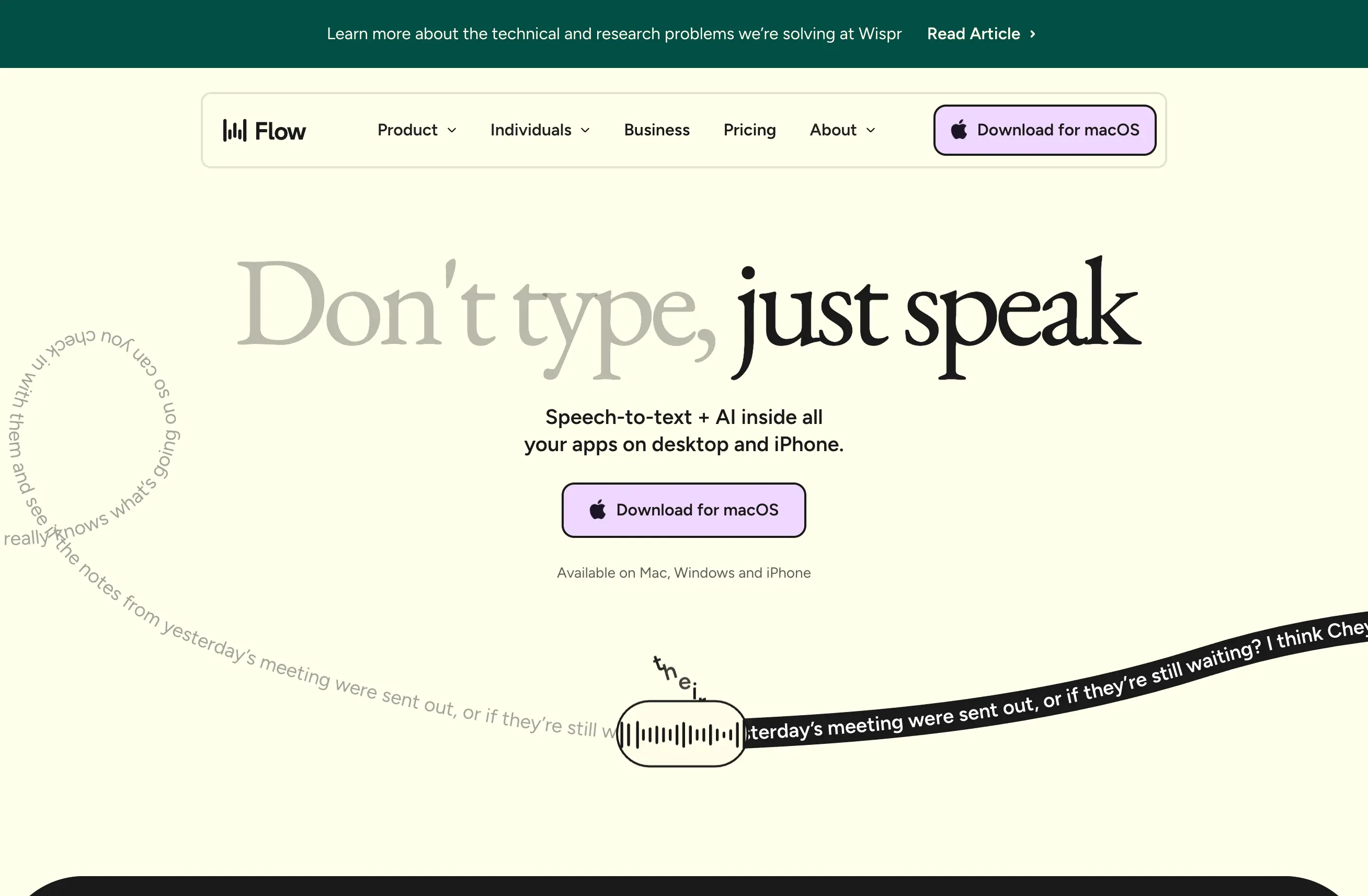
Android has long needed a professional-grade voice transcription solution. Google's built-in options work for basic dictation, but fall short for serious productivity work. Third-party apps either compromise on accuracy or lock core features behind aggressive paywalls.
WisprFlow's Android app, launched in February 2026, targets this gap. After extensive testing across multiple Android devices and real-world use cases, here's what Android users need to know about WisprFlow's voice transcription capabilities.
Voice Transcription Accuracy
Testing Methodology
Testing was conducted across three Android devices spanning different price points:
- Samsung Galaxy S26 (flagship)
- Google Pixel 8 (mid-range premium)
- Samsung Galaxy A54 (mid-range)
Accuracy was measured across different environments: quiet office, coffee shop with background noise, car with road noise, and outdoor with wind.
Results by Environment
Quiet Office Environment WisprFlow achieved 96-98% accuracy across all test devices. Complex technical terms, proper nouns, and natural speech patterns were captured accurately. The AI understood context well enough to correctly punctuate complex sentences without explicit instruction.
Coffee Shop Background Noise Accuracy dropped to 90-93% in moderate noise environments. The AI effectively filtered conversational noise but occasionally struggled with distinguishing words when multiple people spoke simultaneously near the microphone.
Car/Road Noise Testing during driving showed 88-92% accuracy. Road noise presented challenges, but WisprFlow's noise suppression handled consistent background sounds better than intermittent disruptions like passing trucks.
Outdoor/Wind Wind noise proved most challenging, with accuracy ranging from 85-90%. However, performance significantly improved when using phone placement strategies (phone protected from direct wind) or external microphones.
Android-Specific Features
System-Level Integration
WisprFlow takes advantage of Android's open architecture in ways iOS apps cannot:
Universal Voice Input: WisprFlow can inject transcribed text into any Android text field. This means voice transcription works in:
- Email apps (Gmail, Outlook, third-party clients)
- Messaging (WhatsApp, Telegram, Signal, SMS)
- Document editors (Google Docs, Microsoft Word, Notion)
- Note-taking apps (Evernote, OneNote, Simplenote)
- Task managers (Todoist, TickTick, Any.do)
The implementation is seamless. Enable WisprFlow as an input method, and it becomes available anywhere you can type.
Background Recording: Android's background processing allows WisprFlow to continue transcription even when the screen is off or you've switched to another app. This is particularly useful for:
- Long-form dictation while reviewing other documents
- Voice journaling while commuting
- Capturing thoughts while navigating between apps
Intent System Integration: WisprFlow registers for Android intents, allowing other apps to launch voice transcription directly. Say "share with WisprFlow" from any app with sharing capabilities, and voice notes can be appended to ongoing transcriptions or started fresh.
Widgets and Shortcuts
Android's home screen flexibility enables quick access to voice transcription:
Home Screen Widgets: Place a WisprFlow recording button directly on your home screen. Tap to start transcribing immediately, without launching the full app.
Quick Settings Tile: Add a WisprFlow tile to the quick settings panel. Swipe down from the top of your screen and tap to begin transcription — the fastest launch method available.
Custom Shortcuts: Android 13+ users can create custom shortcuts for specific transcription workflows. Create a shortcut that starts a voice note and immediately shares to a specific app or saves to a particular project.
Voice Command Capabilities
Basic Commands
WisprFlow recognizes standard punctuation and formatting commands:
- "period", "comma", "question mark", "exclamation point"
- "new line", "new paragraph"
- "open quote", "close quote"
- "colon", "semicolon", "dash"
These commands work reliably across all test devices and noise environments.
Advanced Commands
WisprFlow includes contextual commands for content organization:
- "Start new section titled [title]" — Creates formatted headers
- "Create list" — Begins bulleted or numbered lists
- "Add note to [project name]" — Appends to specific projects
- "Send this to [app name]" — Direct sharing after transcription
Advanced command recognition improved noticeably after several days of use, as WisprFlow's AI adapted to speaking patterns and command preferences.
Custom Commands
Android users can configure custom voice commands for repetitive workflows:
- "Email to [name]" — Draft and send formatted email
- "Add to daily journal" — Append to specific note with timestamp
- "Create task for [project]" — Generate task with project context
- "Save and share" — Transcribe, save, and initiate sharing sheet
This customization level significantly improves productivity for users with established workflows.
Real-World Performance Testing
Email Dictation
Testing involved drafting various email types using only voice:
Short Emails (2-3 paragraphs): Near-perfect accuracy. WisprFlow correctly formatted professional greetings, body text, and closings. Average time: 45 seconds to draft what would take 2-3 minutes typing.
Long-Form Emails (500+ words): Good accuracy with occasional need for minor corrections. WisprFlow maintained context across longer dictation sessions, properly punctuating complex sentences and paragraph breaks. Average time savings: 60% compared to typing.
Technical Emails: Mixed results. WisprFlow handled standard technical terms well but occasionally struggled with specialized jargon, code snippets, or acronyms specific to particular industries. Custom vocabulary training improved this over time.
Document Creation
Testing included creating various document types:
Meeting Notes: Excellent performance. WisprFlow's AI structured meeting notes intelligently, recognizing discussion topics, action items, and decisions. The ability to add section headers with voice commands created well-organized notes without manual editing.
Project Documentation: Good results for procedural documentation. Explaining processes step-by-step produced clear, readable documentation. However, highly technical documentation with precise terminology required more editing.
Content Drafts: Surprisingly effective for blog posts and articles. WisprFlow captured conversational tone well, and the natural flow of spoken language often produced better first drafts than typed content.
Device Performance Analysis
Flagship Devices (Galaxy S26, Pixel 8 Pro)
Flagship Android devices provided optimal WisprFlow performance:
- Real-time transcription with no perceptible delay
- High accuracy even in challenging noise environments
- Smooth animations and instant UI response
- Background transcription with minimal battery impact
Battery usage during 30 minutes of active transcription: 3-4% drain.
Mid-Range Devices (Pixel 8, Galaxy A54)
Mid-range devices delivered solid performance with minor compromises:
- Slight delay (1-2 seconds) before transcription appears
- Accuracy matching flagship devices in controlled environments
- Occasional UI stuttering during very long transcription sessions
- Higher battery usage during background transcription
Battery usage during 30 minutes of active transcription: 5-7% drain.
Budget Devices (Testing on 2024-2025 models)
Budget Android devices provided functional but limited experience:
- Noticeable 3-5 second delay before transcription appears
- Accuracy decreased 5-10% compared to flagship devices
- Background transcription sometimes interrupted by aggressive battery optimization
- UI responsiveness occasionally sluggish
Battery usage during 30 minutes of active transcription: 8-10% drain.
For budget device users, enabling offline transcription mode improved responsiveness at the cost of slightly reduced accuracy.
Offline Transcription
Offline Mode Capabilities
WisprFlow includes offline transcription for situations without reliable internet:
- Download language models (150-300MB per language)
- Transcribe without internet connection
- Sync transcriptions when connection restored
Offline Accuracy
Offline transcription accuracy tested 85-90% compared to 95%+ with cloud processing. The difference is noticeable but acceptable for situations requiring offline functionality:
- International travel without data
- Poor connectivity areas (basements, rural locations)
- Privacy-sensitive transcription where cloud processing is undesirable
Storage Requirements
Each language model requires 150-300MB storage. For multi-language users, this can consume significant phone storage. However, users can download only needed languages and remove unused models.
Privacy and Security
Data Handling
WisprFlow processes voice data through multiple pathways:
Cloud Processing (Default): Voice audio sent to WisprFlow servers for transcription. Audio is processed and immediately deleted — not stored permanently. Transcribed text syncs across devices.
Offline Processing: Voice processed entirely on-device. No data sent to servers. Transcribed text remains local until user explicitly syncs.
Encryption: All data transmission uses end-to-end encryption. Stored transcriptions encrypted at rest.
Android Permissions
WisprFlow requests these Android permissions:
- Microphone: Required for voice recording
- Internet: Required for cloud transcription and syncing
- Storage: Optional, for local file exports
- Accessibility: Optional, for universal voice input functionality
Users can deny optional permissions without losing core transcription functionality, though some convenience features become unavailable.
Integration with Android Ecosystem
Google Workspace Integration
WisprFlow integrates well with Google's productivity suite:
- Direct transcription into Google Docs
- Voice-composed Gmail messages
- Voice input for Google Keep notes
- Transcribed content searchable in Google Drive
The integration feels native, with transcribed text respecting document formatting and styles.
Samsung DeX Support
Testing WisprFlow with Samsung DeX (Samsung's desktop mode) revealed excellent compatibility:
- WisprFlow scales to desktop window sizes appropriately
- Voice transcription works with external keyboards connected
- Multi-window support allows transcription alongside other apps
- Desktop-optimized UI provides better organization of longer transcriptions
For Samsung users who use DeX for productivity, WisprFlow becomes a powerful desktop dictation tool.
Android Auto
WisprFlow's Android Auto integration enables safe voice transcription while driving:
- Simplified UI designed for glance-based interaction
- Voice commands optimized for driving scenarios
- Automatic saving prevents data loss if drive ends unexpectedly
- Direct sharing to messaging apps through Android Auto interface
This feature significantly improves safety for users who previously attempted to type while driving.
Comparison to Alternatives
vs. Google Recorder
Google's Recorder app offers free, accurate transcription on Pixel devices. However, WisprFlow provides:
- Cross-platform syncing (Google Recorder is Pixel-only)
- Universal voice input (Recorder transcribes recordings only)
- Advanced organization and project management
- Better export and sharing options
For non-Pixel users, WisprFlow is clearly superior. For Pixel users, WisprFlow's additional features justify the subscription cost for professional use.
vs. Gboard Voice Typing
Gboard's built-in voice typing is free and universally available. WisprFlow advantages:
- Superior accuracy, especially in noisy environments
- Intelligent punctuation and formatting
- Project organization for transcriptions
- Voice commands for structure and formatting
- Offline mode with better accuracy
Gboard works for basic dictation. WisprFlow handles professional transcription workflows.
vs. Otter.ai Android
Otter.ai provides meeting transcription and voice notes. WisprFlow differentiates through:
- Universal voice input across all apps
- Better Android system integration
- Lower latency for real-time dictation
- More flexible organization system
Otter.ai better serves meeting transcription specifically. WisprFlow better serves general productivity transcription.
Pricing and Value
Subscription Tiers
Free Trial: 7 days, full feature access
Individual Plan: $19/month
- Unlimited transcription
- Cloud sync across devices
- Offline mode
- All Android integration features
Team Plan: $35/month per user
- Everything in Individual
- Shared transcription projects
- Team collaboration features
- Admin management tools
Enterprise: Custom pricing
- Volume discounts
- Advanced security features
- Custom integration options
- Dedicated support
Value Assessment
At $19/month, WisprFlow costs more than some alternatives but delivers professional-grade transcription. Value calculation depends on use case:
High-value users (savings justify cost):
- Professionals dictating 2+ hours of content weekly
- Users with typing limitations (RSI, accessibility needs)
- Mobile workers who need transcription across multiple apps
- Teams collaborating on voice content
Lower-value users (free alternatives may suffice):
- Occasional voice note users
- Users primarily needing meeting transcription only
- Pixel device owners with access to Google Recorder
- Users satisfied with Gboard voice typing accuracy
Areas for Improvement
Current Limitations
Testing revealed several areas where WisprFlow could improve:
Custom Vocabulary: While WisprFlow adapts to speaking patterns over time, manual custom vocabulary addition would help users in specialized fields add industry-specific terms immediately.
Voice Command Discoverability: Advanced voice commands are powerful but not well documented within the app. Users must discover capabilities through documentation or experimentation.
Notification Management: Transcription notifications occasionally persist after transcription completes, requiring manual dismissal.
Battery Optimization Conflicts: Some Android manufacturers' aggressive battery optimization occasionally interrupts background transcription. While WisprFlow provides guidance for whitelisting, the process varies by manufacturer.
Future Potential
Features that would enhance WisprFlow on Android:
Multilingual Transcription: Real-time language switching for bilingual speakers Voice Profiles: Multiple voice profiles for shared devices Smart Summaries: AI-generated summaries of long transcriptions Automated Sharing Rules: Configure automatic sharing of specific transcription types to designated apps
Final Verdict
Overall Rating: 4.3/5
Strengths:
- Excellent transcription accuracy across noise environments
- Superior Android system integration
- Universal voice input across all apps
- Offline mode with good accuracy
- Professional organization features
- Responsive performance on mid-range and flagship devices
Weaknesses:
- Premium pricing compared to free alternatives
- Limited performance on budget Android devices
- Custom vocabulary management could be better
- Some manufacturer-specific battery optimization conflicts
Who Should Subscribe?
WisprFlow's Android app excels for Android users who:
- Dictate content regularly for professional work
- Need voice input across multiple Android apps
- Value accuracy and formatting intelligence
- Work in mobile contexts where typing is impractical
- Require offline transcription capabilities
For casual users who occasionally need voice-to-text, Android's built-in options may suffice. For professionals who rely on voice transcription for productivity, WisprFlow's Android implementation delivers the accuracy, features, and system integration that justify the subscription cost.
The February 2026 launch established WisprFlow as a serious productivity tool for Android users, filling a gap in the Android ecosystem that free alternatives never fully addressed.
How each tool turns speech into text
The useful difference is where the text appears and how much work remains afterward.
Traditional typing stays precise and familiar for short edits.
WisprFlow dictates into any app with AI formatting, and it is free to try.

Discussion
Giscus