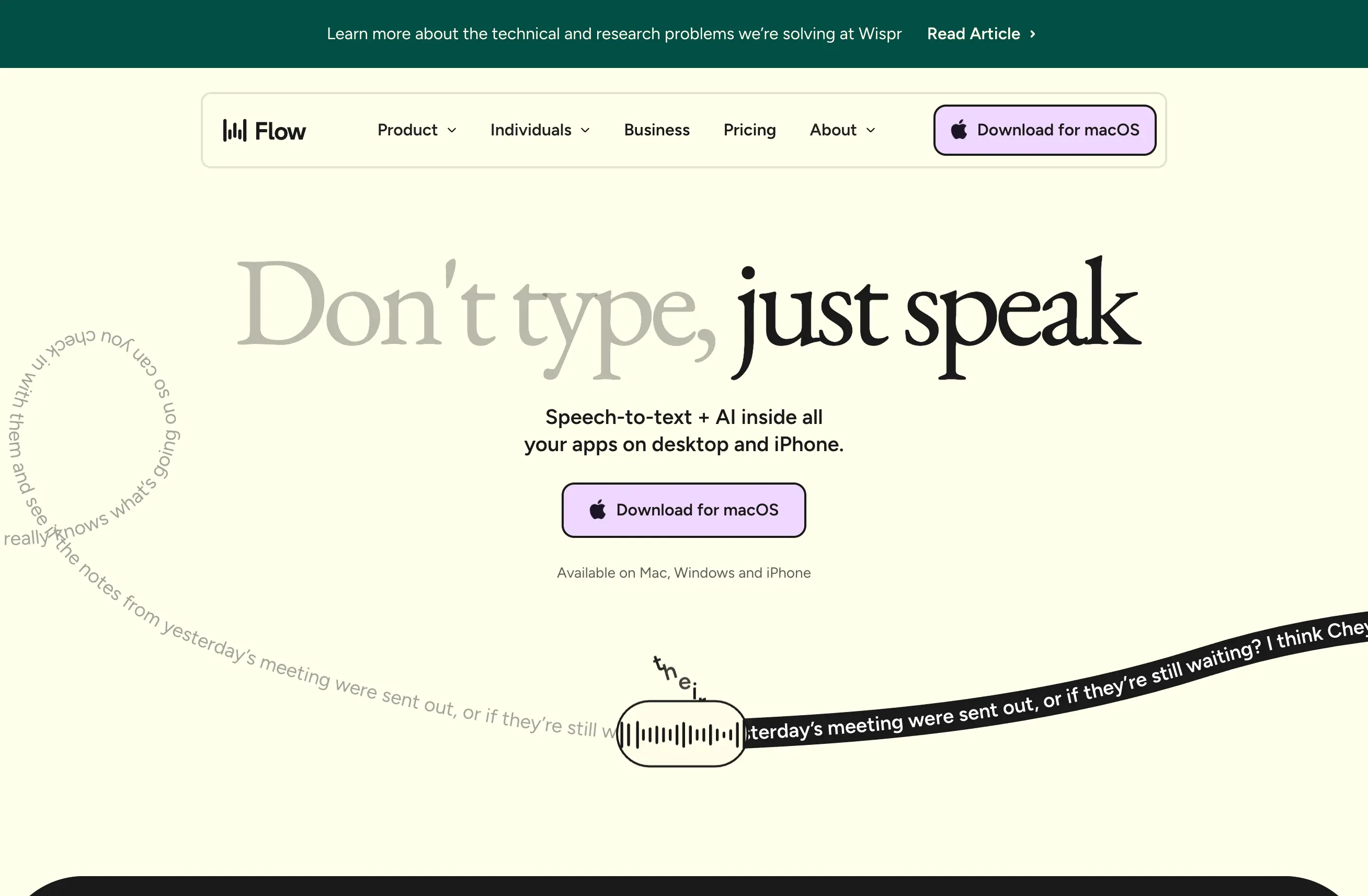
The average doctor spends 6 hours a day on administrative tasks, with patient documentation being the biggest time sink. Voice transcription tools promise to fix this, but most fail in clinical settings. WisprFlow is different.
Unlike traditional dictation software, WisprFlow uses advanced AI to understand medical terminology, handle interruptions, and format notes appropriately for clinical documentation. Here's how doctors are actually using it.
Why Traditional Voice Tools Fail in Healthcare
Most voice transcription tools break down in hospital environments. They can't handle:
- Medical terminology and drug names
- Background noise from equipment and staff
- Quick, fragmented thoughts during patient visits
- HIPAA compliance requirements
- Integration with electronic health records (EHRs)
How WisprFlow Solves Clinical Documentation
WisprFlow's AI understands context and medical language. It can transcribe while you're examining a patient, handling interruptions and background noise without losing the thread of your notes.
Real Clinical Workflows
During patient visits: Record observations, symptoms, and treatment plans while maintaining eye contact with patients. WisprFlow's noise cancellation works even with medical equipment running.
Between appointments: Quickly dictate chart updates, referral notes, and follow-up tasks. The AI formats these appropriately for different document types.
End-of-shift summaries: Review the day's cases with voice notes that capture clinical reasoning and decision-making processes.
HIPAA Compliance and Security
Healthcare organizations need bulletproof security. WisprFlow processes voice data with enterprise-grade encryption and doesn't store recordings permanently. The transcribed text integrates with existing EMR systems without creating additional compliance risks.
Integration with Medical Workflows
The best voice transcription tool is one that fits into existing workflows. WisprFlow integrates with major EMR systems and can export formatted notes directly into patient charts.
Getting Started: Doctor Setup Guide
- Install WisprFlow on your mobile device or computer
- Configure medical terminology preferences
- Set up EMR integration (if your system supports it)
- Practice with a few test recordings to calibrate the AI for your speaking style
The setup takes about 10 minutes, and the AI improves as it learns your voice and terminology preferences.
ROI for Healthcare Practices
Time is money in healthcare. Doctors using WisprFlow report saving 2-3 hours daily on documentation tasks. For a practice billing $200/hour, that's $400-600 in additional revenue per day per provider.
The efficiency gains also improve patient care by giving doctors more time for actual medical work instead of administrative tasks.
Bottom Line
Clinical documentation doesn't have to be a productivity killer. WisprFlow's AI voice transcription understands medical contexts and integrates with healthcare workflows, letting doctors focus on patients instead of paperwork.
The 30-day free trial includes full access to medical terminology libraries and EMR integrations. Worth testing if documentation is eating your clinical time.
How each tool turns speech into text
The useful difference is where the text appears and how much work remains afterward.
Traditional typing stays precise and familiar for short edits.
WisprFlow dictates into any app with AI formatting, and it is free to try.

Discussion
Giscus