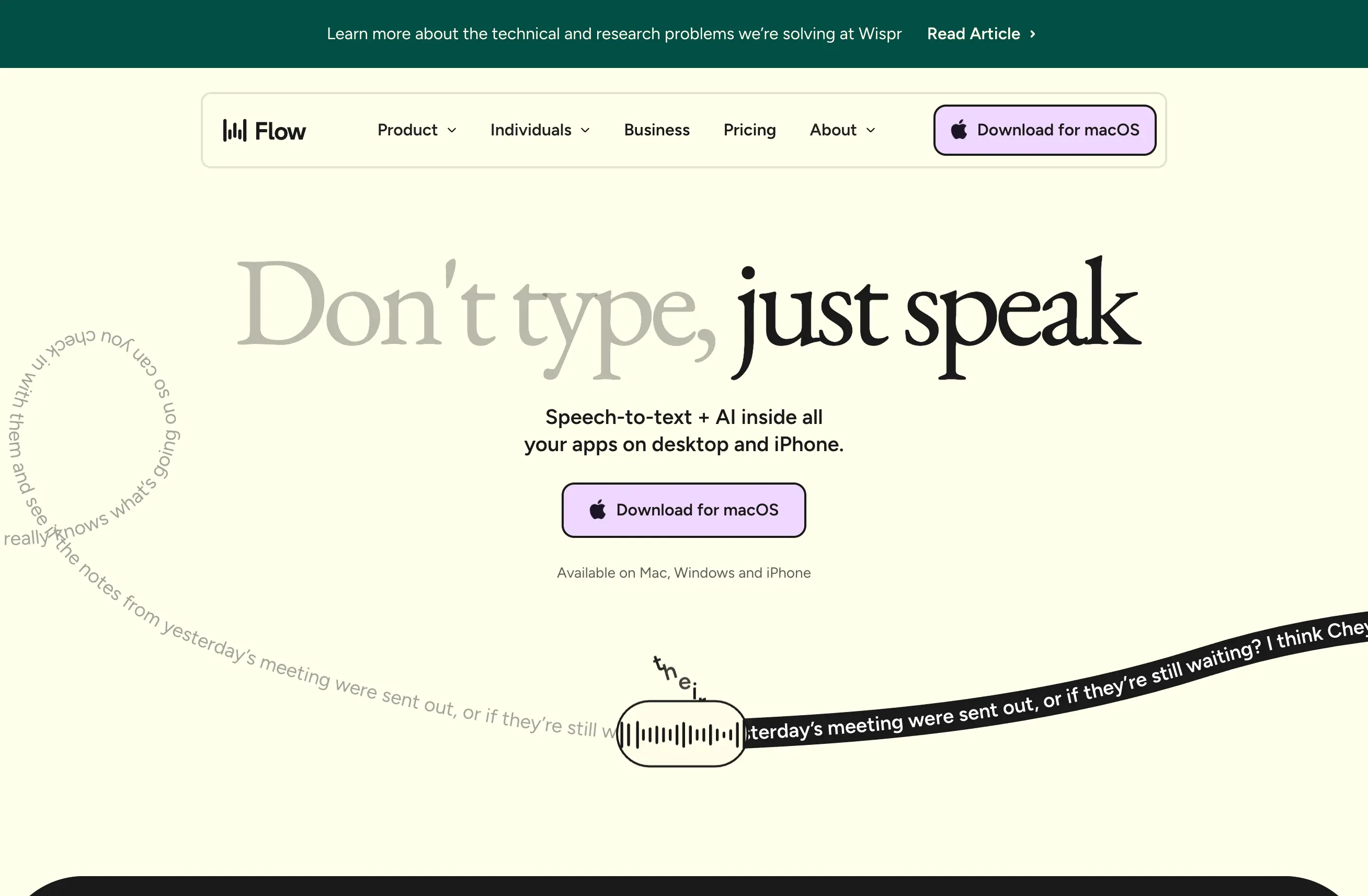
Physicians spend 35-40% of their day on documentation, often working evenings and weekends to complete EMR entries. This administrative burden contributes directly to physician burnout and reduces patient care time. Voice recognition technology promises relief, but traditional solutions like Dragon Medical fall short of modern workflow demands.
WisprFlow represents the next generation of medical voice AI—context-aware, HIPAA-compliant, and designed for complex clinical workflows.
The Documentation Crisis in Healthcare
The average physician sees 20-30 patients daily, generating 4-6 hours of required documentation. Traditional typing creates backlogs that extend workdays and reduce care quality. Voice dictation helps, but Dragon Medical's word-for-word transcription still requires extensive editing and formatting.
Modern EMR systems expect structured data, not prose dictation. Physicians need voice tools that understand medical terminology, clinical decision-making, and documentation requirements simultaneously.
WisprFlow's Clinical Intelligence
WisprFlow goes beyond simple dictation by understanding medical context and EMR structure. When you dictate patient encounters, it automatically formats information according to clinical documentation standards.
Medical Terminology Recognition: Native understanding of drug names, procedures, anatomical terms, and diagnostic codes without training custom vocabularies.
Clinical Reasoning Capture: Recognizes assessment and plan structure, differential diagnoses, and treatment rationales for proper SOAP note formatting.
EMR Integration: Direct integration with major EMR platforms including Epic, Cerner, and Allscripts for seamless workflow integration.
Template Automation: Custom templates for different specialties—cardiology consults format differently from emergency department encounters.
This clinical intelligence transforms voice dictation from transcription tool to documentation assistant.
HIPAA Compliance and Security
Medical voice AI must meet stringent privacy requirements. WisprFlow implements comprehensive HIPAA compliance:
Local Processing: Initial speech processing occurs on-device before any cloud transmission, protecting patient information during the most vulnerable stage.
Encrypted Transmission: All data transfers use AES-256 encryption with certificate pinning for additional security.
Audit Trails: Complete logging of all voice interactions for compliance reporting and security audits.
PHI Handling: Automatic detection and protection of protected health information with role-based access controls.
Business Associate Agreement: Full BAA coverage for healthcare organizations with liability protection.
Specialty-Specific Workflows
Different medical specialties have distinct documentation requirements. WisprFlow adapts to specialty-specific needs:
Emergency Medicine: Rapid patient turnover with structured triage notes, disposition planning, and procedure documentation.
Internal Medicine: Comprehensive history and physicals with chronic disease management and medication reconciliation.
Surgery: Pre-operative assessments, operative notes with detailed procedure descriptions, and post-operative care planning.
Psychiatry: Mental status examinations, treatment plan adjustments, and therapy session documentation with appropriate privacy protections.
Each specialty uses customized templates and terminology databases for maximum accuracy and efficiency.
ROI Analysis for Healthcare Organizations
A 50-physician practice reports saving 2-3 hours daily per physician using WisprFlow versus traditional documentation methods. At average physician compensation of $300,000 annually, improved efficiency translates to $750,000+ in recovered productivity.
Additional benefits include:
Reduced Physician Burnout: Less evening documentation work improves work-life balance Improved Patient Care: More time available for direct patient interaction Better Documentation Quality: Structured notes improve care coordination and coding accuracy Reduced Staffing Needs: Less reliance on medical scribes and documentation support staff
The technology investment pays for itself within 6-8 months while improving physician satisfaction and patient outcomes.
Mobile Documentation: Android Launch Impact
WisprFlow's Android launch transforms mobile medical documentation. Physicians can now dictate notes during hospital rounds, clinic walks, or home visits with full functionality.
This mobility matters in healthcare where patient care happens across multiple locations. Emergency physicians moving between rooms, surgeons doing post-operative checks, and primary care physicians making house calls all benefit from seamless mobile documentation.
The Android implementation maintains HIPAA compliance and EMR integration while providing offline functionality for areas with poor connectivity—critical in rural healthcare settings.
Implementation and Training
Healthcare organizations typically deploy WisprFlow in phases:
Pilot Phase (2-4 weeks): Select physicians test core functionality with existing workflows Training Phase (1-2 weeks): Custom templates and specialty configurations deployed Full Deployment (4-6 weeks): Organizational rollout with ongoing support and optimization
Most physicians report productivity improvements within the first week. The learning curve is minimal because WisprFlow adapts to natural speech patterns rather than requiring rigid command structures.
Voice AI technology transforms medical documentation for physicians who adopt it. Healthcare organizations implementing WisprFlow gain competitive advantages in physician recruitment, retention, and operational efficiency.
Modern patients deserve physicians who spend time providing care rather than typing notes. WisprFlow makes that possible.
How each tool turns speech into text
The useful difference is where the text appears and how much work remains afterward.
Dragon works well for short, literal dictation in a focused text field.
WisprFlow dictates into any app with AI formatting, and it is free to try.

Discussion
Giscus