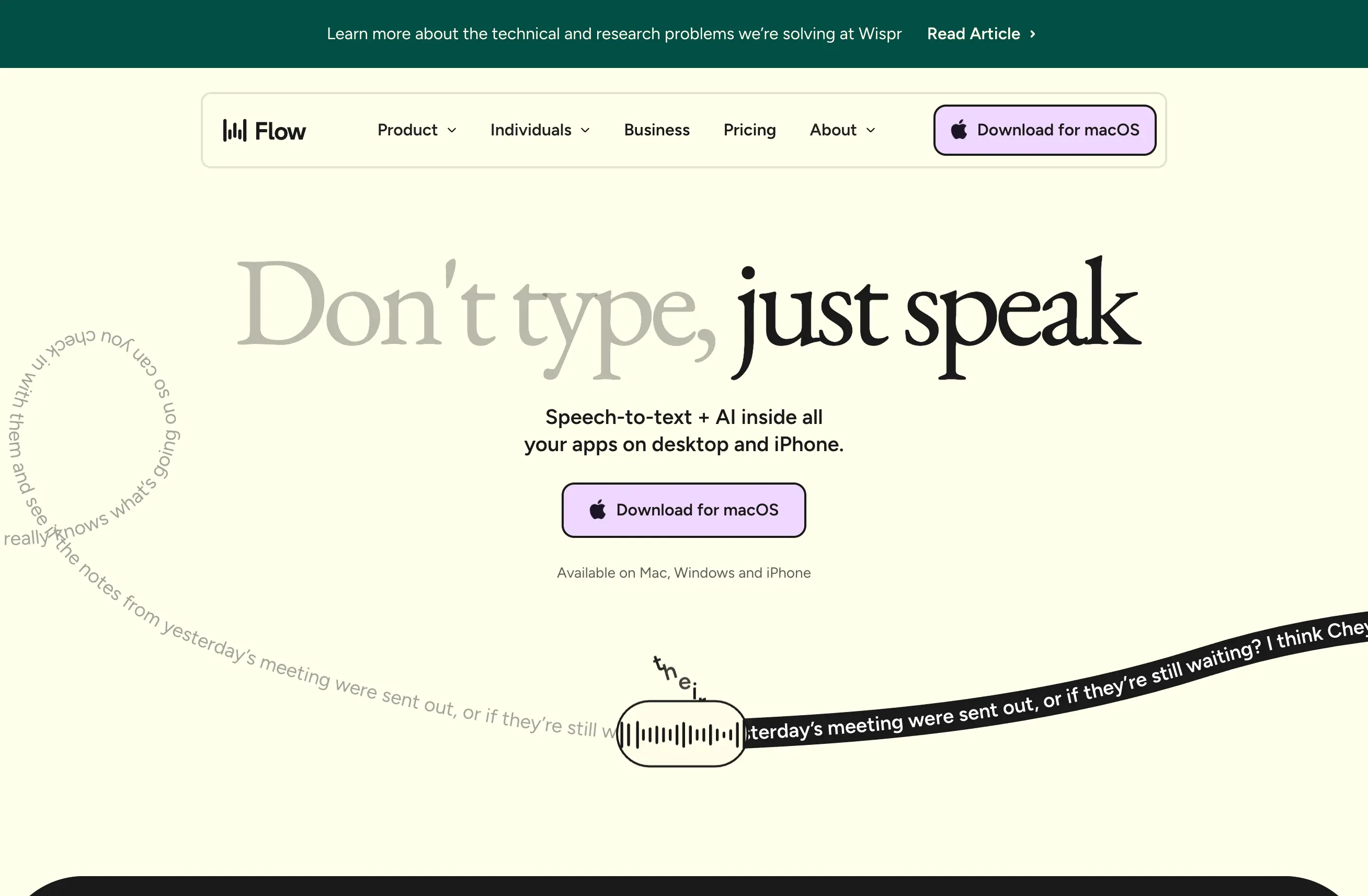
WisprFlow and Dragon NaturallySpeaking represent two generations of voice recognition technology. Dragon pioneered speech-to-text software in the 1990s with desktop-focused solutions, while WisprFlow uses modern AI for cloud-enhanced mobile transcription. Understanding their different approaches helps professionals choose the right tool for their voice input needs.
Technology Architecture
Dragon's Legacy Approach: Desktop software with local processing and extensive user training requirements. Dragon builds personalized voice models through dictation training sessions and vocabulary customization, achieving high accuracy for users willing to invest training time.
WisprFlow's Modern Stack: Cloud-based AI transcription with minimal user configuration. The app uses large language models trained on diverse speech patterns, delivering accurate results without extensive personalization or voice training.
Accuracy and Performance
Dragon's Specialized Precision: After proper training, Dragon achieves 95-99% accuracy for users who speak clearly and consistently. The software excels with technical terminology and industry-specific vocabulary when properly configured.
WisprFlow's General Intelligence: Delivers 90-95% accuracy immediately without training, handling casual speech, background noise, and varied speaking styles more gracefully than traditional recognition engines.
Real-World Comparison: Dragon requires 2-4 hours of initial training for optimal performance, while WisprFlow provides usable results from the first dictation session.
Platform and Mobility
Dragon's Desktop Focus: Primarily Windows-based with limited mobile options. The software integrates deeply with desktop applications but lacks the flexibility for mobile dictation workflows.
WisprFlow's Mobile-First Design: Native iOS and Android apps with cloud synchronization. The platform supports dictation anywhere with cellular or WiFi connectivity, matching modern mobile work patterns.
Integration Differences: Dragon provides direct integration with Microsoft Office and desktop productivity software, while WisprFlow focuses on universal text output that works across platforms and applications.
User Experience and Training
Dragon's Learning Curve: Requires significant upfront investment in voice training, vocabulary customization, and command learning. Power users appreciate the depth of control and customization options.
WisprFlow's Immediate Usability: Works effectively without training or configuration. Users start dictating immediately with results that improve through general usage rather than specific training sessions.
Professional Adoption: Medical professionals and legal professionals often prefer Dragon's specialized vocabularies and local processing, while business professionals appreciate WisprFlow's simplicity and mobile convenience.
Privacy and Security
Dragon's Local Processing: All voice recognition happens on-device, providing complete privacy control for sensitive professional content. No audio data leaves the user's computer during transcription.
WisprFlow's Hybrid Approach: Processes audio locally for privacy, then sends encrypted text to cloud services for AI enhancement. The architecture balances privacy protection with cloud-powered accuracy improvements.
Compliance Considerations: Dragon better serves organizations with strict data retention requirements, while WisprFlow provides adequate privacy protection for most business applications.
Pricing and Total Cost
Dragon's One-Time Purchase: Desktop software with upfront licensing costs ranging from $200-500 depending on version and features. No ongoing subscription fees for basic functionality.
WisprFlow's Subscription Model: Monthly or annual pricing with tiered features based on transcription volume and usage patterns. Predictable ongoing costs with automatic updates and improvements.
Economic Analysis: Dragon provides better long-term value for heavy daily users, while WisprFlow offers lower entry costs and predictable monthly expenses for occasional use.
Professional Applications
Dragon's Enterprise Strength: Dominates in medical transcription, legal documentation, and other specialized professional environments requiring maximum accuracy and local data control.
WisprFlow's Versatile Appeal: Serves content creators, consultants, and mobile professionals who prioritize convenience and cross-platform functionality over specialized features.
Industry Adoption: Dragon maintains strong positions in healthcare and legal markets, while WisprFlow gains traction among knowledge workers and creative professionals.
Future Development Paths
Dragon's Evolution: Nuance (now part of Microsoft) continues developing Dragon with focus on professional markets and Microsoft ecosystem integration. The platform emphasizes local processing and specialized industry features.
WisprFlow's Innovation: Rapid iteration with AI improvements, mobile feature expansion, and cloud service integration. The platform benefits from modern development practices and cloud-native architecture.
Making the Right Choice
Choose Dragon NaturallySpeaking if you need maximum accuracy for specialized professional work, prefer local data processing, and can invest time in training and customization.
Choose WisprFlow if you prioritize mobile convenience, immediate usability, and modern cloud-enhanced features over specialized accuracy and extensive customization options.
Getting Started
Try WisprFlow for modern voice transcription to experience how AI-powered speech recognition adapts to your natural speaking style without training requirements.
Both platforms serve voice recognition needs effectively, but their different philosophies mean the right choice depends on your work environment, accuracy requirements, and technology preferences.
How each tool turns speech into text
The useful difference is where the text appears and how much work remains afterward.
Dragon works well for short, literal dictation in a focused text field.
WisprFlow dictates into any app with AI formatting, and it is free to try.

Discussion
Giscus