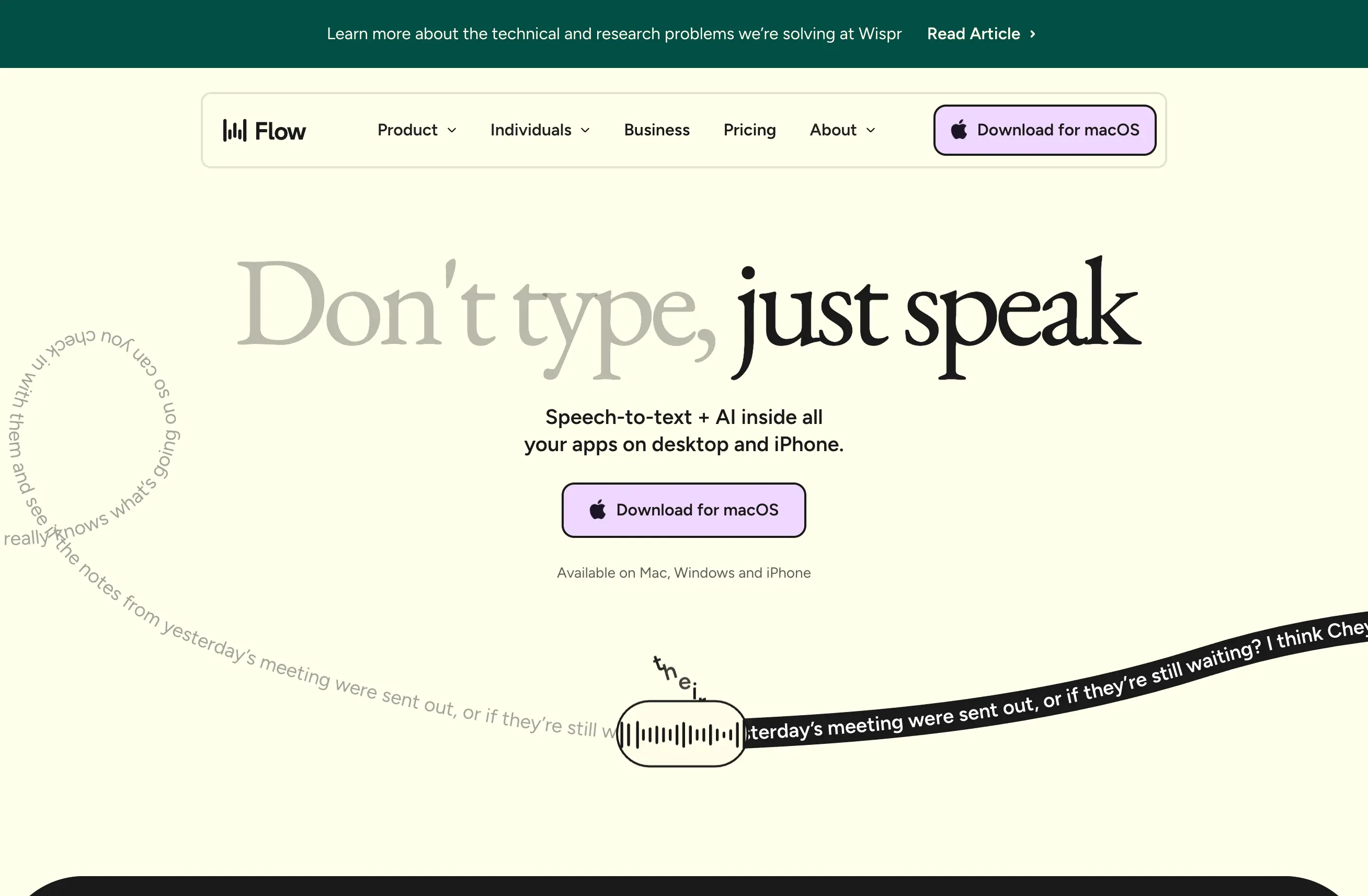
Voice recognition has evolved dramatically in recent years, but many professionals still associate speech-to-text with Dragon NaturallySpeaking's legacy approach. WisprFlow represents the modern AI evolution of voice transcription, delivering superior accuracy and user experience compared to traditional speech recognition software. Here's a comprehensive comparison of these two approaches to voice-powered productivity.
Technology Architecture Differences
Dragon NaturallySpeaking relies on older speech recognition algorithms that require extensive user training, command memorization, and specific speaking patterns. The software was groundbreaking in its era but represents outdated technology approaches.
WisprFlow leverages modern transformer-based AI models that understand natural speech patterns without training, handle various accents and speaking styles, and continuously improve accuracy through advanced machine learning.
Setup and Training Requirements
Dragon's Training Burden
Dragon requires significant upfront investment:
- Voice training sessions lasting 30+ minutes
- Reading training texts to teach the system your voice
- Command memorization for formatting and editing
- Vocabulary building for technical terms and proper names
- Regular retraining when accuracy degrades
WisprFlow's Instant Setup
WisprFlow works immediately:
- Zero training required – works out of the box
- Natural speech recognition – no special commands needed
- Automatic learning – improves with use without manual training
- Technical terminology – understands business and professional language
- Consistent accuracy – no degradation requiring retraining
Accuracy Comparison
Dragon's Accuracy Challenges
- Training dependency – accuracy varies based on training completeness
- Vocabulary limitations – struggles with words not in training set
- Accent sensitivity – requires retraining for different speaking patterns
- Technical terminology – needs manual vocabulary building
- Degradation over time – accuracy decreases without maintenance
WisprFlow's Modern Accuracy
- Contextual understanding – uses conversation context for accuracy
- Broad vocabulary – trained on diverse text sources
- Accent tolerance – works with various speaking styles
- Technical language – understands professional and industry terminology
- Consistent performance – maintains accuracy without degradation
User Experience Differences
Dragon's Complex Interface
Dragon reflects older software design patterns:
- Command-based operation requiring memorized voice commands
- Modal editing – different modes for dictation vs. editing
- Complex corrections – specific procedures for fixing errors
- Application integration – requires specific setup for each program
- Learning curve – significant time investment to reach proficiency
WisprFlow's Modern Simplicity
- Natural language – speak normally without special commands
- Seamless editing – simple text selection and replacement
- Intuitive corrections – natural error fixing through speech
- Universal compatibility – works with any text application
- Immediate productivity – effective from first use
Professional Use Case Performance
Legal and Medical Professionals
Dragon was historically popular in these fields due to specialized vocabulary packages, but required extensive setup and maintenance.
WisprFlow provides superior performance for professional use:
- Built-in terminology – understands legal and medical language without special packages
- Privacy protection – local processing keeps confidential information secure
- Modern integration – works seamlessly with contemporary professional software
- Reduced IT burden – no complex deployment or maintenance requirements
Business and Content Creation
Dragon's command-based approach interrupts creative flow and requires constant attention to formatting commands.
WisprFlow enhances creative and business workflows:
- Natural dictation – maintain creative flow without command interruptions
- Intelligent formatting – understands document structure automatically
- Context awareness – produces appropriately formatted business communications
- Cross-platform consistency – same experience across devices and applications
Cost and Value Analysis
Dragon's Total Cost of Ownership
- High upfront cost for professional versions
- Training time investment – hours of setup and learning
- Maintenance overhead – regular retraining and updates
- Limited device support – typically Windows-only
- Productivity delay – weeks to reach full proficiency
WisprFlow's Value Proposition
- Competitive pricing with modern subscription model
- Immediate ROI – productive from first use
- Zero maintenance – no ongoing training or system upkeep
- Cross-platform availability – works on multiple operating systems
- Instant expertise – no learning curve for basic functionality
The Modern AI Advantage
WisprFlow represents a generational leap beyond Dragon's legacy approach:
- Deep learning models understand language context and meaning
- Natural language processing eliminates artificial command structures
- Continuous improvement through modern AI training methods
- Cloud-enhanced accuracy combined with local privacy protection
- Universal compatibility with modern software and workflows
Migration from Dragon
Professionals transitioning from Dragon to WisprFlow typically experience:
- Immediate productivity gains without retraining
- Reduced frustration from simplified operation
- Better accuracy for modern business terminology
- Enhanced privacy through local processing options
- Lower maintenance burden with automatic updates and improvements
Try WisprFlow free and experience the difference between modern AI voice transcription and legacy speech recognition technology.
Dragon NaturallySpeaking served its era well, but WisprFlow represents the future of voice productivity: intelligent, accurate, and effortlessly integrated into modern professional workflows without the complexity and maintenance burden of legacy systems.
How each tool turns speech into text
The useful difference is where the text appears and how much work remains afterward.
Dragon works well for short, literal dictation in a focused text field.
WisprFlow dictates into any app with AI formatting, and it is free to try.

Discussion
Giscus