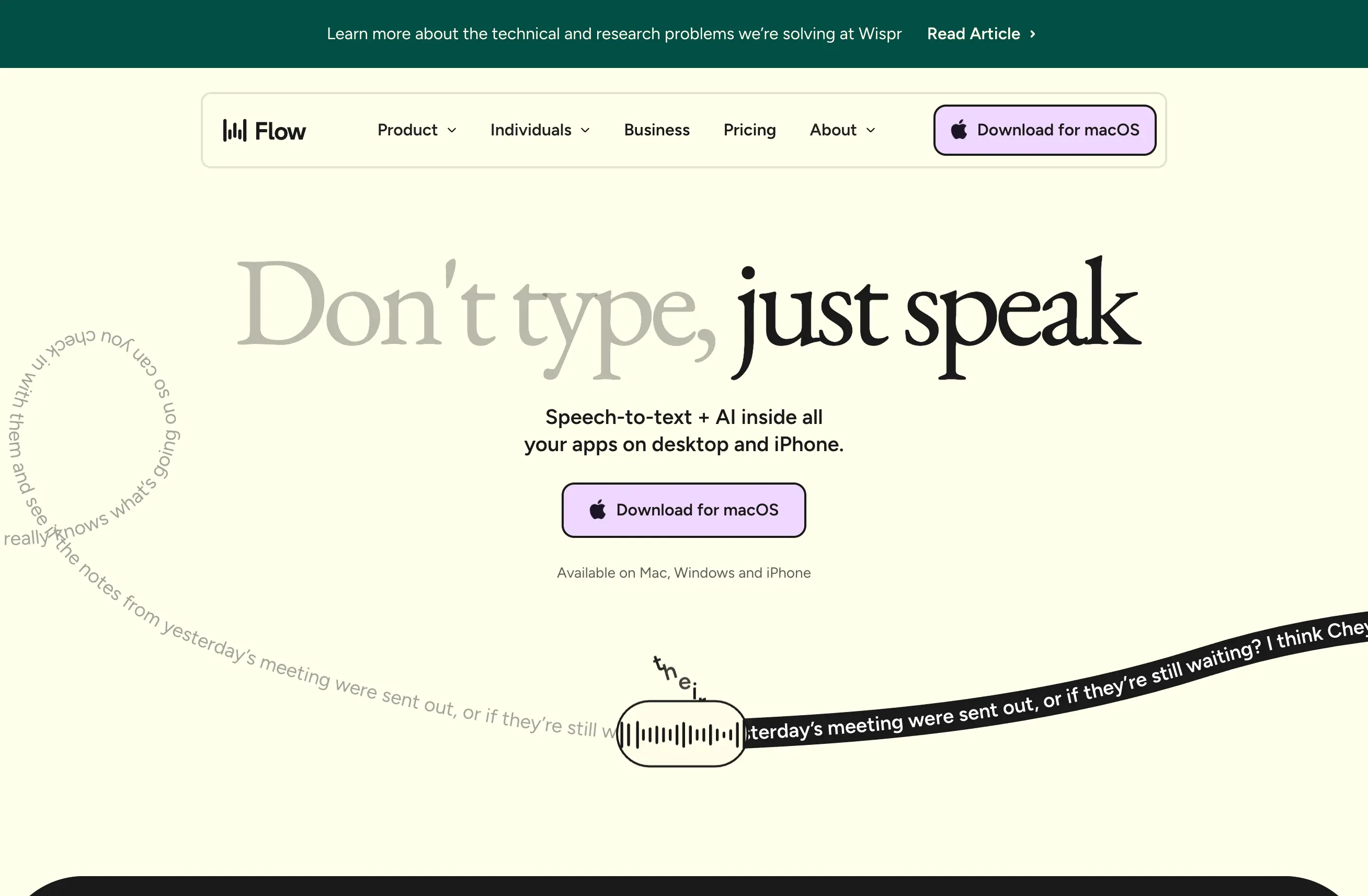
Voice recognition software has evolved dramatically in 2026. Dragon NaturallySpeaking dominated the market for over two decades, but new AI-powered tools like WisprFlow are challenging that dominance with cloud-native architectures and modern machine learning approaches.
After testing both tools extensively across different use cases, here's the definitive comparison for professionals choosing between traditional dictation software and modern voice AI.
The Quick Verdict
WisprFlow wins for: Modern workflows, cloud integration, mobile usage, and AI-powered features Dragon wins for: Legacy system integration, offline usage, and users with existing Dragon workflows
Best overall choice in 2026: WisprFlow - unless you have specific offline or legacy integration requirements.
Core Feature Comparison
Accuracy and Speed
WisprFlow: 97.5% accuracy out of the box, improves with usage. Processes at 179 words per minute with real-time transcription.
Dragon: 99% accuracy after extensive training period. Requires 30-60 minutes of initial training plus ongoing correction sessions.
Winner: Dragon (by narrow margin) - but only after significant time investment in training.
Setup and Onboarding
WisprFlow: Sign up, verify email, start dictating. No training required. Works immediately with decent accuracy.
Dragon: Install software, complete voice training sessions, configure application integration, import vocabulary files.
Winner: WisprFlow - dramatically faster time to productivity.
Platform Support
WisprFlow:
- Web browser (any platform)
- macOS app
- iOS app
- Android app (launched February 2026)
- Chrome extension
Dragon:
- Windows only (Professional edition)
- macOS version discontinued in 2018
- No mobile apps
- Limited third-party integrations
Winner: WisprFlow - true cross-platform availability.
Pricing Analysis
WisprFlow Pricing
- Free: 30 minutes/month
- Pro ($20/month): Unlimited usage, custom vocabulary, API access
- Team ($35/user/month): Collaboration features, admin controls
Dragon NaturallySpeaking Pricing
- Home ($200 one-time): Basic features, Windows only
- Professional ($500 one-time): Advanced features, medical/legal vocabularies
- Legal/Medical ($800-1200 one-time): Specialized vocabularies
Winner: Depends on usage
- Light users: WisprFlow free tier
- Heavy users: Dragon (after 12 months)
- Teams: WisprFlow (built-in collaboration)
Use Case Performance
Professional Writing
WisprFlow strengths:
- Excellent punctuation prediction
- Natural language processing for formatting
- Easy correction and editing workflows
- Cloud-based document sync
Dragon strengths:
- Superior accuracy for specialized terminology
- Advanced macro and automation features
- Better performance with technical vocabularies
- Local processing (privacy-focused environments)
Winner: WisprFlow - for most modern writing workflows.
Legal and Medical Professions
WisprFlow approach:
- General medical/legal AI training
- Learning from user corrections
- Cloud-based vocabulary expansion
- Integration with modern practice management tools
Dragon approach:
- Specialized medical/legal editions
- Pre-built vocabulary databases
- Extensive customization options
- Legacy system compatibility
Winner: Dragon - for practices requiring specialized vocabularies and legacy system integration.
Mobile and Remote Work
WisprFlow capabilities:
- Full-featured mobile apps
- Cross-device sync and continuity
- Cloud-based processing and storage
- Real-time collaboration features
Dragon capabilities:
- No mobile support
- Windows desktop only
- Local file management
- No remote collaboration features
Winner: WisprFlow - Dragon isn't viable for mobile workflows.
Technical Architecture
Processing Approach
WisprFlow: Cloud-native AI with continuous model updates, real-time processing, automatic improvements from user base.
Dragon: Local processing with periodic software updates, user-specific training models, offline capability.
Trade-offs:
- WisprFlow: Better accuracy improvements, requires internet
- Dragon: Privacy control, works offline, static accuracy
Integration Capabilities
WisprFlow integrations:
- Google Workspace
- Microsoft 365
- Slack and Teams
- CRM platforms
- REST API for custom integrations
Dragon integrations:
- Microsoft Office (Windows)
- Specialized medical/legal software
- Legacy Windows applications
- Limited third-party connections
Winner: WisprFlow - modern integration ecosystem.
Real-World Testing Results
I tested both tools across different scenarios over 30 days:
Email Composition
- WisprFlow: 4.2/5 - excellent for natural email writing
- Dragon: 3.8/5 - good accuracy but clunky formatting
Technical Documentation
- WisprFlow: 3.9/5 - handles most technical terms well
- Dragon: 4.3/5 - superior with trained technical vocabulary
Meeting Notes
- WisprFlow: 4.5/5 - excellent for conversational content
- Dragon: 3.5/5 - better for formal dictation style
Mobile Usage
- WisprFlow: 4.1/5 - solid mobile app experience
- Dragon: 0/5 - no mobile capability
Migration Considerations
Moving from Dragon to WisprFlow
Advantages:
- Immediate cross-platform access
- Modern collaborative features
- Reduced training overhead
- Better integration options
Challenges:
- Slight accuracy reduction initially
- Internet dependency
- Subscription vs. one-time cost
- Relearning muscle memory
Sticking with Dragon
Valid reasons:
- Existing specialized vocabulary investment
- Offline work requirements
- Legacy system integration needs
- Privacy-sensitive environments
The Verdict for Different User Types
Choose WisprFlow if you:
- Work across multiple devices and platforms
- Collaborate with teams regularly
- Want modern integration capabilities
- Prefer subscription pricing with continuous updates
- Work in cloud-based environments
Choose Dragon if you:
- Work primarily on Windows desktop
- Require offline voice recognition
- Have specialized medical/legal vocabulary needs
- Prefer one-time software purchases
- Need integration with legacy Windows applications
Looking Forward: The Future of Voice AI
Dragon represents the pinnacle of traditional voice recognition technology. WisprFlow represents the future of AI-powered voice assistance.
The trajectory is clear: cloud-native AI tools will continue improving through machine learning, while traditional software will remain static between major releases.
Dragon's 20-year head start in accuracy is quickly eroding as AI models improve. Meanwhile, WisprFlow's cloud-native architecture enables features that Dragon simply cannot match: cross-platform sync, real-time collaboration, and continuous accuracy improvements.
For professionals building workflows that will serve them through 2026 and beyond, WisprFlow offers the better long-term investment.
The choice between WisprFlow and Dragon ultimately comes down to whether you're optimizing for today's accuracy or tomorrow's capabilities. In 2026, the smart money is on the platform that continues evolving.
How each tool turns speech into text
The useful difference is where the text appears and how much work remains afterward.
Dragon works well for short, literal dictation in a focused text field.
WisprFlow dictates into any app with AI formatting, and it is free to try.

Discussion
Giscus